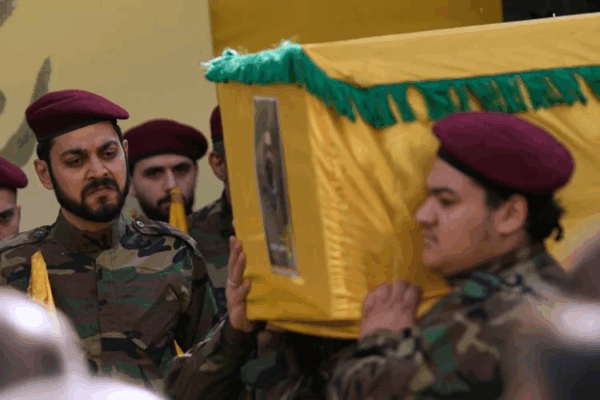
Hezbollah mourns Haytham Tabtabai its chief of staff who was killed by Israel on Sunday in Beirut
Israel’s dramatic strike on Hezbollah’s chief of staff Haytham Ali Tabatabai in Beirut on Sunday should not come as a particular surprise.
The assassination came after a series of warnings from Jerusalem and Washington that the Israel Defense Forces would intensify its air campaign if Lebanon did not move much more quickly to disarm the group.
Earlier this month, Prime Minister Benjamin Netanyahu warned publicly that Israel would do whatever was necessary to keep Hezbollah from rearming, after the group was battered by Israel last year
“We expect the Lebanese government to uphold its commitments, namely, to disarm Hezbollah. But it’s clear that we’ll exercise our right to self-defense as stipulated in the ceasefire terms,” said the premier. “We won’t let Lebanon become a renewed front against us, and we’ll do what’s necessary.”
A senior IDF official recently told Channel 12 news that stepped-up airstrikes in recent weeks were a “preview” of what Lebanon would face if it did not enhance its disarmament campaign.
“If the Lebanese army does not disarm Hezbollah and fails to meet the demands of the ceasefire,” said the officer. “Israel, with US backing, will attack Hezbollah targets across Lebanon, including in Beirut.”
On Sunday, Israel appeared to make good on those threats, killing Hezbollah’s commander Tabatabai and dramatically escalating already building tensions, apparently with Washington’s blessing.
While there are significant gaps between Israel and the US on Gaza, on Lebanon there seems to be consensus between the allies.
A senior American official told Channel 12 Sunday that the US is “pleased with the elimination of the number two in Hezbollah.”
According to the IDF, after the end of the fighting in November 2024, Tabatabai was officially appointed as the military chief of staff in the terror group.
“He led Hezbollah’s renewed efforts to rearm,” charged Netanyahu on Sunday.
“Israel will not allow Hezbollah to rebuild its power,” he stressed. “I expect the Government of Lebanon to fulfill its commitment to disarm Hezbollah.”
Not quite disarmed
Israel has been striking Hezbollah targets since the November 2024 ceasefire, in an attempt to stop imminent threats and to further degrade the group’s weapons stocks.
Under the terms of the 2024 ceasefire deal, which followed fighting that broke out on October 8, 2023, and escalated into all-out war a year later, Hezbollah was required to vacate southern Lebanon and be replaced by the Lebanese military.
“Lebanon’s official military and security forces, infrastructure, and weaponry will be the only armed groups, arms, and related materiel deployed in the southern Litani area,” reads the ceasefire agreement.
Israel also received a “side letter” of guarantees from the US, in which Washington affirmed and detailed Israel’s right to defend itself against renewed threats.
Lebanon’s president, Joseph Aoun, has been challenged with finding a way to disarm Hezbollah without pushing the powerful Iranian proxy too hard and sparking a civil war.
On Friday, Aoun said that a state monopoly on weapons was inevitable, and urged a committee supervising the ceasefire between Israel and Hezbollah to ensure Lebanon’s army was the only armed presence in the country’s south.
In August, his government instructed the army to come up with a plan to eradicate weapons outside state control by year’s end. In September, LAF Commander Rodolphe Haykal presented a five-stage plan to disarm Hezbollah, starting with a three-month effort south of the Litani River, the part of the country along the Israeli frontier.
It is not that the army hasn’t been working on that mission. It has successfully removed nearly 10,000 rockets, almost 400 missiles, and over 205,000 unexploded ordnance fragments during the past year. according to the US Central Command.
Lebanon’s army has blown up so many Hezbollah arms caches that it has run out of explosives, sources recently told Reuters.
But the campaign is not likely to solve the problem of Hezbollah arms. The LAF has operated only south of the Litani, and it is questionable whether the campaign will get to the subsequent stages further north, where Hezbollah’s strategic weapons are stored.
Hezbollah sent a letter this month to Aoun, Prime Minister Nawaf Salaf, and Speaker of the Parliament Nabih Berri decrying potential negotiations with Israel and arguing that disarmament north of the Litani “was neither stipulated in the ceasefire declaration, nor can ever be accepted or imposed.”
Even in the south, it is unclear what exactly the army has destroyed, as it does not publish images or detailed reports of its operations.
Hezbollah itself says it will not disarm. Secretary-General Naim Qassem has accused the Aoun government of “serving the Israeli project” and issued not especially subtle threats about a civil war, a potent threat for a country still recovering from its last internecine conflict
Not only is Hezbollah refusing to give up its current stocks, it also seems to be energetically restocking its supplies.
Hezbollah is “rebuilding its armaments and battered ranks,” including replenishing its rocket, antitank missile, and artillery supply, The Wall Street Journal reported recently.
The question now is whether the elimination of Tabatabai means that Israel is at the start of a significant escalation in Lebanon.
Much depends on how Hezbollah reacts. It has been surprisingly passive in the face of a year of Israeli strikes, losing over 300 fighters after the ceasefire was signed.
Based on the group’s tepid response Sunday — that it would “coordinate” a response with the Lebanese government — it doesn’t appear that Hezbollah has decided that now is the time to change its calculus.
But at some point, the need to save face will likely force the group to react in some way.
Israel may still expand its campaign and initiate a broad wave of airstrikes if it doesn’t see any change in the Lebanese government’s behavior.
The planned visit of Pope Leo XIV to Lebanon a week from now is likely the only major factor holding Israel back.
A bombing campaign that causes civilian suffering ahead of the pontiff’s visit would represent a public relations disaster for Israel in the West.
TOI
