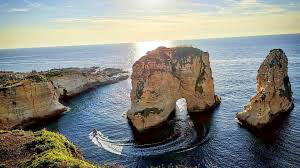
The 52-meter-high cliff is known as a prime destination for desperate, suicidal people, who come to jump from it. It is simple to step over the metal railing and then go through the reeds to find oneself on the edge. It is the most common place for attempting suicide in Lebanon. Many in Lebanon consider Nasrallah’s war with Israel suicidal
Thousands of Hezbollah supporters gathered at a scenic overlook on Beirut’s coast Thursday and projected images of the group’s former longtime leader and his successor on the iconic arched Raouche rock to commemorate their deaths in Israeli airstrikes nearly a year ago.
The move came despite an apparent attempt by Lebanon’s Prime Minister Nawaf Salam to halt the planned light show.
The Hezbollah-affiliated al-Manar channel broadcast an invitation to the march on Thursday, saing: “We invite you to participate in the activities of lighting the Raouche Rock with the pictures of the two martyred sayyeds accompanied by visual and audio activities and slogans and a public parade on marine boats with the raising of flags.”
Hezbollah’s plan to project images of its late leader Nasrallah and his cousin and presumed successor Safieddine onto Beirut’s iconic Raouche Rock triggered sharp political backlash, with critics calling it a “symbol of the group’s growing isolation” and “disconnect from national sentiment.”
In an unprecedented move, Prime Minister Nawaf Salam called for a ban on gatherings in public spaces without prior permission after news of Hezbollah’s intentions broke.
On Wednesday, the governor of Beirut, Marwan Abboud, authorized Hezbollah to hold a rally on Thursday on the Corniche facing the rocks at Raouche, as part of commemorations for the assassination of its former leader Hassan Nasrallah during last year’s war against Israel. However, he did not grant permission for the iconic rocks to be illuminated or for images to be projected onto them, including portraits of Nasrallah and of Hashem Safieddine, who was considered his likely successor.
‘It belongs to everyone’
Forces of Change MP Waddah Sadek wrote on X Thursday: “When the narrative shifts from eliminating the State of Israel to placing an image on the Raouche Rock — while Israel continues its daily attacks and assassinations — the party finds itself in a leadership and political predicament, and it must reassess its position. The only way forward is to accept and commit to the logic of the state, and to return to Lebanon to rebuild it together with the rest of the Lebanese people.”
عندما تنتقل السردية من إزالة دولة إسرائيل إلى وضع صورة على صخرة الروشة، فيما تواصل إسرائيل اعتداءاتها واغتيالاتها اليومية، يكون الحزب في مأزقٍ قيادي وسياسي وعليه إعادة حساباته.
— Waddah Sadek – وضاح الصادق (@WaddahSadek) September 25, 2025
الطريق الوحيد إلى الأمام هو الاقتناع والتسليم بمنطق الدولة، والعودة إلى لبنان لبنائه من جديد مع سائر…
Lebanese Forces MP Ghassan Hasbani, speaking on the program “Ma’ Walid Abboud” on Tele Liban, referring to Raoche’s “great symbolism,” saying that “because it belongs to everyone, it should remain free from provocation,” according to comments reported by the state-run National News Agency on Saturday. “It’s about deep-rooted grievances,” he added.
He explained that the decision to prevent the projection of images of Nasrallah and Saffiedine onto the rock “reflects the state asserting its authority based on the will of a significant portion of the population.”
“The entire Lebanese population is wounded — not just one group,” Hasbani said. “So, when one side says a certain sect is hurt and others must be considerate, they too must consider the pain of all Lebanese who suffered due to wars that dragged the nation into destruction.”
Hezbollah opened what it described as a support front for Gaza in southern Lebanon in October 2023, amid Israel’s devastating onslaught on the enclave. The war with Israel escalated in September 2024, with heavy bombing of Beirut’s southern suburbs and southern Lebanon, as well as the assassination of Hezbollah leaders among many others of the party’s military command and thousands of civilians.
Israel continues to violate the shaky cease-fire signed on Nov. 27, which had ended a full-scale war between Hezbollah and Israel.
ORIENT TODAY/AP
