Allies beware: America’s shield falters when its leader fears the Kremlin.
By Vlad Green
The joint press conference between Donald Trump and Vladimir Putin in Alaska was striking not for what was said, but for what was left unsaid. No questions were allowed. The silence itself spoke volumes. But when asked afterward about his advice to Ukrainian President Volodymyr Zelensky, Trump’s response was startling in its weakness: “Gotta make a deal. Yeah. Look, Russia is a very big power, and they’re not. They’re great soldiers.”
This is not the language of a confident leader defending democratic allies. It is the language of a man intimidated by a strongman he cannot confront.
Admiration Over Adversity
Trump has long admired authoritarian figures, from Putin to Kim Jong Un. His instinct is to praise their “strength” rather than challenge their aggression. By calling Russia’s soldiers “great” while reducing Ukraine to a lesser power, Trump effectively validated Moscow’s narrative that Ukraine cannot resist and must capitulate. Such framing diminishes the very cause the United States is supposed to champion: the defense of sovereignty against naked aggression.
The Missing Counterbalance: Zelensky
Notably absent from the Alaska summit was President Zelensky. His presence could have been a crucial counterbalance, injecting moral clarity and personal courage into the talks. Zelensky has repeatedly shown that standing up to Putin is possible. By excluding him, Trump allowed the stage to tilt entirely toward Putin, and in the process, robbed himself of an ally who could have stiffened his resolve.
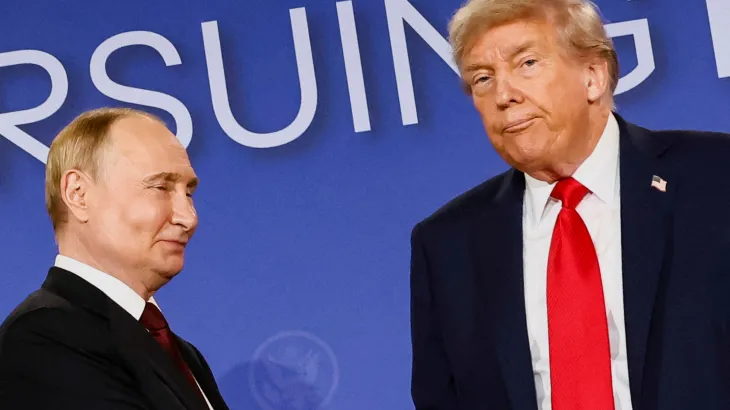
Instead, the image was one of an American president nodding along to Putin’s strength, rather than challenging it. That photo-op will not be lost on America’s allies—or its adversaries.
A Signal to the World
Trump’s intimidation has consequences beyond the U.S.–Russia–Ukraine triangle. Every wavering word, every glance of submission, sends a signal to NATO allies that Washington’s commitment is fragile. It reassures Putin that time is on Russia’s side, and it emboldens China as it watches closely for hints about Taiwan.
Alliances are not held together by treaties alone—they are sustained by the credibility of leadership. When the leader of the free world publicly admires an aggressor while counseling an ally to cut a deal, the entire alliance structure trembles.
The Stakes for America
If Trump cannot stand up to Putin in front of the world, why should smaller nations trust that he will defend them if threatened? The credibility of U.S. alliances is built not only on military power but also on the perception of unwavering resolve. Every time Trump appears intimidated, the deterrent effect of American leadership weakens.
At the Alaska summit, Trump did not look like the dealmaker he claims to be. He looked like a man overawed by power, one who confuses intimidation with respect. And in doing so, he weakened not just Ukraine’s hand, but America’s credibility across the globe.
Conclusion
The United States cannot afford a president who is afraid of the very adversary threatening the foundations of the international order. America’s alliances are its greatest strength—but they depend on the confidence that Washington will never bow before a dictator. Trump’s subdued performance in Alaska casts serious doubt on that promise.
