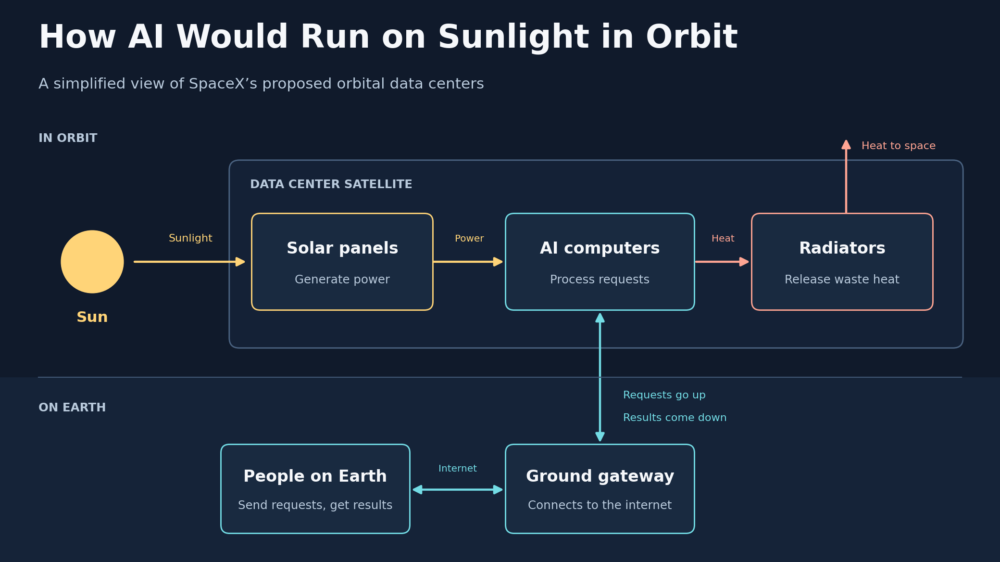
Editorial diagram showing SpaceX’s proposed system, sunlight powers AI computers aboard satellites. Radiators release waste heat into space, while ground stations relay requests to orbit and deliver the answers back to users on Earth.
By Ya Libnan Editor, opinion
Imagine asking an AI to analyze a medical image or predict the path of a storm. Somewhere, a computer does the work and sends back an answer. Now imagine that computer circling Earth, running on sunlight it collects in orbit. The next data center serving your community could be hundreds of miles overhead.
On November 25, the Federal Communications Commission authorized SpaceX to deploy up to one million satellites for its Starmind computing network. The idea is strikingly simple. Solar panels would power the chips aboard the satellites, and the network would send the results back to Earth. The electricity stays in orbit. What comes back is the work it did. FCC announcement · SpaceX’s Starmind design
That possibility deserves as much attention as the headlines about AI’s growing appetite for electricity. The International Energy Agency estimates that data centers worldwide used about 415 terawatt-hours in 2024 and could use about 950 by 2030. Communities are right to ask how growing demand will affect their grids and water supplies. Putting some of that work in orbit could give those communities room to breathe. International Energy Agency
As an engineer, I wanted to see what the numbers looked like. SpaceX lists an average computing load of 175 kilowatts for its AI1 satellite design. Reuters reports that the FCC license calls for 100,000 satellites by November 2035. If 100,000 satellites operated at that average for a full year, their computers would use 17.5 gigawatts of power, or about 153 terawatt-hours of electricity over the year. That gives us a sense of what solar-powered computing in orbit could amount to at scale. SpaceX’s AI1 specifications · Reuters
Put that in terms anyone can picture. Generating the same amount of electricity entirely from oil would take roughly 283 million barrels in a single year and release about 121 million to 134 million metric tons of carbon dioxide from combustion. Using the 2023 average emissions rate for U.S. electricity generation gives a benchmark of about 53 million metric tons. Actual savings would depend on how much computing moves into orbit and which power plants would otherwise serve it. Even a fraction of that potential is worth pursuing. EIA fuel consumption · EIA emissions factors · EPA grid emissions
Think about cooling, too. Chips running in orbit still generate heat, and SpaceX plans to shed it through radiators. Where orbital computing replaces a facility that would use water for cooling, that water can stay on Earth for other uses. A fair comparison also has to count what it takes to build, launch and replace the satellites, as well as the effects of exhaust and reentry on the atmosphere. The first satellites can give us real operating data to judge those trade-offs. SpaceX prospectus· NOAA research on rocket emissions · Research on satellite reentry
I’d like to see SpaceX publish an independently reviewed comparison of the same AI job done in orbit and in an efficient data center on Earth. Show the total emissions, the water used and the electricity demand actually taken off the grid. Give the public numbers it can follow as the fleet grows.
I’m excited about what AI can do for humanity, from helping doctors spot disease to giving communities earlier warning of disasters. We should be just as ambitious about how we power it. If sunlight collected in orbit can help a doctor here on Earth while easing the strain on the grid below, that’s a future worth building.
