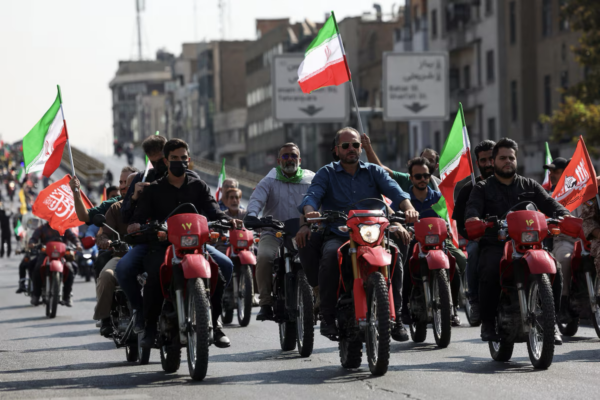
Members of Iranian militia forces (Basij) ride on motorcycles as they participate in a march in Tehran, Iran, September 25, 2026. Majid Asgaripour/WANA (West Asia News Agency) via REUTERS
Iran’s Supreme Leader Mojtaba Khamenei called on Thursday on the Basij, nationwide militia affiliated with the Revolutionary Guards, to broaden their social reach and work towards making “every Iranian, a Basiji”.
Since the start of the war launched by the United States and Israel in late February, Iranian authorities have relied on the Basij to help organize repeated pro-government rallies across the country, with state media portraying them as evidence of broad popular support for the Islamic Republic.
Khamenei has remained out of public view since succeeding his father, Ali Khamenei, who was killed in the opening strikes of the war. He has communicated through written statements, while Iranian officials have cited security concerns to explain his absence from public view.
His latest message, issued to mark Basij Week, urged the organisation to draw on a wider pool of supporters, including people who share its ideology but are not formal members, to help address the country’s problems, state media reported.
The Basij, formally known as the Organisation for the Mobilisation of the Oppressed, was established by Islamic Republic founder Ayatollah Ruhollah Khomeini in 1979. It became a major source of manpower during the 1980-88 Iran-Iraq war and was incorporated into the Revolutionary Guards in 1981.
Its nationwide presence in universities, government institutions and neighbourhoods supports its role in promoting the Islamic Republic’s ideology, enforcing social codes, mobilising supporters for rallies, suppressing protests and participating in disaster relief and state campaigns.
Khamenei’s appeal comes as the Islamic Republic faces mounting economic difficulties and US sanctions, which Washington has sought to use to increase pressure on the government and exploit public discontent.
State media coverage of the wartime pro-government rallies has sometimes highlighted women attending without fully observing mandatory hijab rules, seeking to convey an image of national unity extending beyond the regime’s traditionally conservative supporters.
The government has also sought to mobilize its support base through initiatives such as the Janfada (self-sacrifice) program , which calls on volunteers to register for training and help defend the country, and a Basij energy campaign announced by its newly appointed head Hossein Taeb.
Under the campaign, members were trained to encourage households and businesses to reduce electricity and gas consumption as the country faces the prospect of winter energy shortages.
REUTERS
