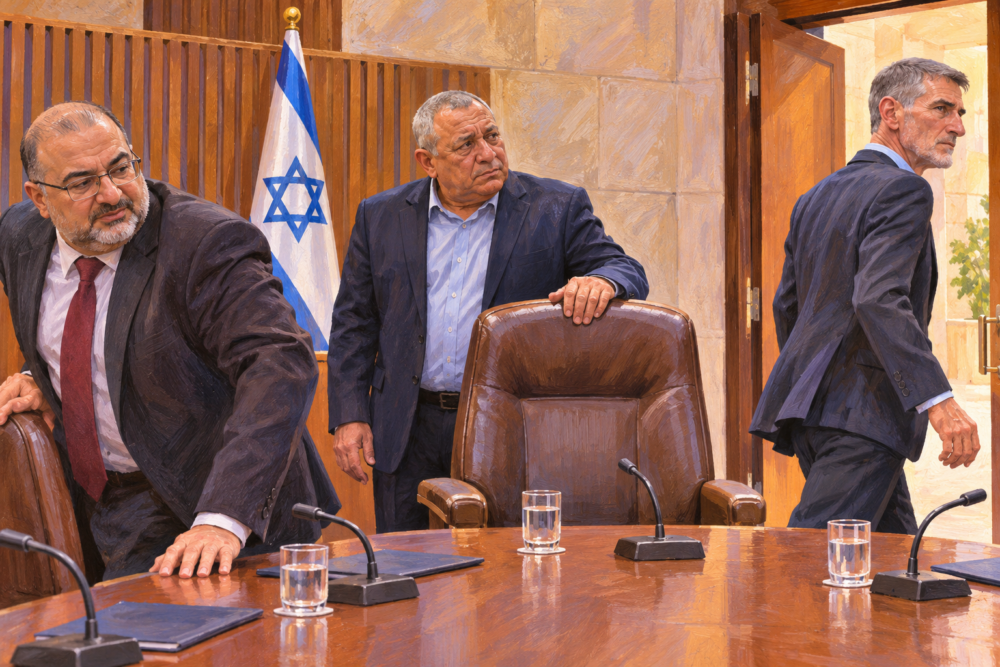
Editorial illustration shows Eisenkot hesitating at the head of a coalition table as the partners he needs begin to leave. It takes courage to bring people to the table. It takes leadership to act before they walk away.
By: Ya Libnan Editor, Opinion
Gadi Eisenkot has just secured his first coalition agreement. He is already at risk of losing another partner. On Tuesday, Eisenkot’s Yashar party announced a deal with Avigdor Lieberman’s party, while Yair Golan’s Democrats suspended talks over Eisenkot’s negotiations with Benjamin Netanyahu’s Likud and the deadlock over forming a government of change. Lieberman’s seven seats were already counted in Eisenkot’s bloc. Golan’s eight are now in doubt. Reuters
Eisenkot’s hesitation is beginning to cost him. President Isaac Herzog gave him the first chance to form a government, despite Netanyahu’s bloc winning 53 seats to his bloc’s 48. Netanyahu lost his majority, yet his alliance still finished ahead of Eisenkot’s despite the backlash over his conduct of the war. Another election would give Netanyahu a fresh opportunity and could leave Eisenkot without the chance he has today. Congressional Research Service
The most direct path to a majority runs through the 19 lawmakers elected on Arab-led lists. Together with a united 48-seat opposition bloc, they could give Eisenkot a parliamentary base of 67 in a 120-seat Knesset. Reaching that number would require real agreements. Lieberman has opposed relying on Arab parties, and Ra’am and the Joint List have signaled different positions on a confidence vote. Eisenkot should be negotiating with both and asking his existing partners what commitments would bring them along. Reuters · The Times of Israel
One obstacle is Eisenkot’s own campaign pledge to keep Mansour Abbas’s Ra’am, in its current form, out of his cabinet. Parliamentary backing and cabinet participation are distinct arrangements, and either could be negotiated around a governing program. Eisenkot should be willing to reconsider the pledge itself. He could invite Ra’am into cabinet talks and discuss terms for parliamentary support with the Joint List. Both deserve a serious hearing on what their voters expect from the next government. The Times of Israel
That is where Eisenkot needs to show a vision for Israel. A government that includes Arab citizens’ elected representatives in serious negotiations can begin to address problems that successive governments have allowed to fester, including violent crime in Arab communities. It can also ask partners to commit to restoring trust in democratic institutions, establishing an independent inquiry into the failures of October 7 and tackling the cost of living. A coalition held together by a common program has a better chance of lasting once the confidence vote is over.
Eisenkot’s choices also matter across the border. Lebanon and Israel have already agreed to a U.S.-mediated framework that could lay the groundwork for peace. Lebanese President Joseph Aoun said Tuesday that the talks were on hold because of Israel’s elections. United Nations · Naharnet
Some Lebanese supporters of a peace agreement have told me they see Eisenkot’s stance on Arab parties as racist. They want Lebanon to reclaim from Hezbollah, Iran’s armed proxy, the right to decide its own future. They also want an Israeli partner who will treat Lebanon as a sovereign equal. When Eisenkot rules out Arab parties as cabinet partners, he gives those Lebanese peace advocates a harder question to answer at home. How can they build trust with a leader who is unwilling to share power with the elected representatives of Arab citizens in his own country?
Eisenkot’s initial mandate runs until December 6, and he can seek an extension. An extension would give him more days to negotiate. It would do little to restore trust with partners who suspect he is preparing a deal with the man they joined him to replace. If all efforts to form a government fail, Israel could be sent back to the polls. Reuters
Eisenkot still has a chance to lead. He should sit down with the Arab parties, bring Golan back to the table and tell Israelis what he wants this government to accomplish. If he lets this opportunity pass, he may spend the next election explaining why he walked away from the partners who could have helped him govern.
