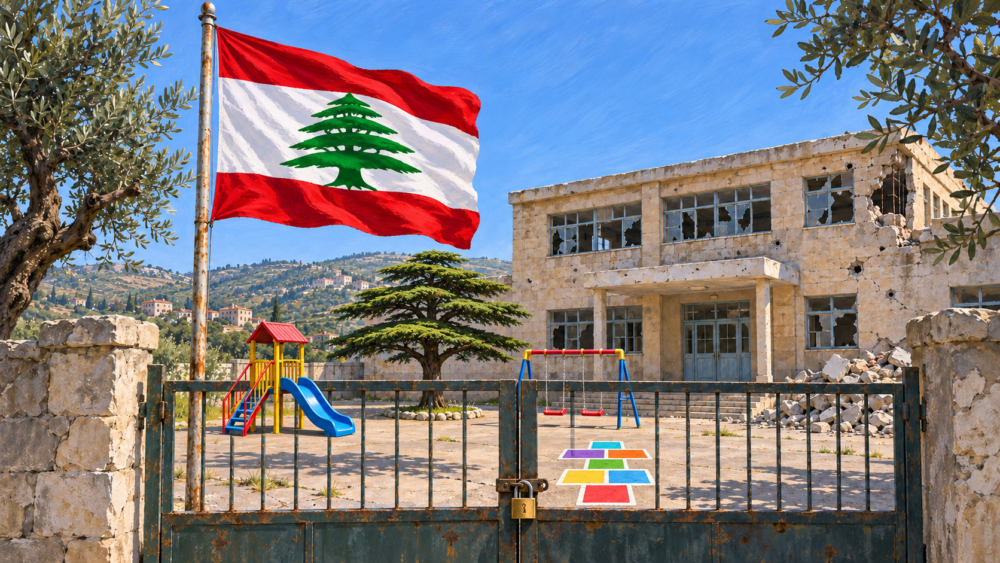
Editorial illustration- Lebanon raises its flag on its 83rd Independence Day. For displaced families in the South, the day worth celebrating will be the day they can go home.
By: Ya Libnan Editorial Bord , opinion
Raise the Lebanese flag. Raise it over every home, business and school, as President Joseph Aoun has asked citizens to do from November 20 to 22. The cedar belongs to all of us. On November 22, 2026, we can honor those who secured Lebanon’s independence 83 years ago and still ask what independence means to a family barred from returning to its village in the South, or to a country that can be dragged into war without its government’s consent. Aoun’s appeal
On March 2, Hezbollah opened fire on Israel after the United States and Israel began attacking Iran. Lebanon’s government had rejected being drawn into the regional war. Hezbollah fired anyway. Israel responded with devastating airstrikes and ground operations. The Lebanese Cabinet banned Hezbollah’s military and security activities, and Prime Minister Nawaf Salam later told the United Nations that the decision to go to war or make peace belongs exclusively to Lebanon’s constitutional institutions. Lebanon’s March 2 statement to the UN · Salam’s UN address · Conflict chronology
We have seen this before. In July 2006, a Hezbollah cross-border raid that captured two Israeli soldiers sparked a monthlong war. On October 8, 2023, Hezbollah opened the Lebanese front one day after the Hamas-led attack on Israel. In March 2026, it chose to enter a war already being fought over Iran. The circumstances differed, but each time Hezbollah made a decision that exposed all of Lebanon to war. In my view, that freedom to act has served Iran’s regional influence at Lebanon’s expense. Israel, for its part, bears responsibility for its own military actions and the destruction they have inflicted. Associated Press chronology
Hezbollah now says Lebanon cannot claim independence while Israel occupies Lebanese land and demolishes homes in southern villages. It puts the occupied area at more than 500 square kilometers and still presents its arsenal as indispensable under the slogan “people, army and resistance.” Parliament Speaker Nabih Berri, whose Amal movement is allied with Hezbollah, called independence incomplete under occupation, rejected a buffer zone and urged support for the Lebanese Army. I agree that Israel must withdraw and that southern families must be able to go home. I would ask Berri to take his support for the Army to its logical conclusion and say plainly that it alone should carry out Lebanon’s military defense under the authority of the elected government. Hezbollah’s statement · Berri’s statement
The U.S.-mediated framework agreed on June 26 provides for phased Israeli withdrawal alongside verified disarmament and the transfer of security responsibilities to the Lebanese Army. Progress has been limited. Hezbollah rejects the agreement, and Army Commander Rodolph Haykal warned in his Independence Day message that Israel’s continued occupation obstructs the Army’s deployment. Now we are told this is a chicken-and-egg situation. Hezbollah cites the occupation to justify keeping its weapons, and Israel cites those weapons to justify staying. June framework and implementation · Haykal’s Independence Day message
It is time to call a spade a spade. Hezbollah’s decision to enter the war in March gave Israel the immediate pretext for its latest ground offensive. Lebanon can take back the decision over war and peace while pressing for Israel’s full withdrawal. Beirut should enforce its ban on Hezbollah’s military activities and give the Army the resources to extend its authority across the country. Washington brokered the June framework. Now it should put its money where its mouth is and help arm and equip the Lebanese Army so it can deploy in the South and assume responsibility for security as Israeli troops withdraw. Words alone will get neither job done. The United States should also press both sides to meet publicly verifiable benchmarks for disarmament, withdrawal and the Army’s deployment. Families in the South should be able to see when they can safely return and begin rebuilding.
There is one more test for next year’s Independence Day. Lebanese depositors should get their money back. Berri has called people’s bank deposits “sacred.” If he means it, he should put his money where his mouth is. As speaker, he can bring a credible deposit recovery bill to a vote. Finance Minister Yassine Jaber, a political ally of Berri, should show depositors how much they can expect to recover, when payments will begin and who will bear the losses. Small savers should come first, and larger depositors deserve a clear, enforceable schedule. After years of waiting, people should be able to look at a bank statement and see that the promise has been kept. Berri’s remarks on depositors · Jaber on the financial gap bill
Raise the flag this year out of respect for what Lebanon won in 1943. By next November 22, let families in the South raise it over homes they have been able to return to, let depositors see their savings coming back, and let the Lebanese state be the only authority that can decide whether the country goes to war. Then we will have something to celebrate.
