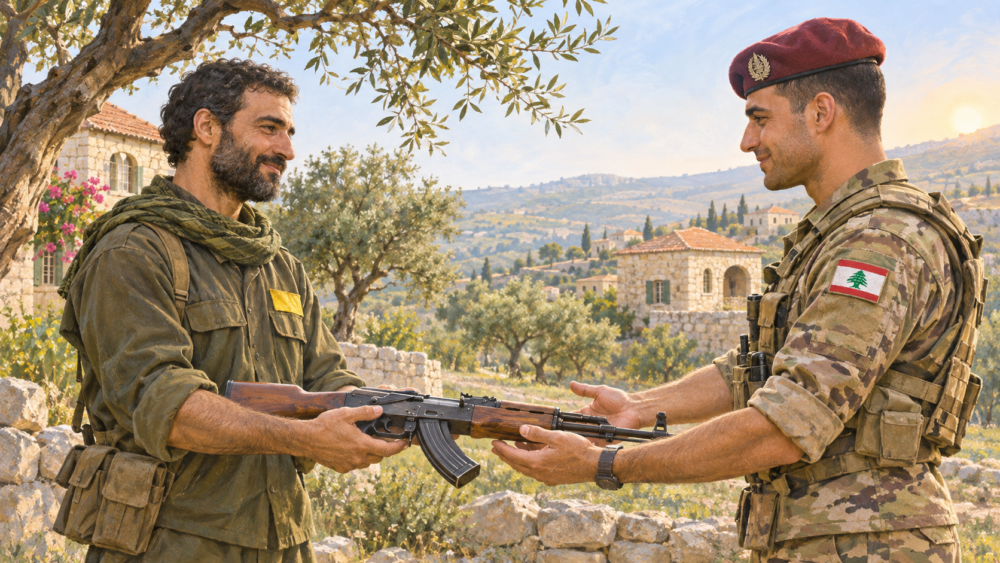
Editorial illustration showing a Hezbollah fighter handing his rifle to a Lebanese soldier, depicting the peaceful disarmament President Joseph Aoun has called for.
How many times should a family in southern Lebanon have to leave home, wait for the fighting to end and wonder whether there will be a home to return to?
That is the question Hezbollah’s leaders should answer before they ask Lebanon to live with their arsenal for another day. Hezbollah’s decisions to enter wars without the consent of the Lebanese government helped bring devastation to the country. Shiite families in the South have borne an especially heavy share of the loss. They deserve to go home, rebuild and raise their children without wondering when another decision made without them will send them fleeing again.
In his November 17 interview with Iraq’s Dijlah television, President Joseph Aoun appealed directly to Hezbollah to hand over its weapons. He said his government was pursuing direct and indirect contacts with the group to reach a peaceful agreement. He also said the state would confiscate Hezbollah arms shipments. The principle behind both commitments is simple. The Lebanese state alone must have the authority to decide questions of war and peace.
Hezbollah’s leaders often invoke their role in ending Israel’s occupation of southern Lebanon in 2000. Aoun himself acknowledged the sacrifices made in that struggle. The leadership must now answer for the choices it has made since. As Aoun argued, Hezbollah’s weapons have come to serve regional agendas, while Lebanese families have paid for the wars fought on their soil. Past sacrifices give Hezbollah’s leaders every reason to spare those families another war.
Israel bears responsibility for its own military actions and must withdraw from Lebanese territory. Lebanon should press that demand through U.S.-mediated talks and insist on implementation of the framework agreement. Aoun identified four goals he says he shares with Hezbollah: Israeli withdrawal, the return of displaced families, reconstruction of the South and the release of prisoners. Lebanon can pursue all four while negotiating a peaceful handover of Hezbollah’s arms. Each effort is urgent in its own right.
Aoun is right to choose diplomacy. Negotiations with Israel are a way to press Lebanon’s demands. Talks with Hezbollah should produce a clear timetable for handing over its weapons to the Lebanese Armed Forces. The government has obligations of its own. It must give the army the resources to protect border communities and make reconstruction and the safe return of displaced families a national priority.
Lebanon’s Shiites have every right to demand security, political representation and a fair share of reconstruction from their state. Hezbollah’s leaders can help secure that future by accepting Aoun’s invitation, agreeing to a timetable and handing over their arms. The families who have paid so dearly deserve to know that the next decision about war and peace will be made by a government answerable to them.
