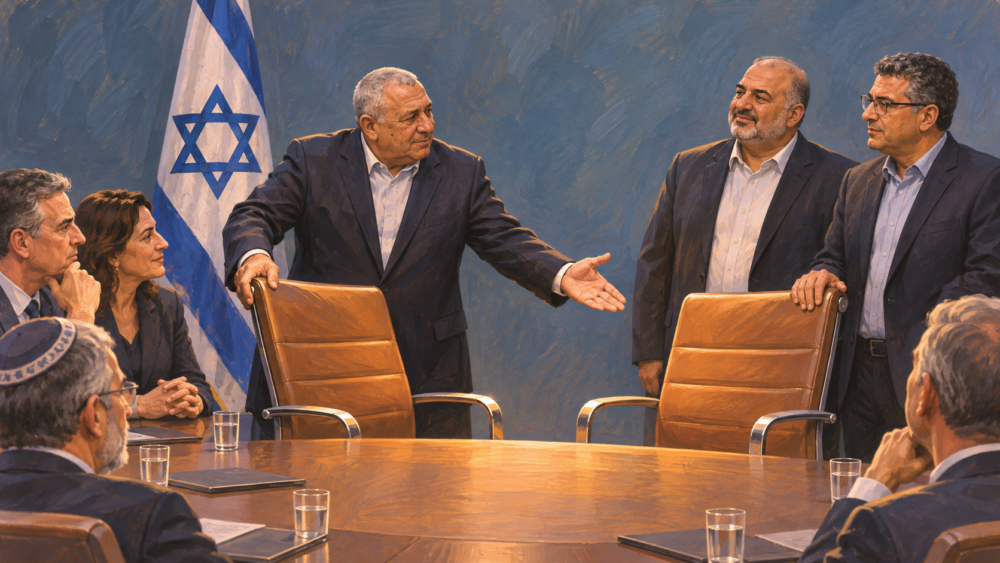
Eeditorial illustration – Eisenkot’s test of leadership is whether he will give Arab lawmakers a seat at the table and a share in governing Israel.
Gadi Eisenkot has a chance to build a government with Jewish and Arab lawmakers. He should take it or make way for someone who will.
By: Ya Libnan Editorial Board , Opinion
Israel has asked Gadi Eisenkot to do something Benjamin Netanyahu could not do after the October 27 election: assemble a governing majority. The former army chief now faces a test of political courage. Will he invite Israel’s Arab-led parties to help govern the country, even if it means reversing a campaign pledge? Reuters
Eisenkot’s bloc won 48 seats in the 120-member Knesset. Netanyahu’s camp won 53. Ra’am and the Joint List won 19 between them, and both recommended that President Isaac Herzog give Eisenkot the mandate to form a government. Herzog did so on November 8. Those recommendations gave Eisenkot the backing of 67 lawmakers to take on the task. A governing agreement still has to be negotiated. Reuters · The Jerusalem Post
An incoming government can win its first confidence vote with a simple majority of votes cast. But 61 seats would give Eisenkot a majority of the full Knesset, a firmer basis for passing a budget and carrying out a program. With both Arab-led parties as partners, his bloc could command 67 seats. That is his clearest route to a government with a working majority.
Eisenkot campaigned against bringing Arab parties into his government. He should tell voters plainly why he is prepared to change course. Arab citizens went to the polls, elected their representatives and gave them the same right as every other lawmaker to negotiate over who governs. How can a leader ask a country to unite while ruling out a share in government for an entire group of its elected representatives?
The Joint List has indicated it could support a government from outside. Eisenkot should go further and invite both parties to negotiate a coalition agreement that offers meaningful cabinet responsibilities. Ra’am already served in the coalition formed by Naftali Bennett and Yair Lapid in 2021. There is precedent for sharing responsibility, and there is practical work to do together, starting with tackling violent crime in Arab communities and establishing an inquiry into the failures of October 7.
The parties will have real disagreements. That is precisely why Eisenkot needs to sit down with them, agree on what they can deliver together and defend that agreement in public. Leadership requires making the difficult choice while it can still make a difference.
Israel needs a prime minister willing to govern with and for all its citizens. Eisenkot has the mandate to try. If he cannot bring himself to offer Arab lawmakers a genuine share in government, he should return the mandate and let someone else try. As the saying goes, if you can’t stand the heat, get out of the kitchen.
