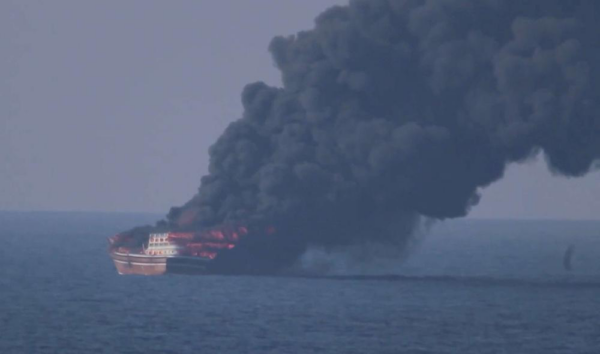
US forces disable cargo ship in Gulf of Oman over alleged Iran blockade breach
HERE IS THE LATEST
- The U.S. military’s Central Command announced Friday it is offering up to $20 million and possible relocation in exchange for information about Iran’s nuclear program, its facilities, equipment or personnel.
- President Trump confirmed on Friday the U.S. carried out “minor strikes” on Iran, after local state media reported missiles striking Qeshm island in the Strait of Hormuz
- Central Command also announced the creation of Task Force Iron Gate, which is supposed to extend the success of the naval blockade to overland routes of trade. The group will be tasked with preventing military technology and illegal revenue streams from entering or exiting Iranian borders, including via the Caspian Sea, but it was unclear if any military force would be brought to bear.
U.S. forces disabled commercial vessel in Gulf of Oman, CENTCOM says
U.S. forces disabled a commercial vessel in the Gulf of Oman on Saturday after the ship’s civilian crew ignored repeated warnings and attempted to violate the naval blockade against Iran multiple times, U.S. Central Command said.
A U.S. military aircraft fired precision munitions at the stern of St.Kitts-flagged M/V Huda, which disabled the ship after the crew was directed to abandon targeted spaces. The cargo vessel tried to depart regional waters after visiting an Iranian port, CENTCOM said.
“All mariners transiting near Iranian coastal areas or surrounding waters are advised to heed blockade warnings from U.S. forces,” CENTCOM said.
Earlier Saturday, CENTCOM said “strict enforcement” of the U.S. blockade on Iranian ports in the Strait of Hormuz continues.
Iran established a chokehold on the strait, a vital strategic waterway in global trade, at the beginning of the war, and has claimed attacks on tankers. The U.S. says its blockade had redirected 144 commercial vessels through the end of October.
U.S. launches new task force to disrupt Iranian ground shipping routes
In what the U.S. military is calling an expansion of the naval blockade, U.S. Central Command announced a new task force Saturday aimed at disrupting the illegal shipment of prohibited items like military technology or illegal revenue streams over ground transportation routes.
“The establishment of Task Force Iron Gate reinforces the success of our ironclad blockade against Iran at sea,” U.S. Central Command chief Adm. Brad Cooper said in a statement. “Strengthening CENTCOM’s collaboration with U.S. interagency partners will further constrain Iran’s ability to finance terrorism, rebuild weapons factories, and replenish their military.”
The U.S. said the task force will be made up of about 20 civilian and military personnel, based in Florida, and will be tasked with the goal of “preventing the movement of advanced weapons systems, dual-use technologies, sanctioned materials, and illegal revenue streams across Iran’s land borders and the Caspian Sea.”
The announcement made no mention of how the task force would be carrying out its goal, including whether any military operations will be involved.
China, Iran’s largest trade partner, has taken to conducting commerce over land, especially by train across central Asia due to the blockade on Iranian ports. The U.S. said the blockade has prevented some $25 billion in Iranian crude oil from being sold, much of it in Asia.
In addition to China, Iran has conducted large amounts of trade over land and via the Caspian Sea with Russia. The landlocked Caspian Sea has proven especially advantageous with a direct route between southwest Russia and northern Iran. Tehran is located just 80 miles south of the Caspian Sea.
Whether any U.S. ships could take to the Caspian Sea was again unclear. CBS News has reached out to the White House for more details.
Iran’s Revolutionary Guard lifts self-imposed missile-range limit
Iran’s Revolutionary Guard says it has lifted a self-proclaimed limit of 1,200 miles on the range of its ballistic missiles, suggesting the country may seek to develop missiles capable of reaching more distant targets amid fears of renewed all-out war.
The comments by the spokesman of Iran’s paramilitary Revolutionary Guard came days after the country’s supreme leader, Ayatollah Mojtaba Khomeini, warned “any kind and level of threat” from the U.S. or Israel would face a response without geographic limits.
Asked at a Tehran press conference about the limit on missile ranges, Gen. Hossein Mohebbi said, “That restriction has been lifted for us.”
He did not say whether Iran had missiles capable of exceeding the limit, saying only Iran would “demonstrate these capabilities in practice” rather than make statements.
Iran is not known to have missiles that can go beyond the 1,200-mile limit — a range that puts parts of Greece and the Balkans, the entire Arabian Peninsula, the Levant and most of Egypt within reach. However, U.S. officials have said technology from Iran’s space program can be repurposed to build intercontinental ballistic missiles.
The Iranian military, meanwhile, said a tanker east of the Strait of Hormuz had hit a naval mine and caught fire. It did not identify the nationality or destination of the tanker, which it said had turned off its navigational beacon and was sailing in a “prohibited area.”
22 killed in Saudi strikes on Yemen’s Sanaa province, Iran backed Houthis say
Saudi strikes killed 22 people , in Yemen’s Sanaa province, as deaths mount in the country’s civil war, Houthi media said on Saturday.
More than 1,600 people have been killed and more than 300,000 displaced since fighting resumed in the impoverished country, according to the U.N.
“The number of victims of the Saudi enemy warplane massacre in the Al-Shariyah area … has risen to 22 citizens, while the number of wounded has risen to 30,” the Houthis’ Saba news agency said.
The Iran-backed group’s Al-Masirah TV provided the same toll.
Saba said earlier Saturday that operations to recover victims from the rubble were ongoing and that “aircraft targeted paramedics with two strikes.”
The Saudi-led coalition in a statement on Saturday said it had intercepted and destroyed a Houthi missile launched toward Riyadh province.
On Friday, an attack on a market in Taiz province killed 30 people. The Houthis said Saudi airstrikes were to blame, while Yemen’s government forces accused the Iran-backed group of having fired a ballistic missile at the site.
Trump confirms U.S. carried out more “minor strikes” on Iran
President Trump confirmed on Friday the U.S. carried out “minor strikes” in Iran, after local state media reported missiles striking Qeshm Island on the Strait of Hormuz.
Speaking to reporters on Friday, Mr. Trump was asked whether the U.S. carried out more strikes on the island.
“I don’t want to talk about it,” the president said. “We do minor strikes. They built a little bit of an anti-aircraft device and we knocked it out in about 15 minutes, maybe 5.”
On Saturday, Iran’s Tasnim news agency reported that two missiles had struck Qeshm island, added that there was no official information on the damage. Iranian state television also reported two explosions on the island.
- The U.S. military’s Central Command announced Friday it is offering up to $20 million and possible relocation in exchange for information about Iran’s nuclear program, its facilities, equipment or personnel.
- President Trump confirmed on Friday the U.S. carried out “minor strikes” on Iran, after local state media reported missiles striking Qeshm island in the Strait of Hormuz
- Central Command also announced the creation of Task Force Iron Gate, which is supposed to extend the success of the naval blockade to overland routes of trade. The group will be tasked with preventing military technology and illegal revenue streams from entering or exiting Iranian borders, including via the Caspian Sea, but it was unclear if any military force would be brought to bear.
U.S. forces disabled commercial vessel in Gulf of Oman, CENTCOM says
U.S. forces disabled a commercial vessel in the Gulf of Oman on Saturday after the ship’s civilian crew ignored repeated warnings and attempted to violate the naval blockade against Iran multiple times, U.S. Central Command said.
A U.S. military aircraft fired precision munitions at the stern of St.Kitts-flagged M/V Huda, which disabled the ship after the crew was directed to abandon targeted spaces. The cargo vessel tried to depart regional waters after visiting an Iranian port, CENTCOM said.
“All mariners transiting near Iranian coastal areas or surrounding waters are advised to heed blockade warnings from U.S. forces,” CENTCOM said.
Earlier Saturday, CENTCOM said “strict enforcement” of the U.S. blockade on Iranian ports in the Strait of Hormuz continues.
Iran established a chokehold on the strait, a vital strategic waterway in global trade, at the beginning of the war, and has claimed attacks on tankers. The U.S. says its blockade had redirected 144 commercial vessels through the end of October.
U.S. launches new task force to disrupt Iranian ground shipping routes
In what the U.S. military is calling an expansion of the naval blockade, U.S. Central Command announced a new task force Saturday aimed at disrupting the illegal shipment of prohibited items like military technology or illegal revenue streams over ground transportation routes.
“The establishment of Task Force Iron Gate reinforces the success of our ironclad blockade against Iran at sea,” U.S. Central Command chief Adm. Brad Cooper said in a statement. “Strengthening CENTCOM’s collaboration with U.S. interagency partners will further constrain Iran’s ability to finance terrorism, rebuild weapons factories, and replenish their military.”
The U.S. said the task force will be made up of about 20 civilian and military personnel, based in Florida, and will be tasked with the goal of “preventing the movement of advanced weapons systems, dual-use technologies, sanctioned materials, and illegal revenue streams across Iran’s land borders and the Caspian Sea.”
The announcement made no mention of how the task force would be carrying out its goal, including whether any military operations will be involved.
China, Iran’s largest trade partner, has taken to conducting commerce over land, especially by train across central Asia due to the blockade on Iranian ports. The U.S. said the blockade has prevented some $25 billion in Iranian crude oil from being sold, much of it in Asia.
In addition to China, Iran has conducted large amounts of trade over land and via the Caspian Sea with Russia. The landlocked Caspian Sea has proven especially advantageous with a direct route between southwest Russia and northern Iran. Tehran is located just 80 miles south of the Caspian Sea.
Whether any U.S. ships could take to the Caspian Sea was again unclear. CBS News has reached out to the White House for more details.
Iran’s Revolutionary Guard lifts self-imposed missile-range limit
Iran’s Revolutionary Guard says it has lifted a self-proclaimed limit of 1,200 miles on the range of its ballistic missiles, suggesting the country may seek to develop missiles capable of reaching more distant targets amid fears of renewed all-out war.
The comments by the spokesman of Iran’s paramilitary Revolutionary Guard came days after the country’s supreme leader, Ayatollah Mojtaba Khomeini, warned “any kind and level of threat” from the U.S. or Israel would face a response without geographic limits.
Asked at a Tehran press conference about the limit on missile ranges, Gen. Hossein Mohebbi said, “That restriction has been lifted for us.”
He did not say whether Iran had missiles capable of exceeding the limit, saying only Iran would “demonstrate these capabilities in practice” rather than make statements.
Iran is not known to have missiles that can go beyond the 1,200-mile limit — a range that puts parts of Greece and the Balkans, the entire Arabian Peninsula, the Levant and most of Egypt within reach. However, U.S. officials have said technology from Iran’s space program can be repurposed to build intercontinental ballistic missiles.
The Iranian military, meanwhile, said a tanker east of the Strait of Hormuz had hit a naval mine and caught fire. It did not identify the nationality or destination of the tanker, which it said had turned off its navigational beacon and was sailing in a “prohibited area.”
By The Associated Press
Updated 8:16 AM / November 7, 2026
22 killed in Saudi strikes on Yemen’s Sanaa province, Houthis say
Saudi strikes killed 22 people, most of them women and children, in Yemen’s Sanaa province, as deaths mount in the country’s civil war, Houthi media said on Saturday.
More than 1,600 people have been killed and more than 300,000 displaced since fighting resumed in the impoverished country, according to the U.N.
“The number of victims of the Saudi enemy warplane massacre in the Al-Shariyah area … has risen to 22 citizens, most of them children and women, while the number of wounded has risen to 30,” the Houthis’ Saba news agency said.
The Iran-backed group’s Al-Masirah TV provided the same toll.
Saba said earlier Saturday that operations to recover victims from the rubble were ongoing and that “aircraft targeted paramedics with two strikes.”
The Saudi-led coalition in a statement on Saturday said it had intercepted and destroyed a Houthi missile launched toward Riyadh province.
On Friday, an attack on a market in Taiz province killed 30 people. The Houthis said Saudi airstrikes were to blame, while Yemen’s government forces accused the Iran-backed group of having fired a ballistic missile at the site.
Iranian army says forces learned from war with the U.S.
Iran’s military is “stronger” and more motivated than it was when the United States and Israel started the war in February, Iranian state media reported on Saturday, citing an army spokesman.
“Today, the Islamic Republic’s armed forces… having gained experience from direct confrontation with the United States and the Israeli regime, are on higher alert and are stronger than they were at the beginning of the war,” spokesman Mohammad Akraminia said, according to the state news agency IRNA.
“They now possess greater motivation, commitment, and self-confidence.
Trump confirms U.S. carried out more “minor strikes” on Iran
President Trump confirmed on Friday the U.S. carried out “minor strikes” in Iran, after local state media reported missiles striking Qeshm Island on the Strait of Hormuz.
Speaking to reporters on Friday, Mr. Trump was asked whether the U.S. carried out more strikes on the island.
“I don’t want to talk about it,” the president said. “We do minor strikes. They built a little bit of an anti-aircraft device and we knocked it out in about 15 minutes, maybe 5.”
On Saturday, Iran’s Tasnim news agency reported that two missiles had struck Qeshm island, added that there was no official information on the damage. Iranian state television also reported two explosions on the island.
White House offers up to $20 million reward for information on Iran’s nuclear program
The Trump administration is offering a reward of up to $20 million for information about Iran’s nuclear program, the U.S. military’s Central Command announced Friday.
The reward, which is being administered through the State Department’s Rewards for Justice national security program, also comes with “possible relocation” for the tipster.
The State Department said it is calling for “information about Iran’s nuclear program, including its facilities, equipment, and associated personnel, such as those in the scientific community, or the movement of any of the above.”
Since the U.S. launched its war with Iran in February, President Trump has repeatedly reiterated that Iran cannot obtain a nuclear weapon.
In its reward form, the State Department noted that according to the United Nations’ International Atomic Energy Agency, Iran’s uranium stockpile is believed to include uranium that has been enriched to 60% purity – “a level that is a short technical step from” the 90% level required to produce nuclear weapons.
“Iran is the only non-nuclear-weapon state to produce uranium at such a high enrichment level,” the State Department said in its Rewards for Justice post. “Experts estimate this quantity, if enriched further, could be enough for several nuclear weapons.”
Iran suspended IAEA inspections following the June 2025 strikes on Iranian nuclear facilities by the U.S. and Israel.
“The regime’s lack of compliance with the IAEA on safeguards obligations has led to the agency’s loss of ‘continuity of knowledge’ regarding Iran’s production and inventory of key components like centrifuges,” the State Department said Friday.
U.S. coordinates with Canada to target Iranian digital asset providers
The Treasury Department on Friday targeted several firms exchanging Iranian rials and other currencies for allegedly helping Tehran evade sanctions and fund its proxies.
Some of the providers dealt with Iranian cryptocurrency exchanges already sanctioned by Washington.
The latest targets were coordinated with the Canadian government as several of the individuals and entities named are based in Vancouver and Toronto.
“Anyone, anywhere in the world, who helps Tehran evade sanctions risks being held accountable,” State Department spokesperson Tommy Pigott said in a statement.
CBS
