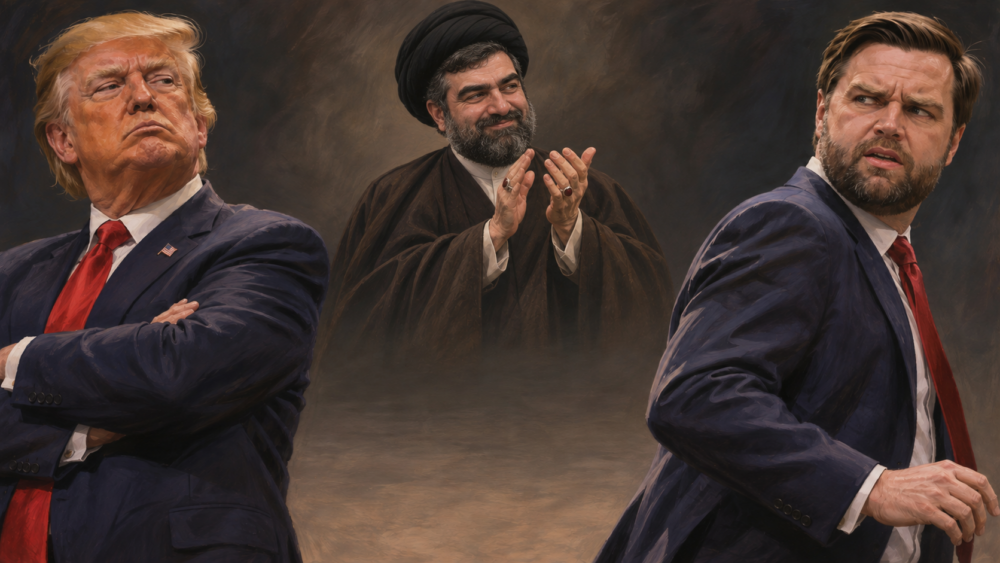
Editorial illustration – As Vance steps away from Trump’s defense of the Iran war, Tehran applauds the appearance of division in Washington.
The vice president owes Americans a strategy that protects their interests and an accounting of his own role in the administration’s policies. Blaming the war after an electoral defeat is not enough.
By: Ya Libnan Editoria Board, Opinion
Vice President JD Vance has identified the culprit behind the Republican Party’s disastrous midterm losses: the war with Iran.
“The reason we lost is the war,” he wrote on November 4.
But Vance is the vice president of the administration conducting that war. His attempt to explain the defeat therefore raises an unavoidable question: Where does his own responsibility begin?
His remarks also handed Tehran an opportunity. Iranian parliamentary speaker Mohammad Bagher Ghalibaf mocked him publicly, asking: “Why not say this to your boss?”
That taunt exposes the danger of conducting an administration’s strategic disagreements through public statements. Iran’s leaders can exploit the appearance of division, portraying Washington as politically exhausted and its vice president as increasingly concerned about the consequences at home.
There is a distinction worth preserving. Trump himself acknowledged that the war hurt Republicans electorally, and he publicly accepted Vance’s comments. The disagreement concerns whether the conflict justified its costs. Trump continues to defend his decision. Vance is now questioning the political price.
It would therefore be premature to declare their partnership broken. But the effort to establish some distance is hard to miss.
Vance has said he would decide after the midterms whether to run for president in 2028. Against that background, his intervention inevitably looks like an attempt to protect his political future. That is a reasonable interpretation of the timing, although ambition alone cannot be established as his motive.
Americans nevertheless deserve consistency. During the summer, Vance defended the conflict’s potential benefits in an interview with Megyn Kelly. If his assessment has changed, he should explain what changed—and what he advised before voters delivered their verdict.
His earlier transformation from a fierce Trump critic into a loyal defender makes that explanation more necessary. Political judgments can evolve. But repeated shifts invite voters to ask whether principle or convenience is driving them.
Vance’s diagnosis also deserves scrutiny. The Associated Press voter survey found widespread opposition to the war, but living costs and government corruption were more frequently identified as crucial voting issues. An election reflects multiple grievances. Reducing this defeat to one cause risks avoiding a broader reckoning with the administration’s record.
Calling for diplomacy is legitimate. Americans have every right to demand an end to a costly conflict, and a vice president should challenge a strategy he believes is failing.
The issue is what kind of settlement he proposes.
A credible agreement must protect freedom of navigation, constrain Iran’s nuclear ambitions through enforceable commitments, and address the danger its armed proxies pose to America’s regional allies and partners. Hezbollah in Lebanon, Iran-backed militias in Iraq, and the Houthis in Yemen cannot be treated as side issues. Their ability to threaten neighboring countries, American personnel, and commercial shipping must be central to any negotiations.
Sanctions relief should be tied to verified compliance, including concrete steps to end Iranian financing, arming, and direction of attacks by these groups. An agreement that constrains Iran’s nuclear program while leaving its proxy networks free to intimidate and attack would leave America’s allies exposed. A settlement that allows Tehran to pocket concessions while preserving these instruments of coercion would invite another crisis.
Vance should explain how his approach meets those tests.
He should also recognize the danger of making Washington’s domestic political timetable so visible. If Tehran concludes that American leaders urgently need an agreement to rescue their electoral prospects, it may calculate that delay will produce better terms. That is a negotiating risk, even if diplomacy remains necessary.
Ghalibaf’s mockery should not determine American policy. Iranian officials have no authority to speak for American voters, and their insults should not push Washington into either reckless escalation or hurried concessions.
The response should be a coherent strategy, clearly explained and backed by credible commitments.
Vance cannot erase his place in this administration by identifying its electoral liabilities after the votes are counted. If he wants Americans to trust his judgment about the presidency, he must demonstrate accountability in the office he already holds.
America needs a secure and durable end to the conflict. Vance owes the country an explanation of how to achieve it—and of his own part in bringing it this far.
