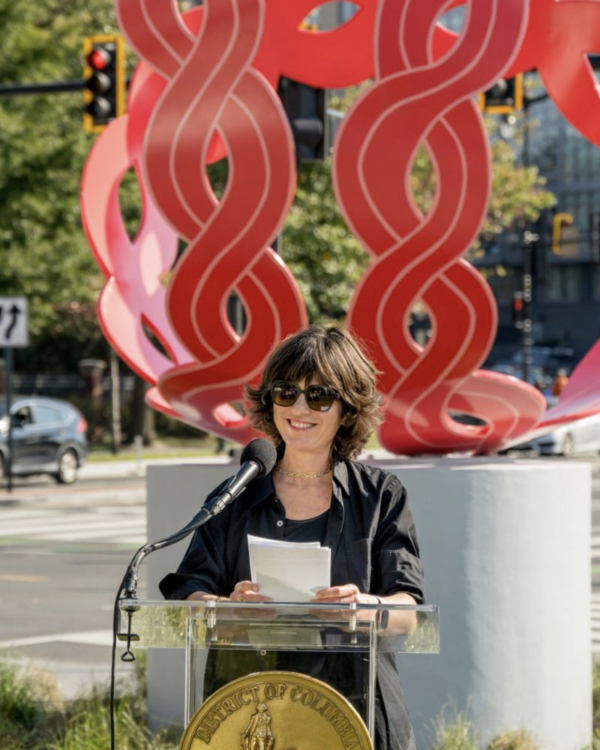
Her newest sculpture, honoring Mamie “Peanut” Johnson, brings beauty, history and a powerful story of human achievement to a transformed Washington intersection.
By: Ya Libnan
A city’s beauty comes from more than its architecture, parks and grand avenues. It also comes from the stories it chooses to preserve—and the artists who give those stories a lasting public presence.
With her newest sculpture, Curve, Washington artist Rania Hassan has given the nation’s capital another reason to pause, look and remember.
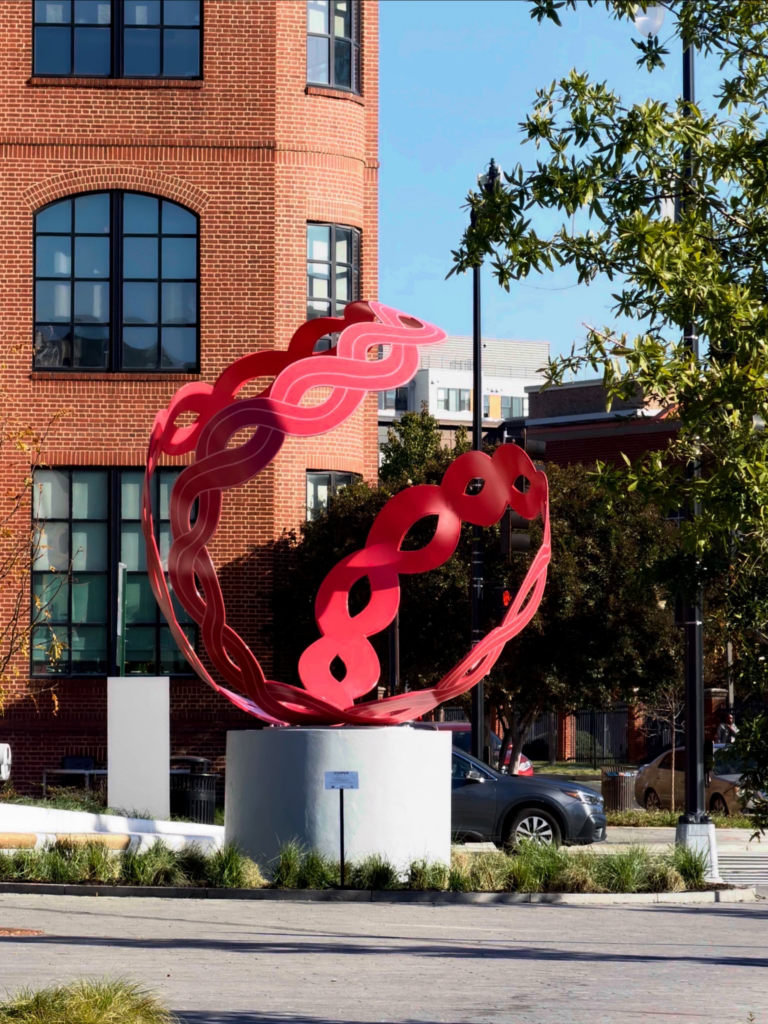
Unveiled by Mayor Muriel Bowser on October 27, the striking red artwork stands at Mamie “Peanut” Johnson Plaza, where Florida Avenue, New York Avenue and First Street NE meet. Once associated with the traffic frustrations of Dave Thomas Circle, this intersection now offers a setting for celebrating an extraordinary Washingtonian.
Mamie Johnson broke barriers as the first woman to pitch in the Negro Leagues. Beyond baseball, she devoted three decades to nursing at Washington’s Sibley Hospital. Her life united competitive excellence with service to others.
Hassan’s achievement is to bring those two careers together in one continuous sculptural form.
The sweeping red curves evoke Johnson’s signature curveball and the stitching of a baseball. Their intertwined movement also references the medical symbolism of her nursing career. A single line becomes a way to tell a life story.
The 12-foot sculpture, mounted on a four-foot base, reaches 16 feet overall. Yet its appeal extends beyond its scale. As viewers move around it, its overlapping forms change. From one perspective, the curves resemble a giant knit stitch—a connection to the artistic language Hassan has developed throughout her work.
Curve follows three other significant installations through which Hassan has enriched Washington’s cultural landscape.
For Halcyon’s 2019 By the People festival, she created an installation at the Smithsonian Arts and Industries Building designed to hang from a 40-foot ceiling. Completely knitted by hand from fine threads, it brought painstaking craftsmanship into a soaring architectural space.
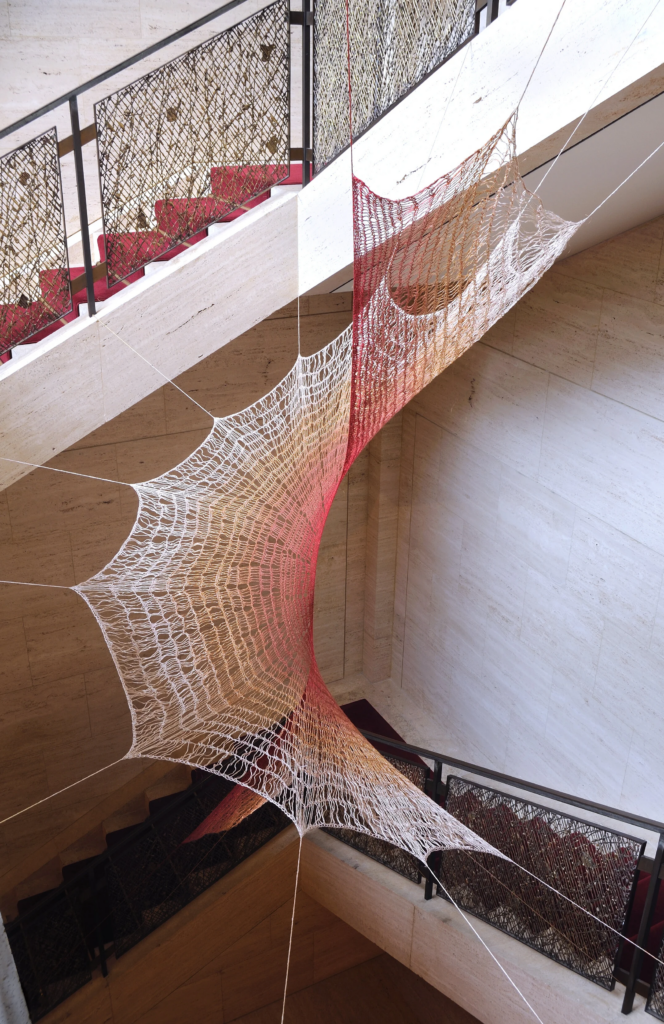
Rania Hassan, Liminality, 2020. Suspended installation: Silk, linen, bamboo, copper, and stainless steel threads. Photo by Greg Staley.
Her knitted installation at the Kreeger Museum further explored the relationship between thread, space and human connection. These works invite viewers to consider how individual strands, joined together, can create something far larger than themselves.
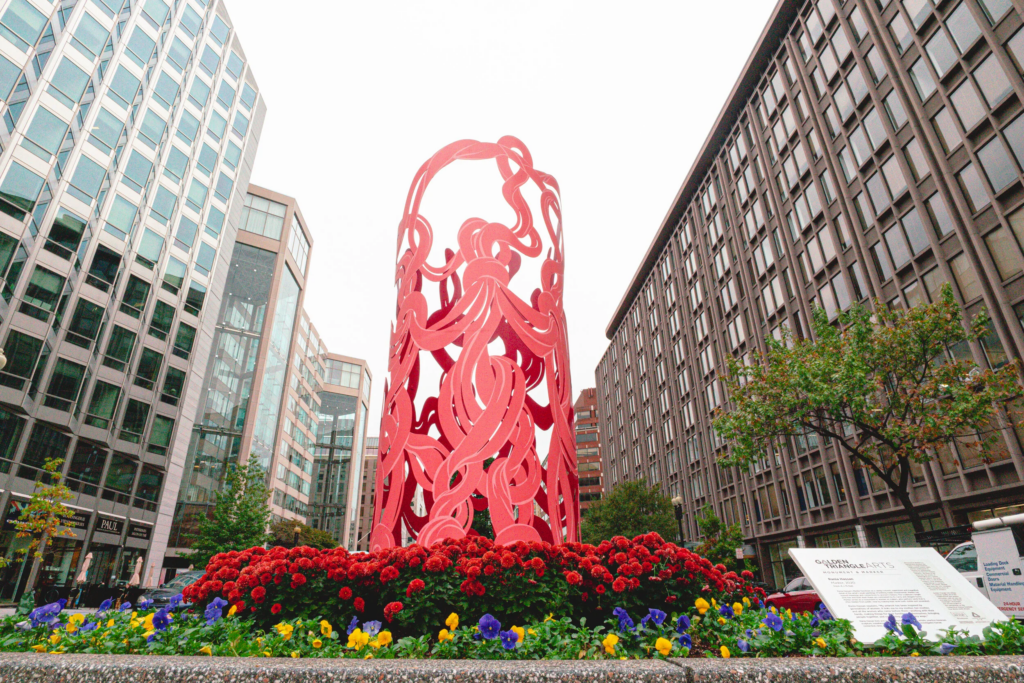
Rania Hassan, Marker, 2020. Connecticut Avenue and K St Washington, DC NW. Steel, 6 x 15 feet. Photo by Albert Ting.
Then came Marker, installed in 2020 at Connecticut Avenue and K Street through a collaboration between the Golden Triangle Business Improvement District and the Smithsonian’s women’s history initiative. Its bright pink steel form translated the curves of knitting into an outdoor sculpture celebrating women’s histories and the connections between us.
Unlike her earlier installations, Curve is permanent—a lasting addition to Washington’s public landscape that will introduce Mamie “Peanut” Johnson’s inspiring story to generations to come.
Across these works, Hassan has maintained a distinctive artistic vision while moving between delicate fibers and substantial steel. Her materials change, but connection remains central.
With Curve, that vision serves a particularly meaningful purpose. It makes Johnson’s story part of everyday Washington life, accessible to people who may never enter a museum or know her name.
A child can ask whom the sculpture honors. A passerby can discover a pioneering athlete’s second career caring for patients. A familiar journey through the neighborhood can become an encounter with history.
Mayor Bowser and the public agencies and community partners behind the plaza deserve recognition for making room for that experience. Improving an intersection can make travel easier; including thoughtful public art can also give the place an identity.
The Commission of Fine Arts recognized Hassan’s accomplishment when it approved the design and commended her beautiful tribute to a notable city resident.
Washington now has another distinctive landmark—and another woman’s achievements brought into public view.
Through Curve, Rania Hassan has again made Washington more beautiful, while giving its residents something equally enduring: a reason to remember.
