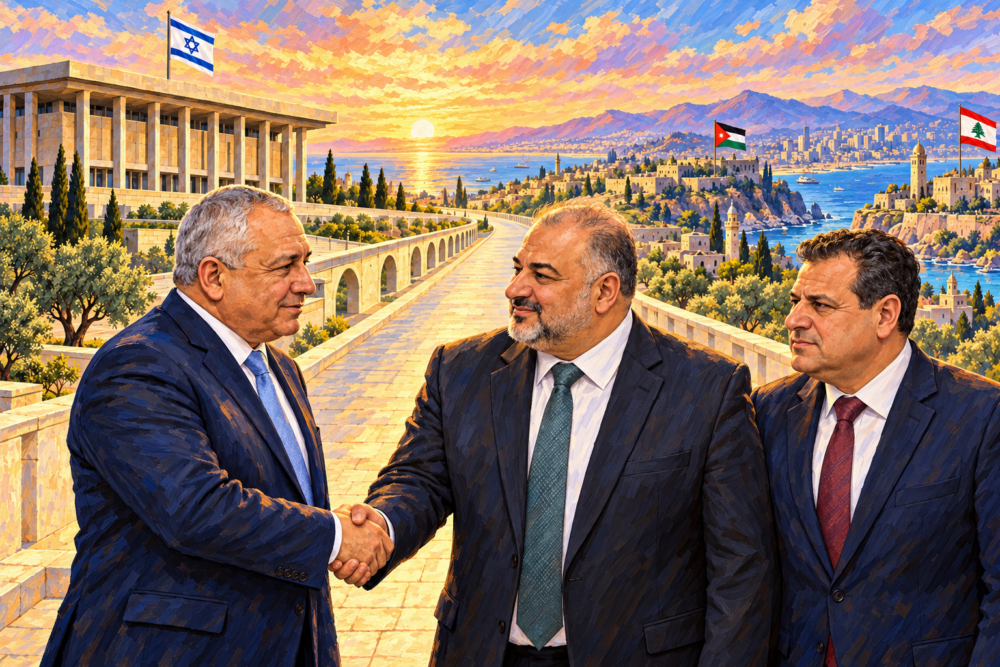
Editorial illustration – Peace begins with partnership: cooperation with Arab citizens at home could help Israel build bridges with its neighbors.”
Cooperation with Arab parties could open the door to a new government—and a broader vision of peace, security and Palestinian statehood
By: Ya Libnan , Opinion
Israel’s election has created an opportunity that political hesitation could squander. Benjamin Netanyahu’s bloc holds 53 seats, while Gadi Eisenkot’s opposition bloc holds 48. The Arab-led parties hold another 19. Together, the parties outside Netanyahu’s camp command 67 seats in the 120-member Knesset—but they do not yet constitute a governing alliance.
The arithmetic offers a path. Leadership must now make it possible.
The most direct route is an Eisenkot-led government supported by Arab parties, through coalition membership, outside parliamentary backing or both. Eisenkot would have to reconsider his rejection of such cooperation and persuade reluctant partners to do the same.
That would require courage. Arab citizens’ elected representatives should be recognized as legitimate participants in determining their country’s government.
A negotiated agreement could begin with practical domestic priorities: protecting judicial independence, establishing a credible state inquiry into the October 7 failures, reducing living costs and combating crime in Arab communities. These should become concrete commitments, without pretending that prospective partners agree on every security or diplomatic question.
Cooperation would require mutual responsibility. Arab parties would need to negotiate workable commitments; Jewish-led parties would need to accept that parliamentary support entails meaningful influence.
Avigdor Lieberman, whose party won seven seats, presents a significant obstacle because of his opposition to cooperation with Arab parties. Every prospective partner should face the same question: will political red lines preserve the government they campaigned to replace?
Another conceivable route is a unity government under Eisenkot, with Netanyahu accepting a subordinate role. That would require an extraordinary political concession. Any proposed ministerial appointment would also need careful legal examination given Netanyahu’s criminal proceedings. It cannot be presented as a simple exchange of offices.
A third possibility is another election. For Eisenkot, that would be a gamble with an opportunity he may never regain. After years of opposing Netanyahu, his bloc still finished five seats behind Netanyahu’s camp. His present opening depends on bridging the divide with Arab parties.
Another campaign offers no guarantee of a stronger result. It could exhaust voters, deepen divisions and allow Netanyahu to rebuild a majority. Eisenkot should not assume that rejecting a difficult compromise today will produce an easier choice tomorrow.
The larger question is what a new government would do with power.
Israel needs a strategy connecting security with a durable political settlement. Many Arab governments share concerns about Iranian interference and armed proxies. Their interests differ, but those concerns create an opening for diplomacy.
Israel’s longstanding peace treaties with Egypt and Jordan demonstrate that negotiated relations can survive severe disagreements. A responsible Israeli government should seek to extend that stability.
Lebanon could offer an important opportunity if negotiations secure sovereignty, resolve outstanding disputes and provide credible security arrangements. Progress with Syria, Saudi Arabia and other regional states would involve different conditions. Peace would require patient negotiation, reciprocal commitments and enforcement.
Central to that effort must be a credible path toward a viable Palestinian state alongside a secure Israel. Saudi Arabia has explicitly tied diplomatic relations to Palestinian statehood. Israel cannot indefinitely postpone the Palestinian question while seeking regional acceptance.
Palestinian freedom and Israeli security deserve recognition in their own right. A credible settlement could also weaken Tehran’s exploitation of Palestinian suffering to justify its regional influence and support for armed groups. It would not eliminate Iranian ambitions, but it could undermine a powerful recruiting argument.
Eisenkot need not resolve every regional conflict before forming a government. He should offer a direction: democratic accountability, equal citizenship, enforceable security agreements and a serious political horizon for Palestinians.
The status quo has delivered neither lasting security nor lasting peace.
Israel has an opportunity to redefine its future. Eisenkot must decide whether to lead that effort—or risk losing the opportunity altogether.
