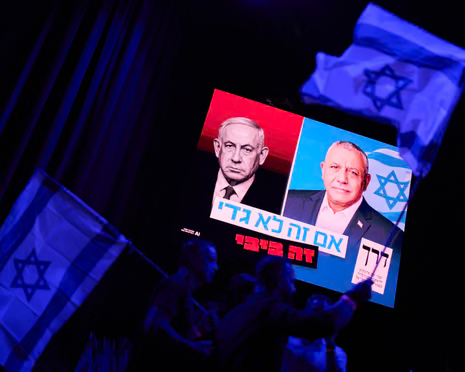
A screen in Tel Aviv shows Benjamin Netanyahu, left, and his main rival, the opposition candidate Gadi Eisenkot, ahead of the Israeli election on Tuesday. Photograph: David Goldman/AP
With 67 seats against Netanyahu’s 53, the opposition should be victorious – but its dependence on 19 Arab lawmakers could keep it from power.
By: Dan Perry*
Israel’s election has produced a messy result: Prime Minister Benjamin Netanyahu’s governing bloc has suffered a major defeat, losing perhaps 11 seats compared with its victory in 2022. Yet the country could still end up with Netanyahu as prime minister. Or a broad unity government that preserves part of the existing order. Or a repeat election.
According to near-final results, Netanyahu and his allies have won just 53 seats in the 120-member Knesset, down from the 64 that gave them a comfortable majority four years ago. The opposition has secured 67 seats, one of the strongest showings for the anti-Netanyahu camp in decades. You might think this would be interpreted as a decisive rejection of the incumbent government and a mandate for political change – yet things are not exactly so.
The complication is that the opposition’s seats include 19 held by Arab parties, whose dramatic electoral gains appear to have been driven by a surge in turnout among Israel’s Arab citizens. The Jewish-led opposition parties together hold just 48 seats, leaving them well short of the 61 needed for a parliamentary majority. And several of their leaders have promised to avoid a coalition with the Arab parties.
That pledge was always difficult to reconcile with Israel’s electoral math – as well as with the promise of equality in its Declaration of Independence. Indeed, the moderate camp has for decades depended on Arab votes for a parliamentary majority, even when Arab parties remained formally outside the governing coalition. The promises in this round were designed to reassure Jewish voters moving away from Netanyahu’s right-wing bloc, many of whom distrust the Arab parties on security, Palestinian nationalism and the Israeli-Palestinian conflict.
Now opposition leaders may have to choose between their principal campaign objective – removing Netanyahu, which the country needs desperately – and a secondary promise that should never have been made. Further complicating the picture are Likud allegations of fraud – expected standard operating procedure – which on Thursday received a boost by reports of an investigation that Qatar might have bribed Israeli Arabs to vote.
Qatar strongly denied the accusations which were called ” dangerous
A major wild card is President Trump, who seems determined to save Netanyahu and may pressure the main opposition leader, Gadi Eisenkot, to acquiesce. No one should be surprised if Trump engineers another Iran war – or, conversely, promises peace plans with the Palestinians and Saudi Arabia – to scramble the Israeli equation in ways that might help his fellow right-wing populist.
There are several possible routes to a government, each involving concessions and risks.
1. An opposition government supported by the Arab parties
The most direct path would be for Eisenkot to accept the parliamentary support of the Arab parties and form a government backed by the 67 lawmakers elected in opposition to Netanyahu’s bloc. This could involve bringing Ra’am, the pragmatic Islamist party led by Mansour Abbas that joined the governing coalition in 2021, into the government, and perhaps relying on outside support from the Joint Arab List, which is less Zionist-friendly.
The latter arrangement would allow the Jewish-led opposition to control the cabinet while giving Arab parties considerable influence without requiring them to assume responsibility for policies they oppose.
They could concentrate initially on domestic priorities, on which they all agree, including restoring democratic institutions, establishing a state commission of inquiry into the Oct. 7 failures, addressing the cost of living, combating crime in Arab communities and reversing controversial authoritarian reforms of Netanyahu’s outgoing government. Additional parliamentary support on individual issues could help reduce dependence on any single faction.
Avigdor Lieberman, the anti-Netanyahu, anti-religious nationalist whose Yisrael Beiteinu party won seven seats, could prove the toughest obstacle. Opposed to a coalition that relies on an Arab safety net, he could potentially demand a turn as prime minister in exchange for his support. Conceivably, some from Netanyahu’s bloc might later join in as well.
2. A unity government under Netanyahu, excluding the far right
A second possibility is a broad national unity government joining Netanyahu’s Likud with most of the Jewish-led opposition while excluding his ultranationalist partners, especially the globally toxic Itamar Ben-Gvir. Such an arrangement would command a substantial parliamentary majority and could be presented as an answer to Israel’s political divisions and security challenges.
Trump, who aggressively endorsed Netanyahu, will probably push for this, and Eisenkot could be receiving some phone calls from the White House.
Netanyahu would argue he should be the prime minister of such a government – or at least go first in a rotation. He’d argue his Likud is still the largest party, but that is actually irrelevant under the Israeli system – only the blocs count.
For Netanyahu, unity would offer an opportunity to shed his most controversial partners while remaining at the helm, claiming national reconciliation.
For Eisenkot and other opposition leaders, the political cost would be enormous. Having campaigned to end Netanyahu’s rule and won a 67-seat majority, they would look weak. They also could find themselves responsible for government decisions that would enrage their supporters, like additional settlements in the West Bank
3. Defections from the opposition give Netanyahu another majority
A third possibility involves Netanyahu persuading opposition lawmakers to change sides, allowing him to assemble a governing majority despite his bloc’s electoral defeat.
Netanyahu could also attempt to recruit such individual lawmakers through ministerial appointments, policy concessions or promises of political influence. Parliamentary rules governing defections could complicate these efforts, particularly for lawmakers seeking to break away individually. But it is possible. One potential figure is, again, Lieberman, whose Yisrael Beiteinu party has been among Netanyahu’s fiercest opponents. A former defense minister and veteran coalition negotiator, Lieberman holds nationalist positions closer to the traditional right than to the liberal opposition, although his longstanding hostility toward Netanyahu would make any reconciliation dramatic – and he has ruled it out. But he has also ruled out a coalition with the Arabs.
The prospect of major cabinet portfolios, a broader realignment of the right and the avoidance of another election could nevertheless become appealing options.
The broader implication is that Netanyahu could retain power through post-election maneuvering.
4. A unity government under Eisenkot, with Netanyahu in senior ministry
A fourth scenario, albeit unlikely, would flip the odd assumption that Netanyahu must lead a unity-government. Using his leverage in parliament, Eisenkot could become prime minister with Netanyahu accepting a senior cabinet position, perhaps as foreign minister or defense minister. Netanyahu would remain a prominent national figure, potentially representing Israel abroad or overseeing a major policy portfolio, while Eisenkot assumed responsibility for leading the government.
There would, however, be significant legal complications. Netanyahu’s ongoing criminal trial blocks him legally from serving as an ordinary cabinet minister rather than prime minister (which, due to a loophole, is possible). Assigning him a portfolio would require legislation and invite judicial scrutiny.
Another main obstacle: Netanyahu is pathologically fixated on retaining the premiership, and almost no one in Israel thinks he would accept such an arrangement over new elections.
5. Another election
The final possibility is that the parties fail to reach an agreement and Israel returns to the polls.
President Isaac Herzog plays an important procedural role, consulting parliamentary factions and assigning the task of forming a government to a Knesset member. The process could begin next week, and the initial mandate normally lasts 28 days, with a possible 14-day extension. Further procedures allow other candidates to seek a majority before another election becomes necessary.
A prolonged deadlock could leave Netanyahu heading a caretaker government while Israel prepares for another election – which is why he probably would not mind.
Another election would raise questions about whether the exceptionally high Arab turnout that helped produce the opposition’s majority could be sustained. Arab voter participation has historically fluctuated, and the latest result could represent either a lasting political transformation or a temporary surge driven by the campaign – then suppressed by bitterness over their exclusion.
For the Jewish-led opposition, returning to the polls would risk squandering its electoral achievement while giving Netanyahu another opportunity to reshape the contest around security, national identity and the legitimacy of Arab parliamentary influence.
If I wore Eisenkot’s shoes
If I were Eisenkot, I would give Lieberman whatever is needed to buy his cooperation and form a government with an Arab parliamentary safety net, remove Netanyahu and secure the premiership.
I would immediately pursue broadly popular policies: a state commission of inquiry into Oct. 7, universal conscription including Arab and Haredi national service, a crackdown on Jewish terrorism in the West Bank and organized crime, particularly in Arab communities, and reversal of Netanyahu’s authoritarian reforms.
I would maintain a firm line against Hamas, Hezbollah and Iran, and close the legal loophole allowing criminal defendants to serve as prime minister.
I would do all that in the first month. In the second, I would invite Likud into a unity government on these terms. Competent governance, relief from the threats of global economic sanctions and incumbency could build momentum, making any subsequent election prospects more favorable.
All that would require focus, determination and a bit of courage. As a former military chief, Eisenkot should be up to the task.
Netanyahu would scream bloody murder. Give him a megaphone, recommend a valium, and send him a copy of Israel’s Declaration of Independence, which promises equality to the Arabs.
The opposition’s leaders have a chance to show us whether they are worthy of leadership. Their decision will determine whether the election becomes a turning point in Israeli politics or another chapter in Netanyahu’s remarkable record of political survival.
* Dan Perry is the former chief editor of The Associated Press in Europe, Africa and the Middle East, the former chairman of the Foreign Press Association in Jerusalem, and the author of two books about Israel.
FORWARD
