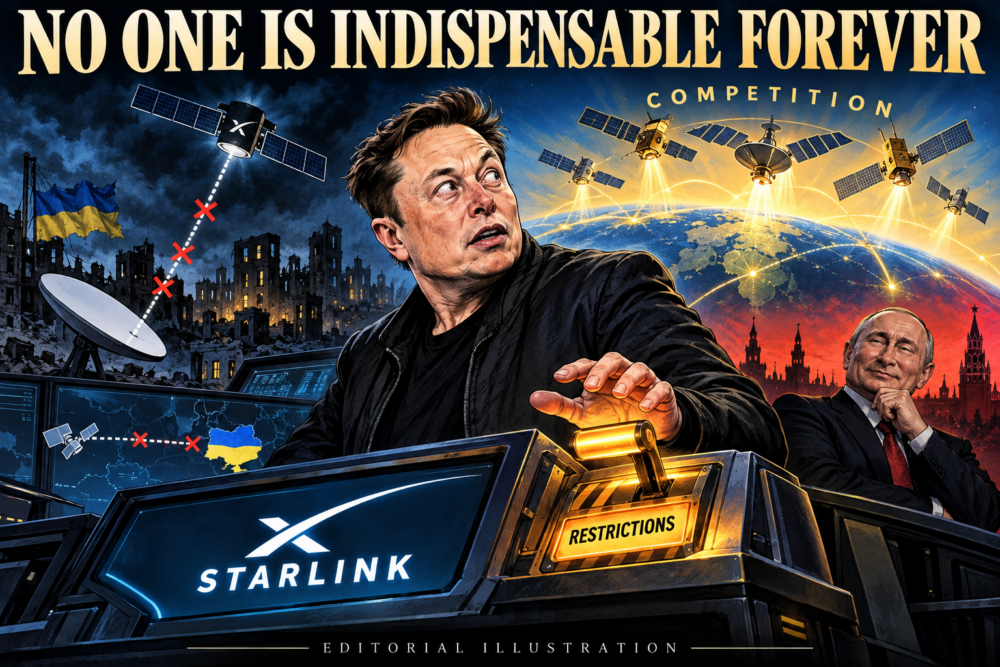
Editoria illustration- Restrictions that weaken Ukraine’s defenses give Russia an advantage—and strengthen the case for alternatives to Starlink. The world wants Musk to succeed—and to recognize the responsibility that comes with his influence.
Disrupting Ukraine’s satellite lifeline benefits Putin—and gives America’s allies another reason to finance Starlink’s competitors.
By : Vlad Green, Opinion
Elon Musk should recognize a basic truth of the technological age: no company is indispensable forever.
Starlink’s achievements are remarkable. SpaceX has built a communications network that has provided essential connectivity to Ukraine during Russia’s invasion. But technological leadership does not guarantee permanent customer loyalty—especially when uncertainty over access becomes a national security concern.
When communications restrictions hamper Ukraine’s ability to defend itself, the consequences reach far beyond a dispute over service terms. They give an advantage to Vladimir Putin, whose forces invaded Ukraine and continue fighting to hold Ukrainian territory.
In October, Ukrainian officials said restrictions affecting Starshield, the military service using SpaceX’s Starlink infrastructure, disrupted connections when terminals traveled faster than approximately 160 kilometers per hour. Officials said the restrictions hampered interceptions of Russian attack drones and forced the cancellation of some operations. Ukraine announced on October 24 that service had returned to the speeds it needed.
Restoring service was essential. Restoring confidence will be harder.
Responsibility for ordering the restrictions remains disputed. The Wall Street Journal reported that Musk ordered the slowdown, while Reuters reported that the order originated inside the White House. Musk initially attributed control over Starshield restrictions to the U.S. government. He later accused Ukraine of violating Starlink’s terms by using it for offensive drone strikes, an explanation disputed by a Ukrainian presidential adviser.
These conflicting accounts require careful attribution. They also expose a serious problem: a country fighting for survival needs to know who controls its essential communications, what restrictions apply, and whether those restrictions can change without warning.
The advantage goes to Putin
Whatever the intention behind the restrictions, their reported effects carry an unmistakable implication. When Ukrainian defenders have greater difficulty intercepting Russian drones, Russia gains an advantage.
That does not establish that Musk intended to help Putin. It does mean that decisions affecting these services must be judged by their consequences as well as their stated justification.
Putin could end Russia’s invasion by ordering his forces to withdraw. Instead, Ukraine must continue defending its cities, infrastructure and people. Making that defense more difficult places additional pressure on the invaded country while benefiting the invader.
Musk cannot reasonably expect the public to assess such restrictions solely as a commercial matter. Once a communications system becomes essential to wartime defense, changes to its availability have strategic consequences.
SpaceX deserves credit for what it has supplied. That contribution makes dependable service, clear contracts and accountable decisions all the more necessary.
Dependence creates demand for alternatives
The commercial warning to Musk follows directly from the security warning to governments.
A dominant supplier may enjoy a considerable advantage when customers find switching difficult. But when dependence becomes dangerous, customers acquire a powerful reason to invest in alternatives.
That search predates this controversy. Eutelsat’s OneWeb already provides connectivity in Ukraine, and Ukrainian officials have identified OneWeb and Amazon’s planned network among possible alternatives. Europe is also pursuing its longer-term IRIS² satellite program.
Replacing Starlink will be difficult. Competing systems face limitations in capacity, equipment, financing and launch access. Governments cannot eliminate those obstacles with speeches or emergency announcements.
But competitors do not have to replace every Starlink connection to weaken its dominance. They need to provide credible alternatives for essential functions, giving governments greater resilience and bargaining power.
America and its allies should support that competition while establishing clear contractual rules governing military use, service restrictions and authority over changes. Soldiers should not discover the limits of a vital service during a mission.
For Musk, the message is straightforward: uncertainty encourages customers to look elsewhere. In matters of national defense, governments may accept higher costs to gain greater control.
Starlink is difficult to replace today. That does not make it indispensable forever.
Time to wake up, Musk. Restrictions that weaken Ukraine’s defenses give Putin an advantage. They also give your customers a compelling reason to help build your next competitor.
