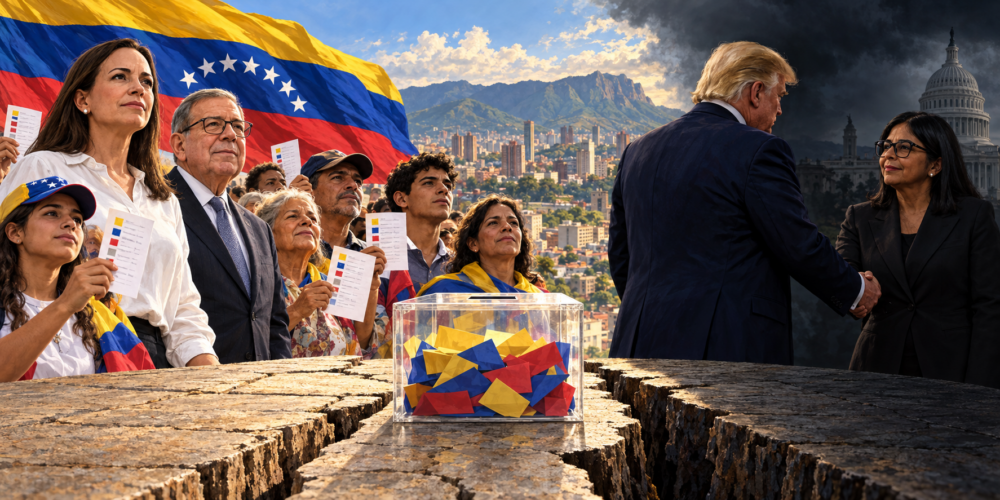
Photo illustration – “Venezuelans voted for change. Will Washington honor their choice?”
Removing Maduro must not become an excuse to preserve the system that denied Venezuelans their democratic victory
By: Ya Libnan Editorial Board, Opinion
Venezuelans should not have to keep proving that they deserve democracy. They have already demonstrated their courage—and expressed their choice at the ballot box.
On July 28, 2024, they voted in a presidential election whose outcome Nicolás Maduro’s government refused to acknowledge credibly. María Corina Machado, barred from running, backed Edmundo González Urrutia. The evidence of his victory was substantial.
The Carter Center’s independent analysis of available polling-station records showed González receiving 67.1 percent of the votes recorded, compared with Maduro’s 30.4 percent. The organization concluded that the election failed international standards of electoral integrity and could not be considered democratic.
Washington itself recognized González as Venezuela’s president-elect in November 2024. This was more than an opposition allegation: the United States formally acknowledged the winner.
That history must remain central to American policy.
Following Maduro’s capture by American forces in January, President Donald Trump’s administration chose to work closely with interim President Delcy Rodríguez, Maduro’s former deputy. Both governments promise elections, but neither has announced a date.
There may be practical reasons to communicate with those controlling state institutions. Keeping essential services functioning and preventing further instability are legitimate concerns.
But practical cooperation becomes dangerous when it allows an interim administration to consolidate power while the electorate’s mandate fades into the background.
Removing Maduro is not the same as restoring democracy.
Rodríguez’s government is holding American-supported talks with an opposition faction that excludes Machado. The composition of a reformed electoral council remains uncertain. These are consequential decisions: whoever controls electoral institutions can shape whether a future vote offers genuine competition.
Machado and her movement should not be treated as inconvenient outsiders to a transition born of their supporters’ struggle.
Nor should González’s documented victory become an embarrassing detail that negotiators quietly set aside.
A transition must address that mandate openly. If changed circumstances require a negotiated electoral settlement, it needs credible democratic participation, clear safeguards and public justification. Washington and Caracas cannot simply decide that Venezuelans’ previous choice no longer matters.
The people have paid too high a price for that.
Thousands recently demonstrated across Venezuela demanding elections, an electoral timetable and the release of political prisoners. Their message was straightforward: promises of eventual democracy are insufficient. They want a concrete path to it.
Washington should respond with equally concrete requirements.
These should include a transparent timetable, independent electoral authorities, freedom for peaceful political organizing, the release of political prisoners, credible international observation and arrangements that allow eligible Venezuelans abroad to participate.
Machado must be free to return and participate safely. Any restrictions on candidates should face independent scrutiny rather than serve those already holding power.
Above all, Washington must explain how its policy respects the 2024 result.
American commercial and strategic interests cannot provide an adequate answer to a democratic question. Even potentially beneficial economic agreements cannot substitute for Venezuelans’ consent.
The United States should seek a stable relationship with Venezuela. Lasting stability, however, requires institutions that command public legitimacy. An arrangement dependent on Washington’s approval and the cooperation of entrenched officials remains vulnerable to the same abuses that produced this crisis.
Trump has an opportunity to support a genuine democratic transition. He also risks lending American power to the survival of an authoritarian system under different management.
His administration should make its choice unmistakable.
Venezuela’s future belongs to its citizens. They are entitled to leaders chosen through votes that are counted honestly and respected afterward.
America must not help erase a victory it once recognized.
Venezuelans have already chosen. Washington must decide whether it stands with their democratic rights—or with those who continue to postpone them.
