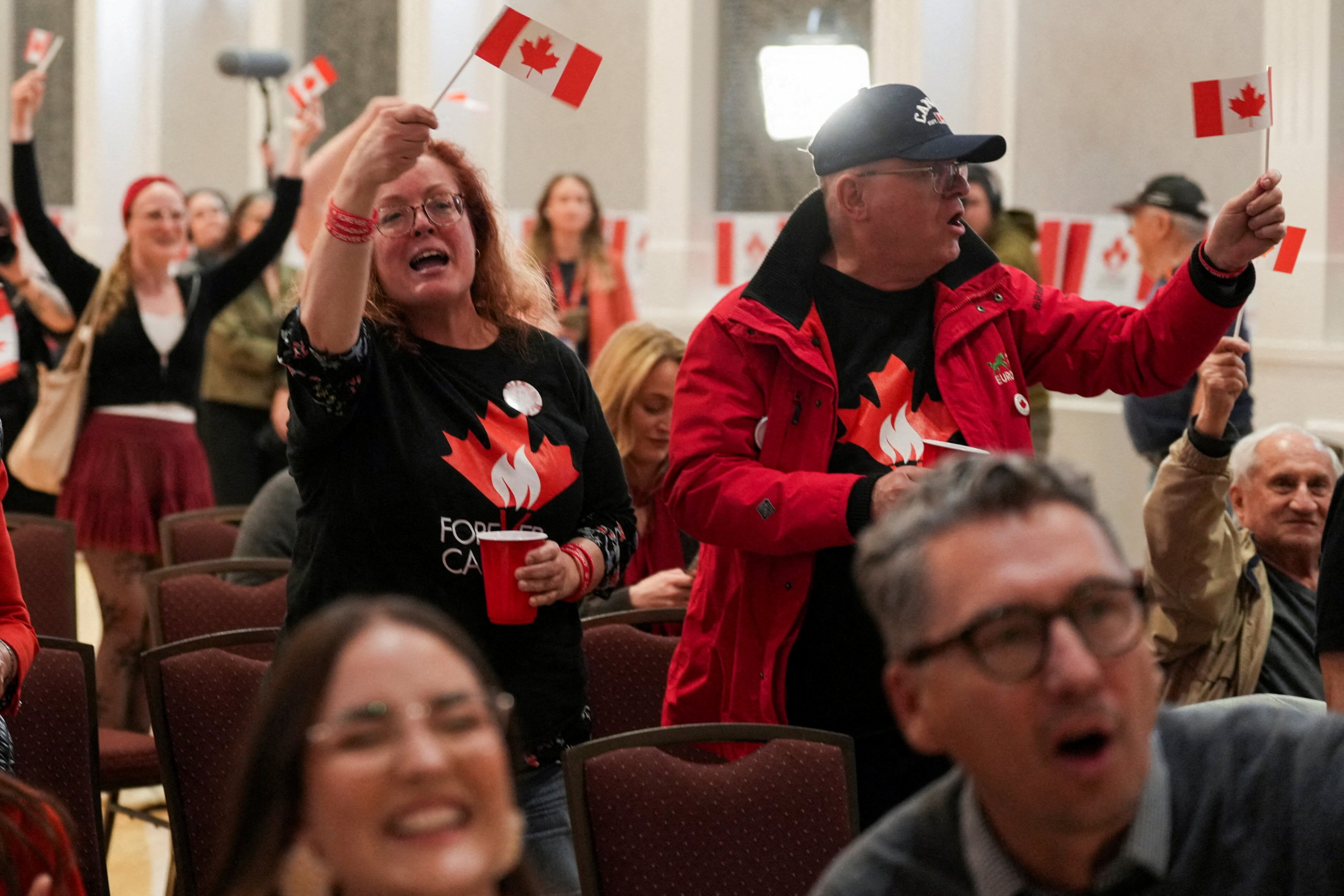
Supporters of the Forever Canadian group, who want Alberta to remain in Canada, wave Canadian flags as they watch the results of a non-binding referendum on Alberta sovereignty in Edmonton, Alberta, Canada October 19, 2026. REUTERS/Todd Korol
By Amanda Stephenson and Maria Cheng
Summary
- Remain side wins 76% of tallied votes against 24% for separation process
- Nonbinding referendum is first time Alberta has had a vote on leaving Canada
- Prime Minister Carney stresses unity in fight against US tariffs
CALGARY-Alberta residents voted by a huge majority to remain part of Canada in the province’s first-ever referendum on separation, handing Prime Minister Mark Carney a much-needed win as he attempts to unify the country amid a trade war with the US.
At 5:45 a.m. (1145 GMT) on Tuesday, with three-quarters of the votes counted, 76% of Albertans had backed the “remain” side versus 24% in favor of a binding vote on separation. The referendum was nonbinding.
“Albertans made a clear choice,” Carney said in a statement. “They chose unity, to build together, and to take care of each other.”
“Canada is greater than the sum of its parts,” he said.
Pollsters and analysts had dismissed the possibility of a separatist victory in Monday’s vote, citing data that showed only about one-third of residents in the western energy-producing province supported a future referendum on leaving.
Alberta Premier Danielle Smith, who announced the referendum in May, issued a statement saying she was “very pleased” that early results showed widespread support for remaining in Canada.
Smith said she would address Albertans at 6:45 p.m. on Tuesday to discuss “where our province goes from here.”
A small but vocal group of separatists has campaigned for months for an independent Alberta, arguing that the province’s energy wealth was subsidizing poorer parts of Canada and that it would be far richer freed from Ottawa bureaucracy.
Last week, Carney told a rally in Calgary that voting to leave Canada would be “a dangerous bluff that will lead to years of deep division”.
CARNEY SEEKS TO REDUCE CANADA’S DEPENDENCE ON US
There was no immediate reaction to the vote’s outcome from President Donald Trump, who has repeatedly talked about the United States annexing Canada. US Treasury Secretary Scott Bessent, discussing Alberta in January, said: “I think we should let them come down into the US.”
Monday’s vote was the second time in two weeks that Carney has had to face a separatist challenge. An independence-minded party won power in the predominantly French-speaking province of Quebec on October 5 but fell short of the majority needed to fulfill a vow to hold a vote on breaking with Canada.
Quebec held independence referendums in 1980 and 1995, both of which failed.
Carney, who grew up mostly in Alberta, acknowledges Albertans have often felt slighted by Ottawa. He has noted his government fast-tracked a proposed new pipeline, with Alberta and the federal government as majority owners. And he has pointed to Alberta’s critical role in helping Canada reduce its dependence on the US.
First Nations groups have also objected to the idea of an independent Alberta, as their land treaties with Ottawa predate the province’s creation within Canada.
ALBERTA INDEPENDENCE MOVEMENT SET TO CARRY ON
The result is unlikely to end the independence movement. Before the referendum, some separatist leaders said they would continue to pursue another vote even if most Albertans said they wanted to remain.
According to data released on October 16 by the pollster Angus Reid, 62% of Albertans believe “there will never be an end to the separatist movement”.
The vote on Monday also included nine other nonbinding questions on proposed measures to strengthen the province’s hand when dealing with Ottawa. These covered immigration, access to provincial services — such as education, social care and healthcare — and voter identification requirements.
Provisional results showed voters backed eight of the nine measures, but some with only small majorities.
REUTERS
