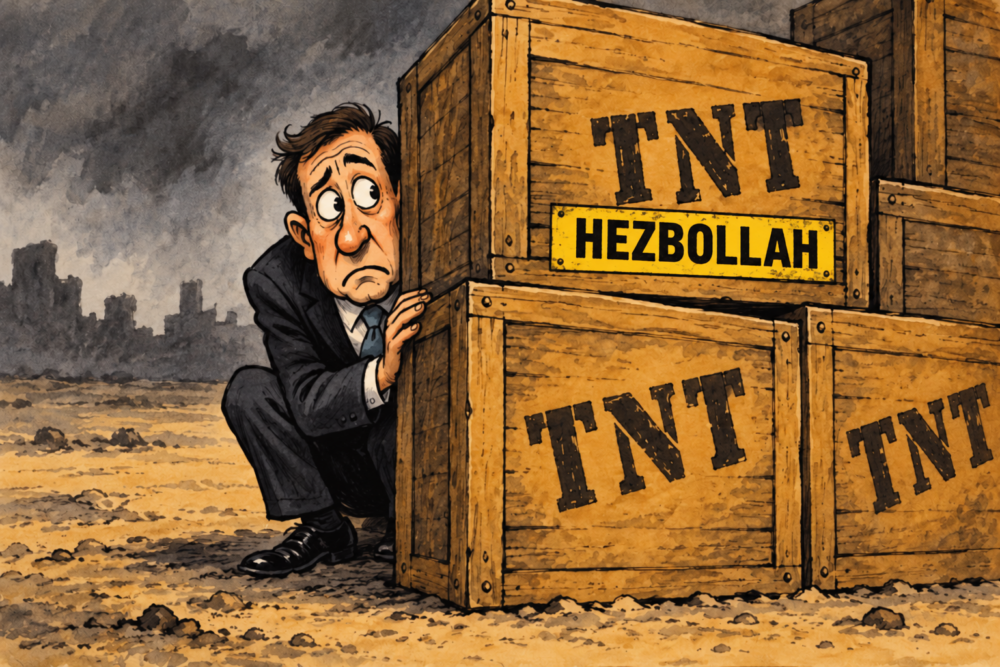
Photo illustration –Political titles cannot shield those responsible for illegal explosives. Lebanon must follow the evidence all the way to those giving the orders
Lebanon must follow the explosives trail through the entire chain of command—and prosecute every leader implicated by evidence, regardless of political title or influence.
By : Ali Hussein , Lebanese Political Analysts , Opinion
An explosives shipment intercepted on the road to Beirut is more than a security incident. It is a test of whether Lebanon’s government can enforce its authority against an armed organization accustomed to operating beyond the state’s control.
Prime Minister Nawaf Salam has promised a thorough investigation into the truck stopped at Dahr al-Baidar. He deserves public support—and the investigation must reach beyond the people transporting the cargo.
According to the Associated Press, judicial officials said the truck carried 780 kilograms of explosives, including 250 kilograms of TNT and 250 kilograms of C4. Two people were detained. Separately, the Lebanese Army announced on October 12 that it had seized approximately 200 kilograms of explosive materials intended for smuggling from Syria into the al-Qasr area. The army said the smugglers fled back into Syria.
The two seizures have not publicly been established as part of the same operation. Each nevertheless demands an exhaustive investigation.
Who supplied the materials? Who paid for them? Who arranged their transportation? Who was supposed to receive them? And, above all, who gave the orders?
Those questions must guide investigators wherever the evidence leads.
Hezbollah’s political leaders cannot simply invoke a distinction between a political wing and a military wing to place themselves outside that inquiry. Political participation cannot become a shield for involvement in illegal armed operations. A minister, parliamentarian or party official who helps organize, finance or facilitate such activity must face accountability just as a courier does.
Lebanon should investigate the organization’s actual decision-making structure, rather than accept labels offered in its defense. If political and military responsibilities overlap, investigators must establish how—and identify the individuals responsible.
That is the central issue. A country cannot maintain one sovereign government while permitting a party to exercise political influence and sustain an armed apparatus beyond state authority.
The government’s prohibition of Hezbollah’s military activities must therefore have practical consequences. Illegal weapons must be seized. Supply networks must be disrupted. Those implicated by evidence must face arrest and prosecution, including senior leaders. Enforcement that stops with drivers and couriers would leave the machinery behind the operation intact.
The authorities have not established publicly whether the intercepted shipment was intended for drones, another military purpose or an assassination plot. That uncertainty must be resolved through evidence. It must not become an excuse to minimize the danger—or a license to announce an unproven plot as fact.
Lebanon’s fear is understandable. Political assassination has repeatedly robbed the country of leaders, journalists and public voices. The Special Tribunal for Lebanon convicted Salim Ayyash and, on appeal, Hassan Habib Merhi and Hussein Hassan Oneissi in connection with the 2005 attack that killed former prime minister Rafik Hariri and 21 others. Those convictions concerned individuals; they were not a judgment establishing the guilt of Hezbollah’s entire political leadership.
That history makes a rigorous investigation essential. It also makes precision essential. Lebanon needs findings capable of surviving scrutiny and producing accountability.
Reports about the suspects’ affiliations must be tested. Any claimed family connection to a political official must be verified. Kinship alone cannot establish criminal responsibility. Investigators need to establish actions, communications, financing and orders.
Demanding evidence is how Lebanon can build a case that political pressure cannot easily dismiss.
Salam’s government should protect investigators from intimidation, preserve the evidence and provide responsible public updates that do not compromise the inquiry. The security forces deserve support for intercepting dangerous materials. They also deserve assurance that their work will lead to action against powerful suspects when the evidence warrants it.
No negotiated political settlement should substitute for investigating criminal conduct. No claim of resistance should automatically excuse the unauthorized possession or movement of explosives. And no political title should place its holder beyond questioning.
This is an obligation to protect every Lebanese community, including Shiite citizens whose security and future belong under the protection of the Lebanese state.
Lebanon has lived too long with the possibility that power can defeat accountability. This investigation offers the government an opportunity to establish a different precedent.
Stopping the truck was the beginning. The decisive test is whether the state will pursue those behind it.
Hezbollah’s political leaders cannot hide behind the “military wing.” If the evidence reaches them, justice must reach them too.
