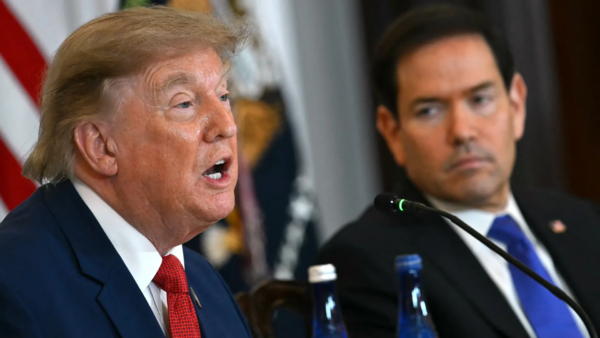
File Photo : President Trump and Secretary of State Marco Rubio at the U.S. Department of State in Washington, D.C. Photo: Kent Nishimura/AFP via Getty Images
US Secretary of State Marco Rubio demanded on Monday that the Iranian delegation to the United Nations General Assembly immediately leave the country after negotiations stalled, according to a U.S. official and a second source with knowledge of the matter.
Why it matters: Though the Iranians were likely to depart soon anyway, Rubio’s move was a highly unusual diplomatic rebuke and laid bare the deep distrust between the two countries amid fruitless efforts to broker an end to the war.
- Qatari mediators tried to secure a diplomatic breakthrough between the U.S. and Iran but made little progress, with neither side willing to budge.
- Among those ordered to leave New York was Rubio’s Iranian counterpart, Foreign Minister Abbas Araghchi.
“Secretary Rubio kicked out the Iranian delegation who had overstayed their welcome. The UN General Assembly was over, so it was time for them to go,” the U.S. official said.
On Monday morning, the White House thought there might be progress in talks with Iran later in the day. But by late afternoon it became clear negotiations were at a stalemate.
- Then on Monday evening, at Rubio’s orders, the U.S. mission to the UN told the Iranian mission to the UN that Araghchi’s delegation had to leave New York immediately, according to the U.S. official.
- The Iranian delegation, including Araghchi, left for the airport several hours later and boarded a flight from New York to Doha at 1:20 a.m. Tuesday.
- A second source confirmed that the U.S. demanded that the Iranian delegation leave, but said Araghchi was scheduled to travel back to Tehran on Monday night anyway.
What’s next: Qatari mediators are continuing to talk to both sides about their compromise proposal, regional sources say.
- “Maybe I will blow ’em up,” President Trump told reporters on Wednesday when asked how he can reach a deal with a regime he says is crazy. “Maybe I blow ’em up. We have to make that decision. We will blow ’em up or make a deal. But the time is coming. It’s gonna end very soon one way or the other.”
- U.S.-Iran talks yield little
- Efforts by Qatari mediators to broker a diplomatic breakthrough between the U.S. and Iran have made little progress, with neither side willing to budge, according to three sources familiar with the talks.
The stalemate bolsters the belief on both sides that a renewed military conflict is becoming more likely. U.S. officials think President Trump could order a return to major combat operations after the midterms.
Qatari officials will keep trying, but they’re growing increasingly frustrated with both sides, two of the sources said.
Qatari mediator Ali al-Thawadi met Monday with Iranian Foreign Minister Abbas Araghchi and his team in New York for several hours.
A source with knowledge said they discussed a two-page Qatari compromise proposal. - According to two other sources, the Qatari plan was aimed at addressing both Iran’s demand for lifting the U.S. naval blockade and the U.S. demand for Iranian nuclear concessions.
- On Monday evening, al-Thawadi held talks in Washington with Trump envoy Jared Kushner and other U.S. officials. Vice President JD Vance also attended a small part of the meeting.
- The White House declined to comment.
- On Monday morning, the White House was hopeful of progress.
- U.S. officials briefed several media outlets, including Axios, saying the talks were “positive and constructive” and that Iran “indicated they are flexible on the nuclear issues.”
- The officials even said Trump was willing to give Iran sanctions relief and release frozen funds in return for concrete steps to pare back its nuclear program.
- But several hours later, while the Qatari officials were still at the White House, Trump posted on Truth Social that he offered nothing to Iran.
- One of the sources said there was no significant movement in the talks on Monday.
- “It is stuck. The Iranians are asking for things the U.S. can’t accept and the U.S. thinks it is winning so there is no need for compromise,” the source said.
- Other regional mediators, including Pakistan and Egypt, urged Iran to agree to nuclear concessions. But the Iranians said they would only consider doing so after the U.S. agrees to return to the June memorandum of understanding, another source with knowledge said.
- Iran’s Secretary of the Supreme National Security Council, Mohsen Rezaei, said Tuesday that Iran has conveyed its terms to the U.S. but that “Trump is incapable of making a decision,” per the Iranian press.
- “Trump is trapped in a quagmire in which he can neither negotiate nor fight,” Rezaei said.
- “They are doing very poorly. I don’t know if they are ready to give up yet. They will give up. This is to stop a nuclear weapon. Iran will not have a nuclear weapon,” Trump told reporters on Tuesday.
- Axios
