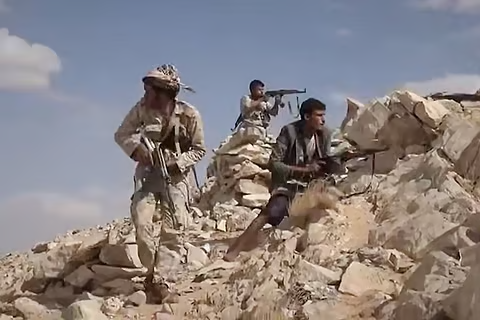
This image taken from an undated video released by the Ansar Allah Media Office, the media arm of Yemen’s Iran backed Houthi rebels, shows what the group says are Houthi fighters battling Saudi-backed forces in eastern Jawf, Yemen. At least 169 people killed in 3 days of fighting in Yemen
Here is the latest:
- Iranian President Masoud Pezeshkian addressed the U.N. General Assembly on Wednesday, saying Iranians are “the victims of terrorism” by the U.S. and Israel, and have “never ever been an aggressor!”
- A commercial vessel was struck in an attack in the Strait of Hormuz on Wednesday, killing one crew member and necessitating the evacuation of more than 20 more sailors, according to the Omani navy.
- U.S. and Iranian officials met Tuesday while both countries were at the U.N. gathering, President Trump said, shortly after threatening in his address that he may “annihilate” the Islamic Republic if a deal isn’t reached soon to end the nearly seven-month war.
U.S. blockade has redirected 115 commercial vessels, military says
The U.S. military blockade on the Strait of Hormuz has now redirected 115 commercial vessels entering or exiting Iranian ports, according to U.S. Central Command.
The total is an increase of five ships since Monday, when the military last provided an update.
The blockade has become a renewed topic of conflict as Iran and the U.S. renewed negotiations this week at the U.N. General Assembly. Representatives from the United States, including Jared Kushner and Steve Witkoff, met with Iranian officials on Tuesday and apparently found some common ground, with President Trump saying the meetings went well.
However, on Wednesday, Iranian Foreign Ministry spokesperson Esmaeil Baqaei reiterated that no deal will be signed until the U.S. removes the blockade on the Strait of Hormuz.
White House responds to Iranian president’s speech at U.N.
President Trump is “courageously” fighting against the Iranian regime, the White House said Tuesday in response to a question about Iranian President Masoud Pezeshkian’s speech at the U.N. General Assembly.
“The Iranian regime has murdered thousands of its own people, killed Americans overseas, executed acts of terrorism in the Strait of Hormuz, and launched indiscriminate attacks against its neighbors in the region,” Anna Kelly, White House principal deputy press secretary, said in a statement. “The President is courageously ensuring that such an evil country never possesses a nuclear weapon, which will make the entire world safer and more stable.”
Through a translator, Pezeshkian said Iran was a victim of Israel and the U.S., and the U.S. is using the Strait of Hormuz “to impose their aggression upon us.”
Iran “will never bow our head or bend at the knee. Iran must be understood by Mr. Trump and those who seek to bully us that we are ready for dialog and diplomacy and negotiations without accepting the language of force,” Pezeshkian said.
Canada imposes new sanctions on Iran officials, entities
The Canadian government announced new sanctions Wednesday against several senior Iranian officials and state-run entities “for their role in the Iranian regime’s brutal repression of its population.”
The sanctions target five senior Iranian security and government officials and five state-run entities, the foreign ministry said in a statement, without providing specifics.
“These individuals and entities have contributed to Iran’s efforts to suppress dissent and restrict fundamental freedoms of Iran’s population, including through digital surveillance, censorship, unlawful violence, arbitrary detention and intimidation,” the ministry said.
A protest movement in Iran sparked in late December by grievances over high living costs rapidly evolved into widespread anti-government demonstrations that peaked on Jan. 8 and 9.
Iranian authorities reported more than 3,000 deaths from the unrest, attributing the violence to “terrorist acts” orchestrated by the United States and Israel. Rights groups based abroad put the toll higher and accused security forces of firing at demonstrators.
Massive protests also erupted in Iran in Sep. 2022 following the death in custody of Iranian Kurdish woman Mahsa Amini, who had been arrested for allegedly violating strict dress rules for women.
UAE sanctions local branches of Iran’s Bank Melli
The UAE central bank said Wednesday that it had imposed sanctions on the Emirati branches of Iran’s Bank Melli, accusing it of violating local laws on money laundering, terrorism and arms proliferation.
The bank said in a statement that “it has been decided to prohibit all branches of Bank Melli Iran operating in the UAE from conducting any financial transactions to and from Iran, including trade finance and fund transfers.”
It cited “non-compliance with the regulations, laws and supervisory decisions in force in the UAE, including the requirements and obligations set out under the legislation related to combating money laundering, the financing of terrorism and proliferation financing.”
The announcement comes against the backdrop of the Middle East war, which began with U.S.-Israeli strikes on Iran in late February, as well as Washington’s more recent economic pressure campaignagainst the Islamic Republic.
As part of that stepped-up campaign, the U.S. announced new measures at the end of August targeting Iran’s trading partners, and sanctioned the director of the Dubai branch of Bank Melli.
Last month, the United Arab Emirates announced the suspension of trade and financial exchanges with Tehran.
German foreign minister: “Iran must engage constructively” in negotiations
Germany’s foreign minister, Johann Wadephul, offered a direct criticism of Iranian negotiations in a meeting with his counterpart, Abbas Araghchi, on Tuesday at the U.N. General Assembly.
“Iran must engage constructively in talks for a sustainable solution to end the conflict in the region & unconditionally open the Strait of Hormuz, ensuring free, safe and toll-free navigation for all,” he said on social media.
Wadephul’s comments came as Iran continues to take a hard line in negotiations, demanding the U.S. remove its blockade on the Strait of Hormuz, end the war on all fronts, release frozen or restricted assets and agree to the Oman-Iran negotiated passage through the strait, according to Iranian Foreign Ministry spokesperson Esmaeil Baqaei.
Araghchi has yet to comment on the meeting with Wadephul, though the government shared photo of the two meeting on the sidelines of the U.N. General Assembly.
Tehran reviewing U.S. response to its proposal, senior Iranian official tells Reuters
Iran is reviewing a U.S. response to its plan to end the fighting between the two countries, a senior Iranian official told the Reuters news agency on Wednesday, adding that many differences remain between the two sides.
The reopening of the Strait of Hormuz and the ending of the U.S. naval blockade of Iranian ports and vessels were subjects discussed during indirect talks with the U.S. on Tuesday, the official said.
Iran’s Supreme National Security Council Secretary Maj. Gen. Mohsen Rezaei said Wednesday in a long interview aired by state television network IRIB that the Strait of Hormuz would remain closed until the U.S. met Iran’s long-stated conditions.
“There is no staging or step-by-step process,” he said. “Iran is trying to have this implemented within three or four days, within four or five days, for example.”
“The next step will also be determined and specified by the Islamic Republic of Iran,” Rezaei said.
Iran has long demanded the U.S. lift its blockade and return to the terms of the Memorandum of Understanding signed in June by President Trump and his Iranian counterpart, which Tehran quickly accused the U.S. of breaching by keeping the blockade in place.
At least 169 people killed in 3 days of fighting in Yemen
As many as 169 people have been reportedly killed in Yemen in the last three days as the Iran-aligned Houthis battle Saudi-backed government forces for control of strategic territory along the Red Sea coast, according to figures provided by both sides in the conflict.
Houthi military officials said at least 118 people had been killed in clashes as well as Saudi air and artillery strikes on Taiz, al-Jawf, Marib and Saada provinces since Sunday, the AFP news agency reported, while Yemeni government sources said at least 36 others had been killed.
According to the United Nations, at least 28 civilians have been killed and 82 injured since the latest escalation in Yemen began in August. The figure was reported by the U.N. Human Rights Office (OHCHR)and reiterated during a Sept. 22 U.N. Geneva briefing.
The U.N. stressed that it is not a comprehensive death toll and that the actual number is likely higher because access to information and verification remain severely restricted in Yemen.
CBS
