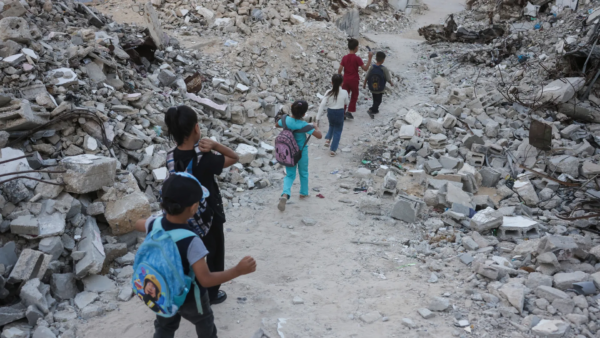
Palestinian children walk to school amid the rubble of destroyed buildings as the academic year begins in Khan Yunis, in the southern Gaza Strip on Sept. 19. (Photo by Bashar Taleb / AFP via Getty Images)
President Trump’s Board of Peace will unveil a six-month, $2.45 billion recovery plan for Gaza at a meeting of its members on Wednesday.
Why it matters: The 66-project proposal offers one of the most comprehensive roadmaps yet for what the early months of post-war reconstruction and governance in Gaza would look like.
- The plan is a result of a year of work by dozens of people both on the Board of Peace, which includes 28 member countries, and in the Palestinian technocratic government.
- It includes projected spending for temporary housing, rubble removal, hospital repairs, economic recovery and the deployment of a multinational security force, according to a copy of the plan obtained by Axios.
- “The plan shows how to stand up a government from nothing, an economy from shambles and a territory from disaster,” a Board of Peace official said.
Yes, but: For the plan to move forward, the Board of Peace needs Israel and Hamas to cooperate.
- While the Netanyahu government has agreed in principle to aspects of the plan that have been previously discussed, it refused to start implementing it, mainly for domestic political reasons ahead of the elections.
- And while Hamas agreed in principle to disarm, it hasn’t been tested yet, partly because Israel won’t implement a 14-day ceasefire before the demilitarization process starts.
- The Board of Peace hopes that after the Israeli elections on Oct. 27 and the formation of a new Israeli government, the Gaza recovery process can finally start.
- But the election is unlikely to yield a clear winner, resulting in a caretaker government and a political stalemate. That could further undermine implementation of the Gaza proposal.
The plan estimates physical damage in Gaza at $35.2 billion and says full recovery and reconstruction will require about $71.4 billion over the next decade.
The plan divides the 66 projects into six areas: infrastructure development, human development, economic acceleration, digital transformation, legal affairs, and peace and security:
Infrastructure accounts for the largest share, at roughly $1 billion, including about $400 million for temporary shelters, $275 million for rubble and unexploded ordnance clearance, $50 million for hospital rehabilitation and $30 million to repair Gaza’s badly damaged road network.
- The plan also calls for repairing border crossings, restoring electricity and water infrastructure, deploying 25,000 portable solar-power kits and permanently filling tunnels beneath sites needed for priority reconstruction projects.
Security-related projects account for roughly $885 million, making them another major component of the proposal.
- The plan allocates about $275 million for a permanent hardened site in Rafah capable of supporting 5,000 personnel from the International Stabilization Force (ISF) and another $140 million to recruit, train, equip and deploy a multinational security contingent.
- Another $120 million would go toward mobilizing Palestinian police. While thousands of Palestinians from Gaza have been selected and vetted to serve in the new Gaza police force, Israel has blocked them from leaving Gaza for training in Egypt.
- $20 million would fund a weapons buy-back program offering incentives for weapons and ammunition to be surrendered by Hamas and members of other armed groups and safely disposed of.
- According to the plan, the Palestinian technocratic government would also eventually take over management of Gaza’s border crossings with Israel and Egypt for both goods and passengers.
What to watch: One of the most immediate priorities is moving Palestinians out of tents.
- Roughly $400 million is earmarked for insulated caravans for displaced Palestinians currently living in tents.
- Separately, the UAE would fund a pilot “Emirati Neighborhood” in the Rafah area designed to house 50,000 people currently living in tents, with independent utilities.
- The plan also allocates roughly $300 million for health, education and welfare programs.
Between the lines: The proposal isn’t limited to emergency relief. It is also intended to establish the infrastructure of a functioning Palestinian administration and restart Gaza’s private sector.
- Projects include a digital ID system, digital payments, 4G connectivity, electronic health and education systems, grants to restart small businesses and a new Gaza investment fund.
- The Board of Peace and the Palestinian technocratic government say recovery should be Palestinian-led and based on “Palestinian ownership.”
What’s next: A key challenge is funding. At the moment, the Board of Peace and the Palestinian technocratic government haven’t secured the entire $2.45 billion.
- But Board of Peace officials say they don’t need the entire sum immediately when the new Palestinian technocratic government enters Gaza.
- The officials expressed confidence that once the political hurdles are cleared, donor countries will step up to fund the various projects.
- Representatives from 35 countries are expected to attend the Board of Peace briefing on Wednesday morning, including from the EU and several of its member states who are not part of the board.
- Trump’s senior adviser and son-in-law Jared Kushner, who spearheaded the administration’s Gaza effort, and White House envoy Steve Witkoff will speak at the event. Board of Peace High Representative Nickolay Mladenov, former British Prime Minister Tony Blair, the head of the Palestinian technocratic government Ali Shaath, ISF Commander Gen. Jasper Jeffers and Board of Peace advisers Yakir Gabay, Liran Tancman, Aryeh Lightstone and Josh Gruenbaum will also brief the participants.
Axios
