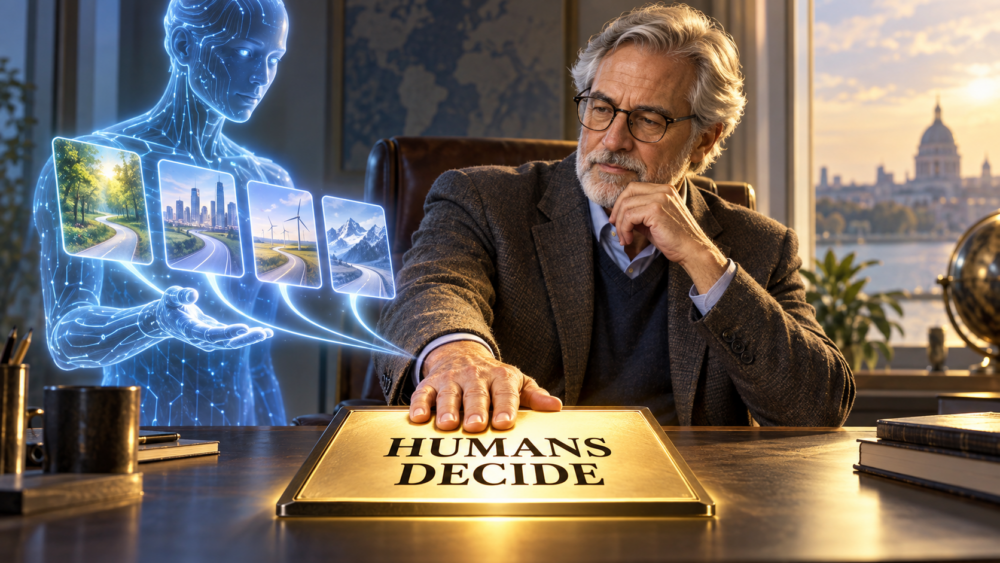
Photo illustration – AI illuminates the possible roads ahead, but human judgment chooses the path.
AI can calculate, analyze and generate possibilities with extraordinary speed. But human beings provide the purpose, make the final decision and accept responsibility for the consequences.
By : Vlad Green- Opinion
Everywhere I go, I hear people discussing artificial intelligence—and much of what I hear is fear.
People ask whether AI will replace human beings, control our decisions or make our intelligence irrelevant. Some speak about it as though a new independent power has suddenly appeared and humanity is about to surrender control.
We need to correct this misunderstanding.
Artificial intelligence can generate an answer. It cannot make that answer wise. It can recommend a course of action. It cannot give that action moral legitimacy. It can imitate reasoning, but it cannot assume responsibility for the consequences.
The final judgment belongs to human beings.
I learned this lesson long before anyone used the term artificial intelligence.
As an engineer in the 1970s, I worked in an era when the slide rule was an essential professional tool. Then electronic calculators became widely available. They were faster and more accurate, and they quickly made the slide rule obsolete.
But calculators did not replace engineers.
A calculator could tell us that two multiplied by two equals four. It could perform in seconds calculations that previously required considerable time. But it could not decide which bridge should be built, whether its design was safe, whether the assumptions entered into the calculation were correct or whether the project served the public interest.
If an engineer entered the wrong figures, the calculator could produce a perfectly calculated wrong answer. The machine performed the calculation; the engineer remained responsible for the judgment.
That distinction is fundamental.
The same fear returned with the personal computer. Accountants worried about spreadsheets. Secretaries confronted word processors. Draftsmen saw computer-aided design enter their profession. Managers discovered that computers could process and organize information faster than any office staff.
Yet the computer did not decide which investment was prudent, which building was beautiful, which employee deserved promotion or which words were honest. It processed what human beings gave it and presented results for human beings to evaluate.
The computer changed the work. It did not inherit the worker’s conscience, accountability or authority.
Artificial intelligence is far more sophisticated, but the governing principle has not changed.
AI can examine thousands of medical reports and identify a pattern a physician might otherwise miss. But the physician must evaluate the patient, consider circumstances the data may not contain and accept responsibility for the treatment.
AI can help an engineer compare hundreds of designs. But it cannot sign the plans, certify public safety or stand before grieving families if the structure fails.
AI can help a judge locate precedents. But it cannot understand mercy, live under the sentence or accept moral responsibility for depriving another human being of liberty.
AI can help a journalist organize information and improve the presentation of an argument. But it cannot decide what that journalist believes, which cause is worth defending or whether publishing a claim is fair.
In every example, AI contributes capability. Human beings supply purpose and judgment.
I experience this directly in my own writing. I bring the idea, the conviction and the life experience. AI helps me organize the argument, challenge weak reasoning, clarify sentences and communicate more effectively. I accept or reject its suggestions. I correct it when it misunderstands. The finished article carries my name because the final judgment is mine.
AI is not the author of my convictions. It is a tool that helps me express them.
People sometimes respond that future AI systems may operate with increasing autonomy. That is possible—but autonomy granted by people is not the same as moral authority.
If a company permits an algorithm to reject a job applicant automatically, human executives made that policy. If a hospital follows an AI recommendation without medical review, human administrators permitted it. If a military allows a weapon to select its own target, human leaders authorized that surrender of judgment.
We should never allow people or institutions to escape accountability by saying, “The computer decided.”
The computer did not establish the rules, purchase itself, deploy itself or grant itself authority. Human beings did. Even the decision to accept an AI recommendation without reviewing it is itself a human decision—and sometimes a dangerously irresponsible one.
This is where society should concentrate its attention. The central danger is not that AI will mysteriously acquire responsibility. It is that people may use AI to avoid their own responsibility.
That is why we need clear safeguards. Important medical, legal, financial, military and governmental decisions must retain meaningful human oversight. People affected by automated decisions should have the right to an explanation and, where appropriate, an appeal to another human being. Companies should be accountable for the systems they deploy. Governments should punish the misuse of AI just as they punish the misuse of other powerful technologies.
AI itself should neither be worshipped nor blamed. It has no conscience to praise and no conscience to punish.
Used wisely, it can expand human capability enormously. It can help discover medicines, prevent accidents, improve education, expose financial fraud and allow ordinary people to use capabilities that were once available only to large institutions. It can free professionals from repetitive work and give them more time for the decisions that genuinely require human understanding.
Used carelessly, it can spread falsehoods, magnify prejudice and produce bad recommendations with impressive confidence. That is precisely why human judgment becomes more important—not less—as AI becomes more powerful.
The calculator required the engineer to understand the problem, not merely press the keys. The computer required the professional to evaluate its output, not merely print it. AI requires all of us to question, verify and decide.
We should therefore stop asking whether AI will replace humanity as though the outcome were controlled by the machine. The real question is whether human beings will use AI intelligently while refusing to surrender their judgment.
Machines can calculate. Machines can process. Machines can generate.
Only human beings can determine what should be done, accept responsibility for doing it and live with the consequences.
AI may offer the answer. Humanity must deliver the verdict.
