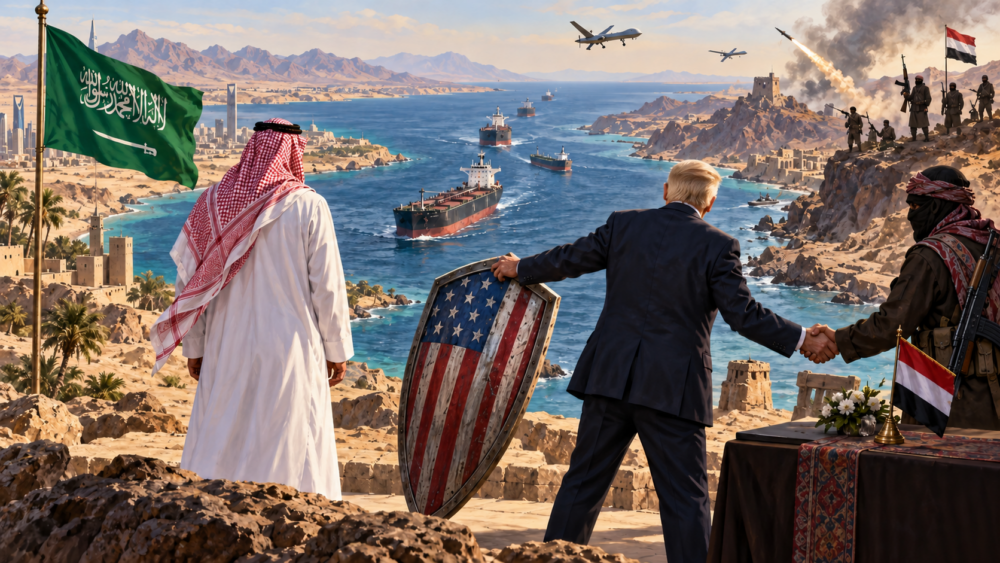
Photo illustration – As the Houthis threaten Saudi Arabia and Red Sea shipping, Washington withdraws its shield from a longtime ally.
Washington is reportedly talking with the Houthis while declining Saudi Arabia’s request for military support. A deal that protects American shipping but leaves Saudi vessels exposed would call the U.S.–Saudi partnership into question.
By : Vlad Green, Opinion
Saudi Arabia has been a close American partner for more than eight decades. Today it faces missile and drone attacks on its territory, threats to its oil infrastructure, and a Houthi advance toward Bab el-Mandeb. Yet reports say that Washington has declined Riyadh’s request to help repel that advance while U.S. officials have met Houthi representatives in Oman.
Why is the United States talking to the force threatening its ally while refusing the help its ally requested?
The answer cannot simply be that diplomacy is preferable to war. Talking to an adversary can be useful. What matters is the bargain being discussed. According to the reporting, the Houthis offered to spare international shipping while reserving the right to target Saudi linked vessels. If Washington accepts safe passage for American ships while Saudi ships remain under threat, it will have secured an exception for itself, not freedom of navigation.
We have seen the danger of allowing an armed force to decide which vessels may pass through an international waterway. Iran has used its position near the Strait of Hormuz to put enormous pressure on Gulf economies. Now the Houthis’ territorial gains along Yemen’s Red Sea coast give them greater power to threaten traffic near Bab el-Mandeb. For Saudi Arabia, these are threats at both ends of its vital energy routes.
The timeline matters. The Houthis said their attacks on Red Sea shipping from 2023 to 2025 were tied to the Gaza war. Those attacks paused after the Gaza truce. Reuters reported in June that the Houthis had largely stayed out of the wider war that began with the U.S.–Israeli attacks on Iran in February 2026. The current campaign against Saudi Arabia is a new escalation. It should be judged for what it is doing now, not dismissed as another chapter of the Gaza shipping crisis.
Washington may fear opening another military front. That is a serious concern. But restraint requires a strategy for protecting an ally and keeping a major shipping route open. Saudi Arabia needs to know whether the United States will help defend it against attacks, provide the support it has requested, and reject any arrangement that treats Saudi vessels as acceptable targets.
The Trump administration itself restored the Houthis’ Foreign Terrorist Organization designation in 2025. That designation does not prohibit talks. It does make the administration’s choices harder to explain: what is the purpose of condemning the Houthis’ conduct if Washington then accepts a shipping arrangement that leaves its ally vulnerable to that same conduct?
The United States does not have to agree to every Saudi request for military action. But it owes Riyadh a clear answer and a credible plan. It cannot ask Gulf partners to host American forces, rely on their cooperation in a regional war, and then appear willing to bargain over the safety of their ships without them.
If the U.S. protects its own vessels while leaving Saudi Arabia to face the Houthis alone, Riyadh will call it betrayal. So will many others watching whether America’s security partnerships still mean what Washington says they mean.
