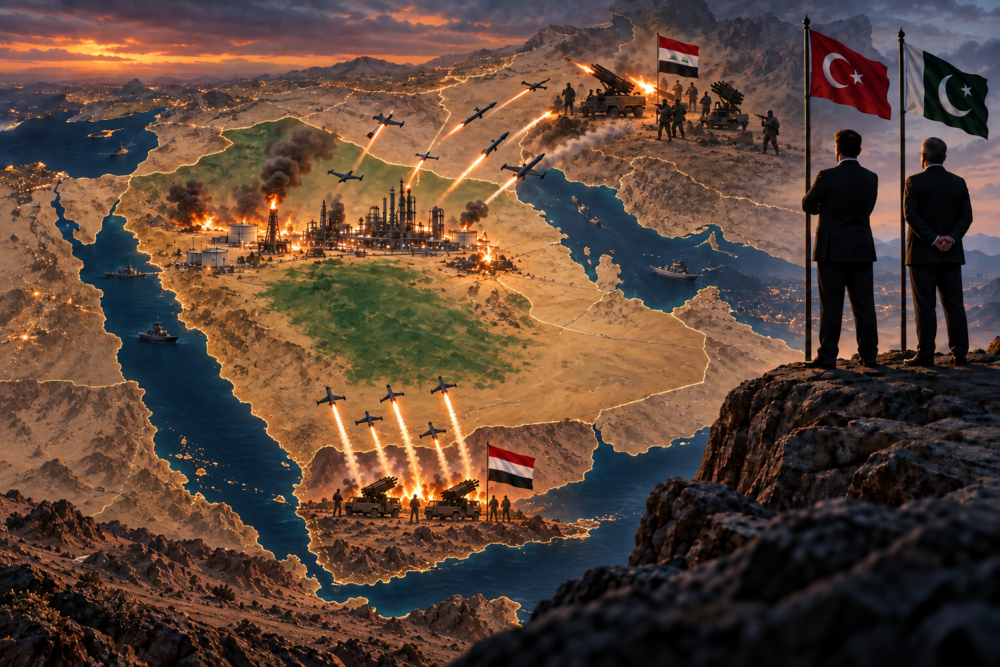
Photo illustration- As Iran-backed forces attack Saudi Arabia from Yemen and Iraq, its new defense partners, Pakistan and Türkiye, remain spectators.
The agreement says that any armed attack against one member will be treated as an attack against all. Saudi Arabia has been attacked repeatedly. Diplomatic statements alone cannot constitute credible collective defense.
By: Ya Libnan Editorial Board, Opinion
Only weeks after Saudi Arabia, Pakistan and Türkiye signed their celebrated Joint Defence Agreement in Mecca, the pact has already encountered the very test it was supposedly created to meet.
On September 8, Iran-backed Houthi forces launched a major barrage of drones and missiles against Saudi Arabia, reportedly targeting military and energy infrastructure. Further attacks and Houthi advances in Yemen have increased the danger to Saudi territory, oil facilities and shipping through the Red Sea.
Yet neither Pakistan nor Türkiye has launched military operations alongside Saudi Arabia. Both governments have condemned the attacks and expressed solidarity with Riyadh, but solidarity expressed in communiqués is not the same as collective defense.
This raises a simple and unavoidable question: What exactly did Pakistan and Türkiye promise Saudi Arabia in Mecca?
An agreement written in unmistakable language
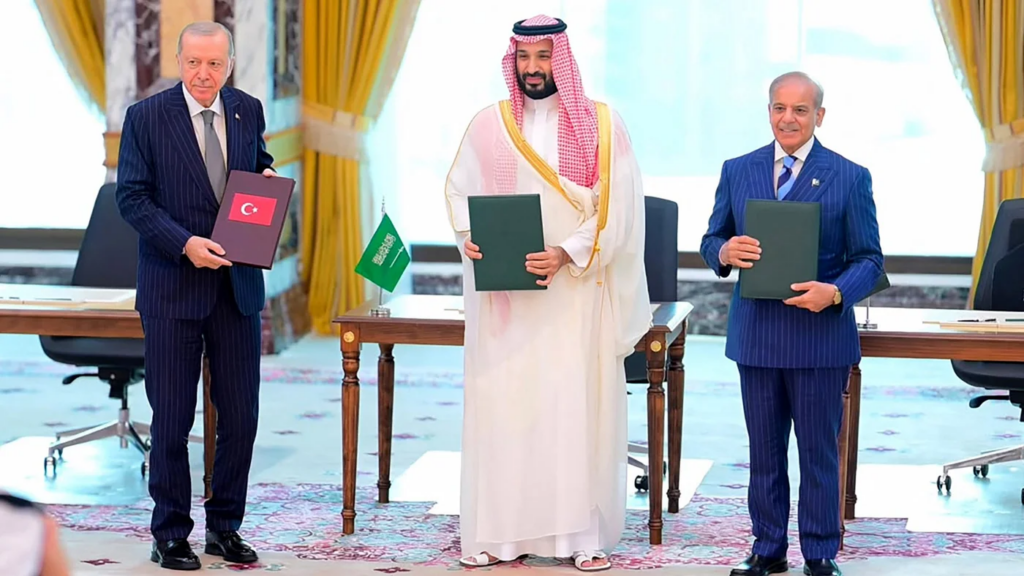
Saudi Crown Prince Mohammed bin Salman, (C) Turkish President Recep Tayyip Erdogan(L) and Pakistani Prime Minister Shehbaz Sharif (R) posing after signing the Mecca Joint Defence Agreement in Mecca, Saudi Arabia, on 7 August 2026 (Handout/Pakistan prime minister’s office/AFP)
Signed on August 7, the Mecca Joint Defence Agreement declares that any armed attack against one of the three signatories will be considered an attack against all. That language immediately drew comparisons with Article 5 of the NATO treaty.
The agreement does not say that the attacker must be a recognized government. It does not exempt militias, terrorist organizations or proxy forces. It says any armed attack.
Houthi missiles and drones have attacked Saudi territory. The condition described in the agreement has therefore been met, regardless of whether Saudi Arabia has formally invoked the pact or requested a particular military response.
This does not necessarily mean that Pakistani and Turkish aircraft must begin bombing Yemen tomorrow. Even NATO’s Article 5 allows every member to determine what action it considers necessary. Assistance can include intelligence, air and missile defense, naval protection, logistics, weapons, troop deployments or, when required, direct military force.
But flexibility cannot become an excuse for paralysis. If collective defense produces nothing more than condemnations when one member is struck by missiles and drones, it is not much of a deterrent.
These are not isolated Yemeni attacks
The Houthis are not operating with homemade slingshots. Their ability to threaten Saudi cities, energy installations and shipping has been built with extensive Iranian support.
Iran has supplied weapons, technology, training and strategic assistance to the Houthi movement. Investigators have documented Iranian components and design similarities in missiles and drones used by the group. The Houthis form part of the regional network through which Tehran projects power while reducing the danger of direct retaliation against Iran itself.
We may not possess public evidence proving that Tehran personally selected every Houthi target or authorized every launch. But that narrow question should not obscure the strategic reality.
A missile does not become less Iranian merely because a Houthi presses the launch button.
When Iran equips and enables a force that attacks Saudi Arabia, it cannot escape all responsibility simply because its own flag is absent from the launch site. These should be understood as Iranian-enabled proxy attacks that advance Iran’s regional objectives.
Recent reports make the situation even more disturbing. During secret discussions in Oman, Houthi representatives reportedly assured American officials that they would not attack American, Israeli or other commercial vessels, while reserving the right to target Saudi ships.
If those reports are accurate, the calculation is chillingly clear: avoid provoking the powers most capable of devastating retaliation while concentrating pressure on Saudi Arabia.
This follows a familiar pattern. Iran has repeatedly used armed partners to pressure Arab states while preserving plausible deniability. A defense agreement designed for the Middle East should have anticipated proxy aggression, because proxy aggression is among the region’s most persistent security threats.
Pakistan’s predictable dilemma
Pakistan now says that no military response under the pact has been discussed. Islamabad has condemned the attacks and attempted to persuade Iran to restrain the Houthis, but it appears determined to avoid becoming a direct combatant.
Its hesitation is understandable—but it was also entirely predictable.
Pakistan shares a long and sensitive border with Iran. It faces domestic security pressures, economic hardship and serious military commitments elsewhere. In 2015, Pakistan’s parliament rejected a Saudi request to join the intervention in Yemen and instead called for neutrality.
Pakistan also wants Saudi investment, energy assistance and defense contracts. It evidently desired the economic, strategic and diplomatic benefits of the Mecca agreement without surrendering its freedom to avoid another Middle Eastern war.
But Riyadh is entitled to ask why these reservations were not reflected honestly in the agreement’s language. A country should not promise that an attack against its partner will be treated as an attack against itself—and then behave as though the attack concerns someone else.
Türkiye wants influence without confrontation
Türkiye’s calculation is similar. Ankara wants Saudi investment, defense-industrial cooperation and a leading position in any future regional security architecture. Its military experience, drone industry and NATO membership gave the Mecca pact much of its apparent credibility.
At the same time, Türkiye maintains important political and economic relations with Iran and does not want to be pulled into a direct confrontation with Tehran or its proxies. Turkish officials emphasized almost immediately that the agreement was not directed against Iran or any other specific country.
That qualification may have reassured Tehran. It may also have weakened the deterrent message the pact was supposed to send.
Türkiye could contribute intelligence, air-defense systems, drones, naval patrols or logistical support without launching a wider war. But it should publicly explain what assistance it is providing and what additional attack would cause it to act more forcefully.
A pact must deter before it is forced to fight
Saudi Arabia may also be exercising restraint and may not yet have formally requested military intervention. Riyadh has good reason to avoid a conflict that could inflict further damage on its cities, oil infrastructure and ambitious economic transformation.
But the three governments cannot allow procedural ambiguity to conceal the larger failure. The purpose of a defense pact is not simply to organize retaliation after disaster. Its first purpose is to deter the attack from occurring.
Deterrence requires clarity. An aggressor must believe that attacking one member will bring meaningful consequences from the others. Instead, the Houthis—and their Iranian supporters—are watching Pakistan and Türkiye emphasize all the reasons they do not want to fight.
The three signatories should urgently clarify the pact by answering several questions:
- Has Saudi Arabia formally requested assistance under the agreement?
- What assistance have Pakistan and Türkiye already provided?
- Does collective defense include joint interception of missiles and drones?
- Will the partners help protect Saudi shipping and energy infrastructure?
- What additional action would trigger direct military participation?
- Does the agreement explicitly cover attacks conducted by proxies?
These questions do not require reckless escalation. They require honesty.
Pakistan and Türkiye were eager to stand beside Saudi Arabia for the signing ceremony. Now they must demonstrate that the agreement means something after the photographs have been taken.
Otherwise, Saudi Arabia may reach an uncomfortable conclusion:
with partners like these, it hardly needs enemies.
