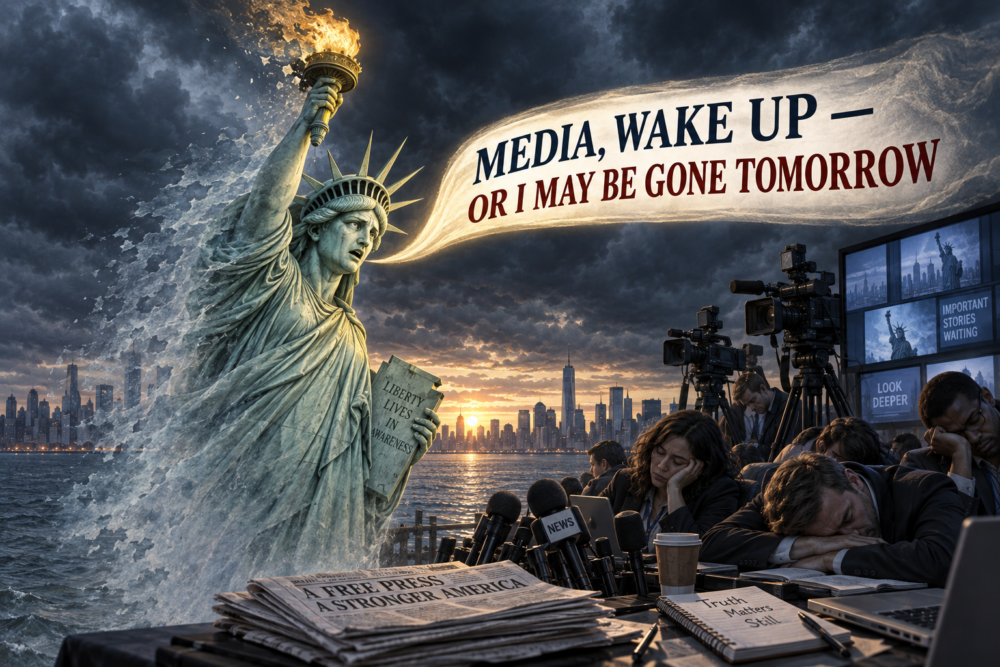
Photo illustration- As the media concentrates on legality, debt and inflation, the Statue of Liberty warns: Wake up and defend democracy—before freedom itself disappears.
The legality, inflationary impact and enormous cost of Trump’s promised payment matter. But the gravest question is whether the promise of public money is being used to help one political party retain power—and undermine American democracy.
By: Vlad Green , Opinion
President Donald Trump has promised to issue a $5,000 “dividend” to every adult American citizen if Republicans retain control of both the House of Representatives and the Senate in the looming midterm elections.
“If the Republicans win, you win with us, and you get $5,000,” Trump told his audience.
America’s largest and most influential news organizations—including Reuters, AP, CNN, CBS and NBC—quickly reported the announcement. Their coverage focused primarily on whether the proposal is legal, whether Congress would approve it, how it would be financed, how much it would add to the national debt and whether injecting more than $1 trillion into the economy would fuel inflation.
All these questions are legitimate.
But they are not the most important question.
What does this promise mean for American democracy?
Why are America’s most powerful media organizations reluctant to confront that issue directly?
A sitting president has told the American people that if they return his political party to complete control of Congress, the government will send every adult citizen $5,000.
The money would not come from Donald Trump. It would not come from the Republican Party or its campaign funds. It would come from the United States Treasury—from money belonging to the American people themselves.
This is what makes the promise so disturbing.
Trump is not merely proposing a new economic policy and asking Congress to debate it. He has explicitly connected the payment to one electoral outcome: Republican control of both chambers of Congress.
The message could hardly be clearer:
Keep my party in power, and you will receive $5,000.
Legal experts may argue that this does not meet the technical definition of vote-buying because the proposed payment would apparently go to all adult citizens, regardless of how—or even whether—they voted.
That legal distinction is important, but journalism should not end where the legal analysis ends.
Something can escape the narrow legal definition of vote-buying while still violating the spirit of free democratic choice.
The greater issue is the precedent being established. If a president can promise every citizen $5,000 on the condition that his party controls Congress, what prevents the next president from offering $10,000?
What prevents future political leaders from conditioning tax rebates, healthcare subsidies, government contracts, disaster assistance or other public benefits on the continued electoral success of their party?
At that point, elections would no longer be contests between competing ideas and national visions. They would gradually become auctions in which politicians bid for votes using money that already belongs to the voters.
That is not democracy.
It is political power financed by the public treasury.
Congress holds the constitutional power of the purse. A president cannot simply withdraw more than $1 trillion from the Treasury and distribute it under his personal name. Yet calling the payment a “Trump Dividend” creates the impression that the money is a personal gift from the president rather than a public expenditure requiring congressional authorization.
Why is the American media not sounding the democratic alarm?
Are journalists afraid of being accused of political bias? Are major news organizations intimidated by repeated attacks against the press? Are corporate owners reluctant to confront the administration too forcefully?
Or has the media simply become so accustomed to extraordinary political conduct that it no longer recognizes how extraordinary—and dangerous—it is?
We cannot know whether fear is the explanation. But whatever the reason, the failure to examine the democratic implications is deeply troubling.
A free press has responsibilities beyond reporting the estimated price of a government program. Its mission is not merely to calculate how much a proposal will add to the debt or how many percentage points it might add to inflation.
Its higher responsibility is to defend the public’s right to make an informed, independent and uncoerced political choice.
When a president connects a large government payment directly to his party’s victory, the press must ask whether the freedom of the voter is being compromised.
America has not suddenly become a dictatorship. Its courts, elections, state governments and constitutional institutions continue to exist. But dictatorships and one-party systems do not always arrive overnight through military coups.
Democracy can be weakened gradually.
It weakens when political loyalty becomes more important than loyalty to the Constitution. It weakens when government institutions are transformed into partisan instruments. It weakens when citizens are encouraged to believe that their financial wellbeing depends on keeping one party permanently in power.
And it weakens when the nation’s most powerful media organizations describe each individual incident without helping the public recognize the larger pattern.
This should not be treated as a partisan concern.
Republicans should be just as alarmed as Democrats. Any power accepted when one’s preferred party controls the government can later be used by the opposing party.
If Republicans defend a $5,000 payment conditioned on their electoral victory today, they cannot credibly object when a future Democratic president promises even more money to secure Democratic control of Congress.
America’s constitutional system was designed to prevent any president or political party from treating the government as its private property. The Treasury belongs neither to Republicans nor Democrats. It belongs to the American people.
The United States calls itself the leader of the free world. It urges other nations to conduct free elections, respect political opposition and protect democratic institutions.
But democratic leadership must begin at home.
How can America credibly defend freedom abroad if its own political leaders place a financial reward beside the name of their party—and its most influential media organizations fail to confront what that means?
The real question is not simply whether America can afford these checks.
It is not merely whether the checks would increase inflation.
It is not even only whether the proposal is technically legal.
The real question is whether American democracy can afford the precedent.
Can a vote remain genuinely free when a president places a $5,000 government promise beside the name of his political party?
America’s media should have the courage to ask that question.
A citizen’s vote is not worth $5,000.
It is priceless.
What happened to America?
