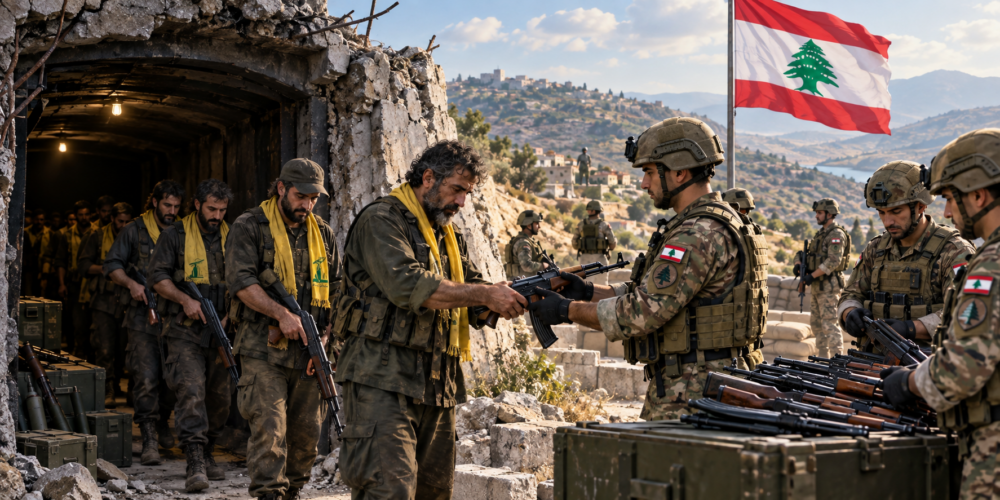
Photo illustration- Hezbollah cannot hide underground forever. The time has come to emerge, hand its weapons to the Lebanese Army and allow the state to reclaim Lebanon.
After spending two decades and enormous Iranian resources building a subterranean fortress, Hezbollah discovered that tunnels cannot protect it—or Lebanon—from the consequences of maintaining a private army
By : Ya Libnan Editorial Board, Opinion
For decades, Hezbollah tried to persuade the Lebanese people that its underground fortifications were invulnerable—that its tunnels, weapons depots and secret command centers gave it a permanent military advantage over Israel.
The battle for the Ali al-Taher ridge has shattered that illusion.
On September 3, the Israel Defense Forces announced that they had achieved “operational control” of the strategically important ridge, both above and below ground. According to the IDF, some Hezbollah fighters were killed while others fled, and two major underground routes were cleared. Israel said it was continuing efforts to neutralize the remaining infrastructure.
Hezbollah has not accepted Israel’s version of events. Its officials have questioned whether Israeli forces actually entered and occupied the entire underground complex. Their doubts cannot simply be dismissed: Reuters reported that a Lebanese military officer said Israel had seized the southern entrances and was monitoring the northern entrances by drone, but that it remained unclear how deeply Israeli troops had penetrated. Reuters also said it could not independently verify the ridge’s status.
An Associated Press photographer who visited nearby Kfar Rumman also reported seeing no visible Israeli military presence on the ridge. But an absence of visible troops does not prove that Hezbollah remains in control of its tunnels—particularly when Israeli surveillance, bombardment and ground operations have apparently prevented the facility from functioning as intended.
Whatever the final military assessment, one fact is already clear: Ali al-Taher has failed to provide Hezbollah with the permanent protection its leaders promised.
A fortress two decades in the making
Ali al-Taher is not an insignificant hill. Located approximately 10 kilometers from the Israeli border, the ridge commands views of a broad section of southeastern Lebanon. It overlooks villages and roads leading toward Nabatieh and connects the border region with Iqlim al-Tuffah, an important Hezbollah logistical and operational area.
Beneath it, Hezbollah reportedly constructed an elaborate military complex with Iranian assistance. According to the IDF, the facility contained command centers, weapons-storage rooms, generators, living quarters, showers and a kitchen, allowing fighters to remain underground and conduct operations for extended periods.
Israel says the network was planned and financed by Iran and took approximately 20 years to construct.
Two decades of digging. Two decades of financing. Two decades of accumulating weapons and preparing for war.
Yet the complex was eventually isolated, penetrated and prevented from carrying out the mission for which it had been built.
That is the lesson Hezbollah does not want the Lebanese people to discuss.
Tunnels cannot win Lebanon’s wars
Hezbollah official Mahmoud Qamati acknowledged the ridge’s importance in late August while attempting to minimize the consequences of losing it.
“Ali Taher is important, but if it is lost it does not mean the end of Hezbollah,” he said.
Hezbollah MP Ihab Hamadeh offered a similar defense after Israel’s announcement, arguing that losing Ali al-Taher would be neither a military disaster nor “the end of the road” for Hezbollah.
No one claimed that losing one ridge would automatically mean the end of Hezbollah. That is not the real issue.
The issue is what Ali al-Taher tells us about Hezbollah’s entire military doctrine.
A fortress that took two decades to build can be surrounded. Its supply routes can be cut. Its entrances can be monitored. Its fighters can be trapped underground. Its weapons can be destroyed, and the villages around it can be devastated.
Hezbollah can build more tunnels, but it cannot remain underground forever. Fighters need food, water, ammunition, communications and access to the outside world. Once those lifelines are severed, an underground fortress can become a prison—or a grave.
Most importantly, tunnels cannot protect Lebanon’s people. They cannot rebuild destroyed villages, return displaced families to their homes, restore the economy or recover territory occupied by Israel.
Instead, Hezbollah’s private arsenal gives Israel the justification to remain in Lebanon and continue its military operations.
The true defense of Lebanon
The defense of Lebanon cannot depend upon secret tunnels financed by Iran and controlled by a political party. It must depend upon the Lebanese state, the Lebanese government and the Lebanese Army.
Hezbollah was reportedly asked to hand Ali al-Taher over to the Lebanese Army before Israel seized the initiative. It refused, allegedly fearing that Israel might subsequently take the ridge from the Army.
But that refusal produced the very outcome Hezbollah claimed to fear.
Instead of transferring the ridge peacefully to Lebanon’s legitimate armed forces, Hezbollah continued defending its private military installation. The result was more fighting, further destruction and an expanded Israeli presence on Lebanese territory.
This cycle must end.
Ali al-Taher should not become another excuse for Hezbollah to dig deeper, acquire more weapons and prepare Lebanon for another war. It should become the moment Hezbollah finally recognizes that its military project has reached a dead end.
Iran can provide money, missiles, drones and engineering assistance. It cannot provide security to Lebanon. Every Iranian-financed fortress eventually turns the surrounding Lebanese community into a battlefield.
Lebanon does not need another underground command center. It needs one sovereign government, one national defense policy and one army exercising authority over every inch of Lebanese territory.
Now that Hezbollah has discovered that it cannot hide underground forever, it should find the courage to come above ground and face the truth.
The time for hiding is over.
The time for Hezbollah to hand its weapons and military installations to the Lebanese Army has arrived.
