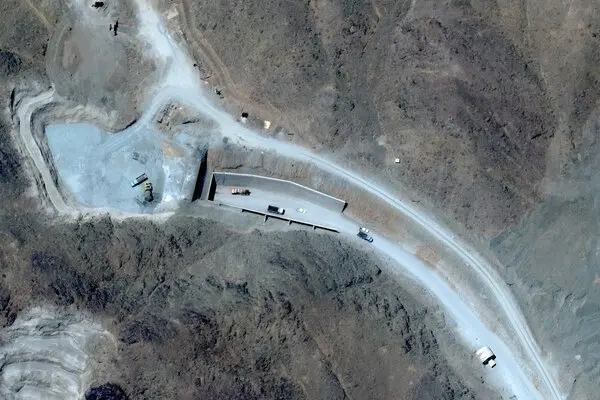
President Trump told reporters he’s considering striking Pickaxe Mountain, a subterranean site in Iran that some analysts believe could be part of the country’s nuclear program
HERE IS THE LATEST-
- President Trump called the war with Iran “small potatoes” and defended his vice president, who said Thursday it shouldn’t be called a war, saying, “A lot of people don’t call it a war. I call it a military conflict.”
- U.S. gas prices surged ahead of Labor Day weekend, with diesel hitting a record $5.85 a gallon Friday and AAA predicting travelers will face the highest prices ever seen over the holiday weekend.
- Despite President Trump insisting the amount of oil flowing out of the Persian Gulf has rebounded, traffic through the Strait of Hormuz remains well below pre-war levels. Shipping data firm Lloyd’s showed 102 ships transited the waterway last week, compared with 126 the week before — and that’s compared with pre-war levels of about 150 ships daily.
U.S. approves sale of arms to Saudi Arabia
The United States on Friday announced the approval of a $5 billion sale of bombs, guidance kits and other equipment to Saudi Arabia, which has been repeatedly attacked during the U.S.-Israeli war against Iran.
“The proposed sale will improve Saudi Arabia’s airborne defense capability to counter current and future regional threats, strengthen its homeland defense, and improve interoperability with systems operated by US forces and other Gulf region partners,” the U.S. State Department said in a statement.
The sale will also “support the foreign policy goals and national security objectives of the United States by improving the security of a Major non-NATO Ally,” the department said.
Saudi Arabia has been targeted with drone and missile strikes by Iranian forces and Yemen’s Tehran-backed Houthi rebels since the United States and Israel launched their war against Iran earlier this year.
The State Department has notified Congress of the proposed sale of the bombs to Riyadh, which still needs to be approved by U.S. lawmakers.
Trump says U.S. may hit Iran’s alleged Pickaxe Mountain nuclear site “very soon”
President Trump told reporters he’s considering striking Pickaxe Mountain, a subterranean site in Iran that some analysts believe could be part of the country’s nuclear program — reiterating a threat the president has made for months.
“Iran will not have a nuclear weapon. We’ve stopped them from having. We may hit Pickaxe very soon because if there was anything going on with Pickaxe,” the president told reporters. “We know everybody that’s moving at Pickaxe. We know everybody that’s moving everywhere all over Iran, and if anything goes bad, we hit them. We hit them hard.”
“Small potatoes” for U.S.
President Donald Trump said Friday the Iran war was “small potatoes” for the United States, a day after Vice President JD Vance said he wouldn’t describe the conflict as a war.
“A lot of people don’t call it a war. I call it a military conflict because it’s small potatoes for us. It’s not a big thing. We did Venezuela, and we did this,” Trump told reporters when asked about Vance’s comments.
In a post on Truth Social on Friday morning, though, Mr. Trump referred to it as a war multiple times.
Asked if the war would be over by the midterm elections, Vance disputed whether the conflict was still a war.
“I wouldn’t call it a war,” Vance said Thursday during a White House news briefing. “Right now, there is no active shooting. I recognize there have been places where this has flared up.”
The vice president also said major combat operations ended after about six weeks. An Air Force email from August, obtained by CBS News, shows the Pentagon was instructing personnel to stop referring to the ongoing U.S. military operations in Iran as “Operation Epic Fury” — three months after the Trump administration declared it had ended.
U.S. hopes Israeli release of prisoners builds momentum for peace deal
The U.S. Embassy in Beirut called the decision by Israel to release prisoners from Lebanon a “positive step” as the two sides work to fulfill a deal bartered by the U.S. earlier this summer.
“We welcome Israel’s release of prisoners as part of the Lebanon-Israel Trilateral Framework,” the embassy said on X. “This is a positive step. We urge both sides to continue to build on this momentum ahead of the next round of talks.”
Israel freed four prisoners from Lebanon on Friday, one day after freeing the first prisoner as part of the trilateral agreement signed between the U.S., Israel and Lebanon in late June. The 13th point in the 14-point agreement agreed both sides would “pledge to work towards the search for and return of remains and the release of detainees.”
In return for the prisoners released by Israel, Lebanon said it would search for the bodies of Jewish Lebanese citizens from the Lebanese civil war fought in the 1970s and ’80s.
The implementation of key provisions in the trilateral agreement have been slow to come to reality. The biggest objective was for Israeli forces to exit southern Lebanon and hand over security to the Lebanese army. However, this would only occur once the Iran-backed Hezbollah militia in the country surrendered its weapons and exited the security zone.
Hezbollah, which was not party to the trilateral agreement, has not disarmed and has continued to carry out occasional attacks on Israeli soldiers, largely making the agreement moot.
U.S. issues new sanctions on Turkish financial institution tied to Iran

The U.S. issued sanctions Friday against a Turkish financial firm that the U.S. Treasury alleges is connected to Iran’s Revolutionary Guard.
Golden Global Yatirim Bankasi Anonim Sirketi, which is based in Turkey, allegedly has facilitated tens of millions of dollars in transactions to the Islamic Revolutionary Guard Corps, according to the Treasury.
The Treasury called the bank a “critical financial lifeline” for the Iranian regime.
“Financial institutions continue to find out the hard way that we are serious about Operation Economic Outcast,” Treasury Secretary Scott Bessent said in a statement. “While we hope no more banks will need to be sanctioned, that ultimately depends on how quickly the international community comes to its senses and ceases support of the murderous Iranian regime. We know who you are, we know where you are, and we will continue to take action together with our allies and partners until we have buried the head of the Iranian snake.”
The Trump administration recently sanctioned the United Arab Emirates branches of Banque Misr, which is based in Egypt. The sanctions only target the ones based in the UAE, which the U.S. also accused of being a lifeline to Iran’s economy.
Iran’s president says government will manage economic concerns, won’t raise gas prices
Iranian President Masoud Pezeshkian told Iranian state TV that the government “is not seeking to impose any order or decision on the people” when it comes to managing growing economic concerns for Iranians.
Pezeshkian said the public should be prepared to manage energy consumption and said the government is not currently planning to raise gas prices. He said fuel consumption would instead be managed through non-pricing measures.
“The government’s policy is to manage and control consumption using mainly non-price tools and policies, and under no circumstances should decisions in this area be made in a way that exposes society to sudden and shocking behavior,” Pezeshkian told Iranian state TV.
“Every amount of savings and revenue resulting from reduced gasoline consumption will be spent on strengthening the electronic food voucher program, and no other use will be considered for these resources,” he said.
The Iranian currency has collapsed . The US dollar is now worth over 2.2 million Iranian rials on the black market . In 1978 and prior to the 1979 Islamic revolution the US dollar was worth less than 70 rials. Many believe that Iran is heading the Venezuelan way , where it takes over a billion old Bolivars to buy one US dollar
Iran army spokesman says U.S. and Israel failed to achieve their key war objectives
Iranian army spokesman Brig. Gen. Mohammad Akrami-Nia argued Friday that the U.S. and Israel had failed to achieve their primary objectives in the war.
“The enemy had set many objectives in its attack on Iran, including the destruction of missile and nuclear capabilities, overthrowing the system and, of course, the partition of Iran. But it failed to achieve all of these objectives,” he declared in a statement relayed by state news agency IRNA.
Akrami-Nia said Iran’s enemies had made several miscalculations, including “not correctly understanding the Iranian people” and “not correctly understanding the military capabilities of the Islamic Republic of Iran.”
He also said the U.S. had failed to anticipate Iran’s ability to control the globally crucial shipping lanes through the Strait of Hormuz, and had failed to secure support from its NATO and other allies ahead of the war.
Weaker than Ever
Yesterday Israeli Prime Minister Benjamin Netanyahu voiced confidence that Iran’s regime could soon fall, saying it was weaker than ever as the United States resumed attacks.
“This regime is currently teetering. It is weaker than ever. It is fighting for its survival,” Netanyahu said at an event with Israeli military leaders.
“I am convinced that we can remove this threat once and for all, that is, to overthrow this regime. That is the central task that still lies ahead of us, but it is close. It is not impossible. It is within reach,” he said.
“If they’re not attacking us, it is not by chance. They attack everyone, but not us,” Netanyahu said of Iran. “… They know our power, the strength of our arms, and our determination.
Iranian officials acknowledge “economic pressure on the people” due to U.S. “severe sanctions”
An Iranian government spokeswoman acknowledged Friday that the country is facing economic pressure and shortages, insisting that officials do not deny the difficulties confronting regular Iranians.
Fatemeh Mohajerani, speaking at the opening of a 64-bed hospital in the western Ilam Province, said U.S. sanctions had impacted the implementation of infrastructure projects across the country.
“The government does not deny the economic pressure on the people and the shortages, and whenever we have spoken to the people honestly and transparently, the people have also cooperated with the officials,” she said, according to Iran’s state news agency IRNA.
She said delays in completing infrastructure projects “should not be attributed to the inefficiency of managers, because the severe sanctions have affected the process of securing resources and implementing projects.”
Mohajerani said Iran’s government would continue efforts to complete unfinished projects despite the constraints.
Iran’s Central Bank Governor Abdolnaser Hemmati, meanwhile, was quoted on Friday as telling state television that the bank would intervene in the foreign currency exchange market “in a timely and forceful manner” when necessary, acknowledging that the war with the U.S. had caused “abnormal fluctuations in the market.”
“Whenever rates move away from economic realities, intervention will take place so that market traders do not regard the fluctuations as one-way,” he said, without laying out any specific plans.
The value of Iran’s currency, the rial, has been falling for years under foreign sanctions pressure, and the U.S. military blockade of Iranian oil exports has depleted it further and sent inflation to record levels in the Islamic Republic. As of Friday, one U.S. dollar was worth a record 2.2 million rials on the black market, which is how most Iranians and visitors to the country access foreign currency.
Lebanon’s leader thanks Trump and U.S. as Israel hands over 5 former detainees
Lebanese President Joseph Aoun thanked President Trump and the U.S. for “all the efforts and initiatives” that on Friday “led to the release of the first group of Lebanese detainees held by the Israeli government.”
Israel handed over one former detainee on Thursday and four more Friday, the International Committee of the Red Cross, which acted as an intermediary for the transfers, confirmed in a statement Friday.
The five were among about 30 people from Lebanon who have been detained by Israel before and during its war against the Iran-backed Hezbollah group, according to reports by The Times of Israel and the BBC.

The Israeli military released four individuals detained in southern Lebanon, handing them over to the International Committee of the Red Cross (ICRC) in the border town of Naqoura, Lebanon, Sept. 4, 2026. The Lebanese Army subsequently received the released individuals from the ICRC in the Mansouri area in southern Lebanon.Houssam Shbaro/Anadolu/Getty
“Many families in Lebanon are still waiting for answers about the fate of loved ones who may be detained, deceased or otherwise unaccounted for,” the ICRC said in its statement, noting that it “continues to engage with the families themselves and remains determined to clarify the fate of their loved ones.”
The ICRC also said it had not been given access to “detainees held in Israeli places of detention, including Lebanese nationals,” since the war in Gaza started in October 2023, and it reiterated “the requirement to receive information on conflict-related detainees and to be granted access to them.”
In his statement, Lebanon’s president called the release of the five nationals this week a first step to reaffirm “the effectiveness of the firm Lebanese position” as his government works toward “the restoration of full Lebanese sovereignty.”
Israel’s government announced the release on Thursday, saying interrogations determined the five former detainees were “civilians who are not members of any terrorist organization, have not engaged in terrorism, and there is no reason to continue holding them in Israel.”
Israeli forces have occupied a strip of land stretching about 6 miles into Lebanese territory from Israel’s border. Israeli officials have said the troops will remain in the “security zone,” and not allow the thousands of Lebanese residents forced to evacuate from it return until the threat posed by Hezbollah is eliminated.
CBS
