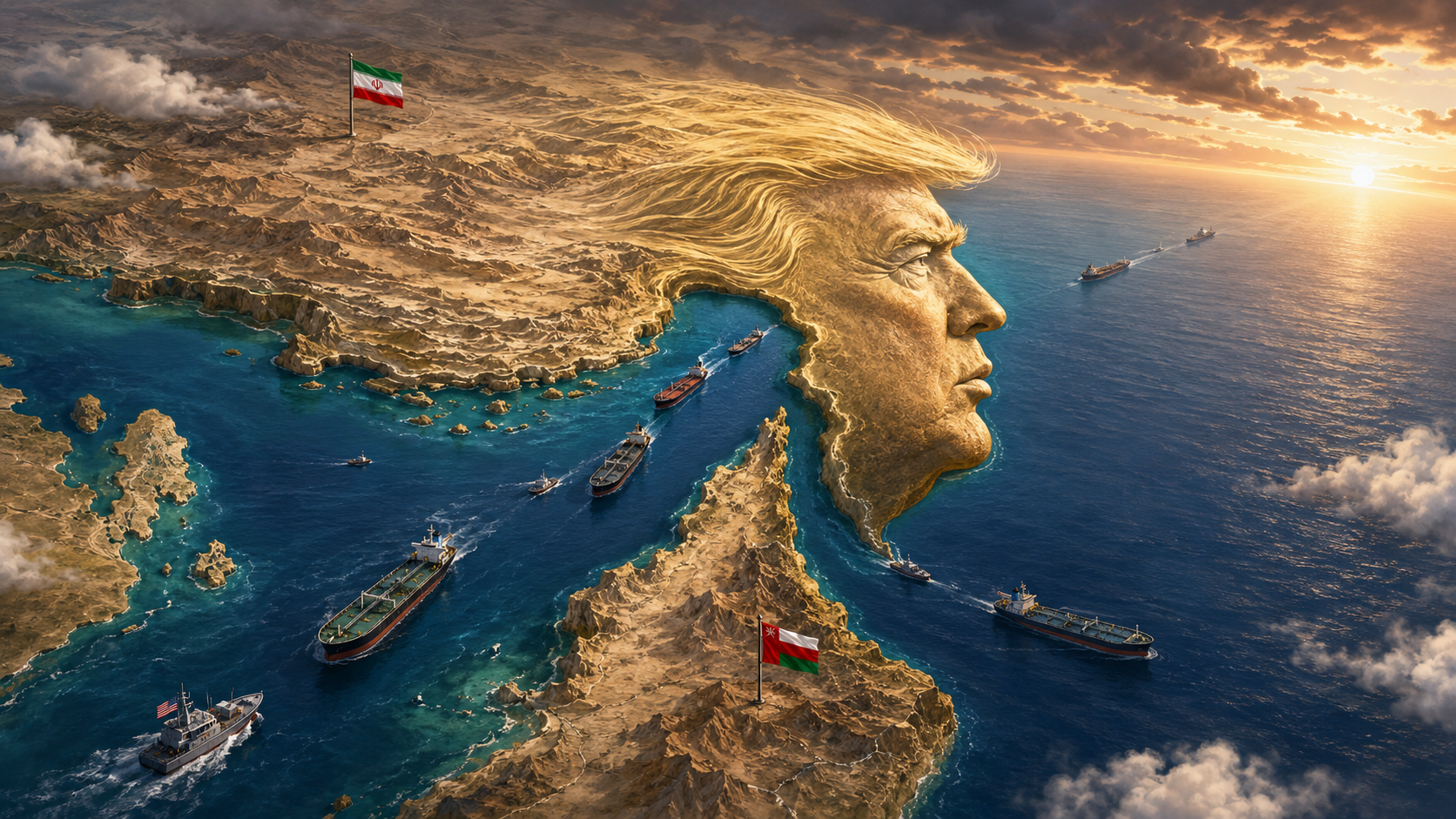
Photo illustration- Trump can put his name on Hormuz only by earning it—through permanent freedom of navigation, not ownership, tolls or temporary agreements.
If President Trump wants history to associate his name with the Strait of Hormuz, he must transform it from an Iranian instrument of blackmail into a permanently open international waterway.
By : Ya Libnan Editorial Board, Opinion
President Donald Trump has suggested that the Strait of Hormuz could one day bear his name. His critics will dismiss the idea as another exercise in branding. His supporters may embrace it immediately. Both reactions miss the more important question:
What would Trump have to accomplish to earn that distinction?
The answer is not to seize the strait, rename it by decree or replace an Iranian toll collector with an American one. Iran and Oman remain the sovereign states bordering this waterway. The name would have meaning only if Trump succeeds in securing something the world has repeatedly failed to guarantee: permanent, nondiscriminatory and uninterrupted freedom of navigation through one of the most important maritime passages on Earth.
At present, that achievement remains far away.
Iran has expanded its blacklist of commercial vessels barred from the strait to 56 ships. The list reportedly includes crude-oil tankers, liquefied-natural-gas carriers and vessels connected to major regional shipping companies. Tehran has even threatened ships that cooperate with blacklisted vessels through ship-to-ship transfers. Reuters
This is not maritime regulation. It is political coercion dressed up as administration.
Traffic figures show the consequences. Only four commodity vessels reportedly crossed the strait on Tuesday, compared with a ten-day average of approximately 13. Before the conflict, nearly one-fifth of global oil shipments passed through Hormuz. Reuters
When a regional power can decide which ships may sail, which flags are acceptable and which countries deserve access, the entire world economy becomes hostage to its political agenda.
The Islamic Revolutionary Guard Corps has spent years turning geography into a weapon. Mines, drones, missiles, seizures, blacklists, navigation interference and threats against crews all serve the same purpose: convincing the world that passage through Hormuz is a privilege Iran may grant, withdraw or sell.
It is not.
The International Maritime Organization has reaffirmed that arrangements concerning Hormuz must preserve the nondiscriminatory and unimpeded right of transit passage through the internationally recognized traffic-separation scheme. That principle must become the foundation of any lasting settlement.
Trump deserves credit for recognizing that endless statements of concern will not keep ships moving. Commercial operators do not sail because diplomats issue communiqués. They sail when crews are safe, mines are cleared, insurance is available and aggressors understand that attacks will bring immediate consequences.
But military action by itself cannot create lasting freedom of navigation.
A few successful escorts, retaliatory strikes or temporary understandings may reopen shipping lanes for days or weeks. They will not prevent Iran from waiting until international attention moves elsewhere and then reviving the same blackmail under a different name.
We have already seen the weakness of temporary arrangements. Every pause allows Tehran to regroup. Every ambiguous agreement invites a new interpretation. Every payment or concession teaches the IRGC that disruption works.
If Trump genuinely wants to leave his mark on Hormuz, he should build an enduring international security system rather than an exclusively American possession.
That system should begin with a permanent multinational maritime coalition composed not only of the United States and its European partners, but also of the countries most dependent on the waterway. China, India, Japan, South Korea and the Gulf states all have an enormous stake in keeping Hormuz open.
Freedom of navigation cannot remain an American service consumed by countries unwilling to help provide it.
The coalition should maintain continuous mine-clearing capacity, coordinated naval patrols, shared intelligence, protected shipping corridors and clearly announced rules for responding to attacks. It should also establish an international mechanism to assist with war-risk insurance so that Iran cannot close the strait merely by frightening insurers away.
Most importantly, the system must reject discriminatory tolls and political blacklists.
Iran and Oman may exercise their lawful coastal responsibilities, but no military organization should be permitted to impose ideological tests on commercial passage. The IRGC cannot be allowed to decide that one tanker may sail because of its destination while another must remain trapped because of its owner, flag or government.
Trump should also resist the temptation to make the United States a substitute toll collector. Charging cargo owners a percentage of the value of their shipments would weaken the very principle Washington claims to defend.
The goal is a free international waterway—not a transfer of maritime taxation from Tehran to Washington.
There is an important difference between guardianship and ownership. A guardian protects a right shared by everyone. An owner decides who may use what belongs to him.
America should lead as the former and never pretend to be the latter.
The Strait of Hormuz cannot legally or politically become American territory, nor should it. But history often gives informal names to places associated with extraordinary achievements.
If Trump can unite the nations that depend on Hormuz, end the IRGC’s ability to hold global trade hostage and leave behind a durable security structure that survives his presidency, people may someday use “Trump Strait” as shorthand for the moment maritime blackmail was finally defeated.
That would be a legacy worth claiming.
The illustration of Trump’s profile emerging from the shores of Hormuz should therefore not be read as a map of conquest. It is a challenge.
His face belongs on the strait only if freedom of navigation becomes stronger than any president, any agreement and any regional regime.
The name must be earned—not merely announced.
