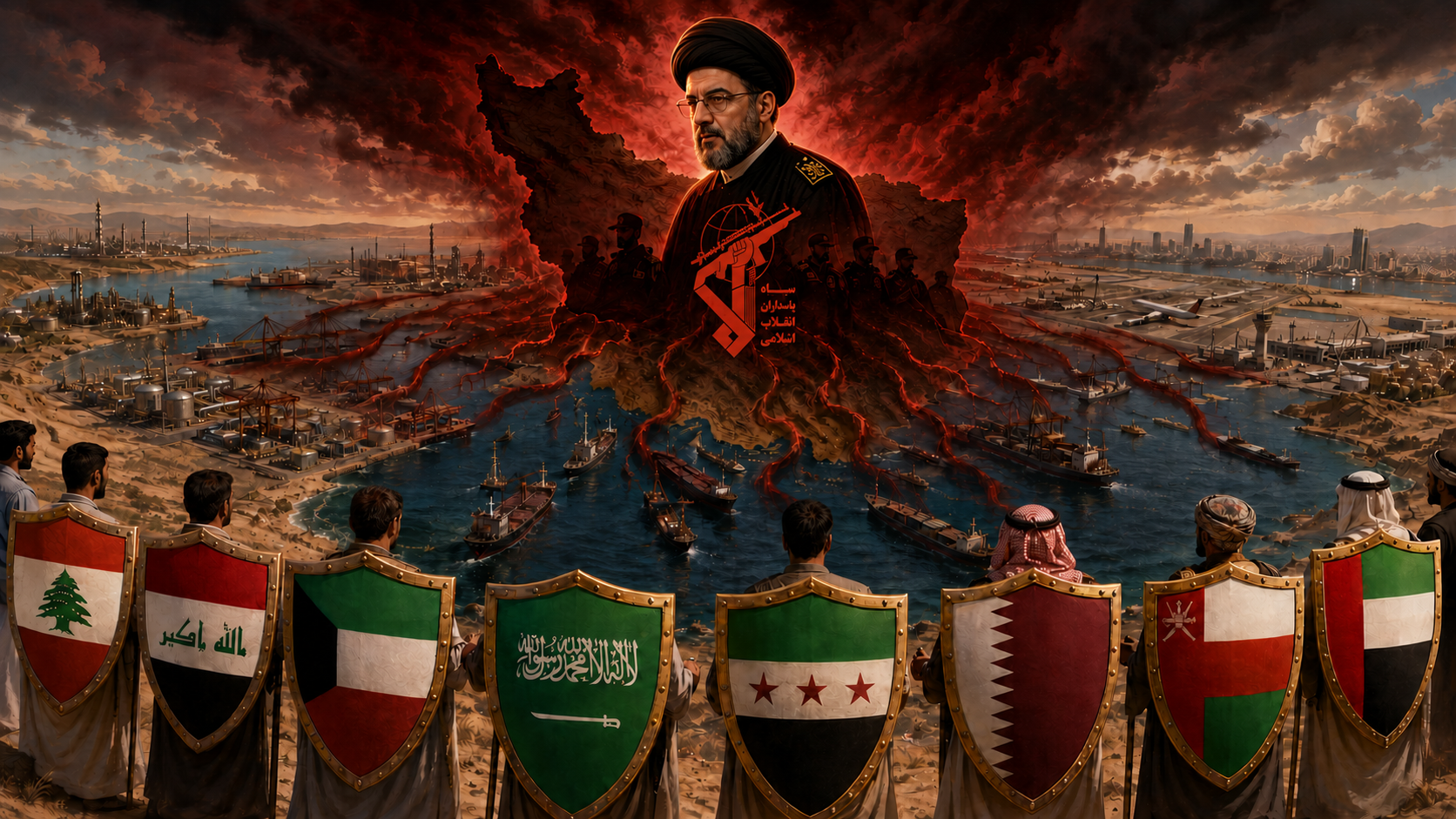
Photo Illustration- Iran cannot demand Muslim unity while its missiles, drones and armed proxies threaten the very Muslim nations it asks to unite.
Before lecturing the Islamic world about its “real enemies,” Tehran must explain why its missiles and drones targeted Muslim countries, why it armed militias against Arab states and why it turned the Strait of Hormuz into a weapon against the entire region.
By : The Editorial Board, Opinion
Iran’s supreme leader, Ayatollah Mojtaba Khamenei, has urged the rulers of Muslim nations to “know your real enemy, understand its plans and confront it.”
He identified the United States and Israel as the enemies of all Islamic nations and appealed for Muslim unity, cooperation and mutual defense.
But before Khamenei tells Muslim nations who their enemies are, he should examine the conduct of his own regime.
Six months after the United States and Israel attacked Iran, killing his father and other senior Iranian leaders, Khamenei still has not appeared publicly. His latest message came in a letter addressed to religious leaders attending a conference in Tehran.
The letter called for solidarity among Muslims. Yet the war exposed precisely why so many Muslim governments no longer trust Iran.
Iran struck targets in neighboring Gulf Arab countries, including the UAE, Oman, Qatar, Kuwait, Bahrain and Saudi Arabia. It also restricted navigation through the Strait of Hormuz, threatening the economic lifeline of those same Muslim nations and disrupting energy supplies and international commerce.
What made these attacks even more indefensible was Iran’s choice of targets. When the United States and Israel attacked Iran, Tehran did not limit its response to the American military bases located in Gulf countries. Instead, it attacked the infrastructure of Arab states that had neither launched the war nor authorized attacks against Iran.
Those countries were not Iran’s enemies. Their airports, ports, energy facilities and other economic assets belonged to their people—not to the United States or Israel. Attacking them was therefore not legitimate retaliation against those responsible for the war. It was collective punishment directed at neighboring Muslim nations because they were closer, more vulnerable and easier to hurt.
This was a cowardly act. Iran avoided confronting the military forces it blamed for the war and instead inflicted damage on countries that had tried to remain outside it. Tehran effectively told its Arab neighbors: if we cannot strike our principal enemies without paying an unbearable price, we will destroy your prosperity instead.
Iran then compounded the damage by restricting navigation through the Strait of Hormuz, placing the exports, energy supplies and economic security of the entire Gulf at risk. It used Arab economies as leverage in a conflict those countries did not start.
Now Khamenei asks these same governments to unite with Iran against their “real enemy.” But a government that attacks its neighbors’ infrastructure cannot credibly present itself as their defender. Iran’s conduct showed that when Tehran felt threatened, Muslim solidarity disappeared and Muslim countries became convenient targets.
Tehran cannot fire missiles and drones toward Muslim countries on one day and call for Muslim unity on the next.
It cannot attack its neighbors and then demand that they accept its definition of their “real enemy.”
Iran Came to Export Revolution, Not Peace
The Islamic Republic came to power in 1979 promising not merely to transform Iran, but to export its revolution throughout the Muslim world.
From its earliest days, the regime sought to replace the existing regional order with movements and governments committed to Tehran’s revolutionary ideology. It presented that project as Islamic awakening and resistance. In practice, it became a campaign for Iranian domination.
Iran did not build its regional influence through economic development, scientific cooperation, free trade or respect for sovereignty. It built its influence through the Islamic Revolutionary Guard Corps, armed proxies, political assassinations, sectarian mobilization and military organizations operating outside the authority of legitimate governments.
This was never Muslim unity. It was an attempt to hijack the Muslim world.
Few regimes have inflicted more sustained and systematic damage on the Middle East over the past four decades. Iran did not cause every regional conflict, and other governments committed their own grave mistakes. But no other regime created such an extensive network of armed organizations specifically designed to weaken neighboring states from within.
Tehran’s strategy was simple: identify a vulnerable country, arm a faction loyal to Iran and gradually make that faction more powerful than the state.
Iran’s Axis of Weakened States
In Lebanon, Iran created, financed and armed Hezbollah until the organization became more powerful than the Lebanese state.
Hezbollah maintained its own army, communications network, intelligence apparatus and foreign policy. It intimidated opponents and claimed the authority to decide when Lebanon went to war, regardless of the decisions of the Lebanese government or the interests of the Lebanese people.
Iran called Hezbollah a resistance movement. For Lebanon, it became an armed state within the state—answerable ultimately to Tehran.
In Iraq, Iran cultivated militias that accumulated weapons, money and political influence outside the control of the national army. Some became so deeply embedded in Iraq’s political and economic institutions that the government struggled to exercise sovereignty within its own territory.
Instead of helping Iraq rebuild a strong and independent state, Tehran benefited from keeping it divided, penetrated and dependent.
In Syria, Iran and its allied militias helped preserve Bashar al-Assad’s government through a devastating civil war. Syrian territory became a corridor for Iranian weapons, foreign fighters and regional confrontation. The Syrian people paid the price for Tehran’s determination to maintain its strategic bridge to Lebanon and the Mediterranean.
In Yemen, Iran’s support helped transform the Houthis into a heavily armed force capable of challenging the state, attacking Saudi Arabia and the UAE, and threatening international shipping through the Red Sea and Bab el-Mandeb.
In Gaza, Tehran supported Hamas Movement while ordinary Palestinians repeatedly suffered the consequences. Iran supplied money, weapons and the language of “resistance,” but Iranian leaders did not live beneath the bombs or among the ruins. Palestinian families did.
Iran called this network the “axis of resistance.” In reality, it became an axis of weakened states.
Wherever Tehran gained the greatest influence, national institutions weakened, militias became stronger, economies deteriorated and citizens became less secure. Lebanon, Syria, Iraq, Yemen and Gaza were not liberated by Iran’s strategy. They were turned into arenas for Iran’s confrontation with Israel, America and the Arab world.
Iran fought its enemies from other people’s territory and frequently with other people’s blood.
Iran Helped Turn Israel From Enemy Into Partner
The Iranian regime also produced a result its founders could never publicly acknowledge: it helped drive Arab countries closer to Israel.
For generations, Israel was regarded across much of the Arab world as the principal regional enemy. The Palestinian issue remains unresolved, and Israeli policies continue to generate anger throughout the region.
But as Iran expanded its missile program, armed militias inside Arab countries and threatened Gulf infrastructure, the security calculations of several Arab governments began to change.
Israel remained a source of profound disagreement, but Iran increasingly appeared to be the more immediate threat to their sovereignty, stability and survival.
That changing perception helped create the political environment for the Abraham Accords.
The UAE and Bahrain did not normalize relations with Israel solely because of Iran. Economic opportunities, American diplomacy, technology and national interests also played important roles. Morocco and Sudan had their own reasons for joining the process.
But the shared fear of Iranian expansion was unquestionably a powerful driver of the emerging strategic relationship between Israel and several Arab governments.
Tehran therefore achieved the opposite of what it proclaimed.
A regime that claimed to lead the struggle against Israel helped convince Arab governments that cooperation with Israel might be necessary to protect themselves from Iran.
Iran did not eliminate Israel’s presence in the Middle East. It helped make Israel a strategic partner for countries that once refused even to recognize it.
That may be one of the greatest failures of the Islamic Republic’s entire foreign policy.
Who Is the “Real Enemy”?
Khamenei now asks Muslim rulers to identify their “real enemy.”
But those rulers have watched Iran’s conduct for nearly half a century.
They saw Iran arm Hezbollah in Lebanon, militias in Iraq, the Assad government and foreign fighters in Syria, the Houthis in Yemen, and Hamas in Gaza.
They watched Tehran use sectarian loyalties to penetrate Arab societies while claiming to defend Islam as a whole.
They saw Iran threaten oil facilities, airports, military installations and international waterways. Most recently, they saw Iranian missiles and drones directed toward Muslim countries that were not seeking war with Iran.
For a Gulf nation whose territory has been attacked, Tehran’s missiles are not an ideological abstraction. They are a direct threat.
For a Lebanese citizen whose government cannot control Hezbollah’s weapons, Iranian interference is not solidarity. It is an assault on sovereignty.
For an Iraqi who wants one national army rather than competing militias, Iranian influence is not protection. It is an obstacle to statehood.
For a Yemeni whose country has been devastated by war, Iranian weapons are not liberation.
Iran does not have the right to choose other nations’ enemies for them—particularly after treating those nations as battlefields.
Do Not Confuse Iran With Its Regime
Iran’s rulers should stop lecturing the Muslim world—and start answering for the enormous damage their regime has inflicted upon it.
This indictment must not be directed against the Iranian people.
The Iranian people are heirs to one of the world’s great civilizations. They have also paid an enormous price for the regime’s revolutionary ambitions.
While Tehran spent billions supporting armed groups abroad, Iranians endured sanctions, inflation, isolation and declining living standards. Resources that could have modernized Iran’s infrastructure, created jobs and improved education and healthcare were invested instead in missiles, militias and foreign wars.
The Iranian people did not benefit when Hezbollah dominated Lebanon, militias weakened Iraq, Assad devastated Syria or the Houthis prolonged Yemen’s war.
They were sacrificed alongside the Arab peoples whose countries became instruments of Tehran’s regional strategy.
The problem is not Iran as a nation. The problem is a revolutionary regime that repeatedly uses Islam to justify expansion, repression and confrontation.
Unity Cannot Mean Submission to Tehran
If Iran truly wants unity, it must begin with a simple principle: stop attacking Muslim countries and stop arming militias inside neighboring states
Muslim unity cannot mean submission to Iran.
It cannot require Muslim governments to tolerate Iranian proxies inside their countries. It cannot mean surrendering their sovereignty, accepting attacks on their infrastructure or allowing Tehran to decide when their people must go to war.
Real Muslim unity must be based on mutual respect, peaceful cooperation and recognition of every nation’s sovereignty.
It requires strong national armies—not militias receiving orders and weapons from foreign capitals.
It requires secure borders—not smuggling corridors for missiles and drones.
It requires economic integration—not attacks on oil facilities, ports and shipping lanes.
It requires protecting Muslim lives—not sacrificing them in permanent wars marketed as “resistance.”
If Iran truly wants unity, it must begin with a simple principle: stop attacking Muslim countries.
It must stop arming militias inside neighboring states, stop using Arab territory as a battlefield, stop threatening international waterways and stop treating the Middle East as property of the Iranian revolution.
Tehran cannot demand solidarity from the governments it has attacked. It cannot portray itself as the defender of Muslims while its weapons endanger Muslim cities, economies and populations.
Khamenei tells Muslim nations to recognize their “real enemy.”
After nearly five decades of Iranian interference, militias, intimidation and warfare, those nations are fully capable of judging threats for themselves.
Iran’s rulers should stop lecturing the Muslim world—and start answering for the enormous damage their regime has inflicted upon it.
