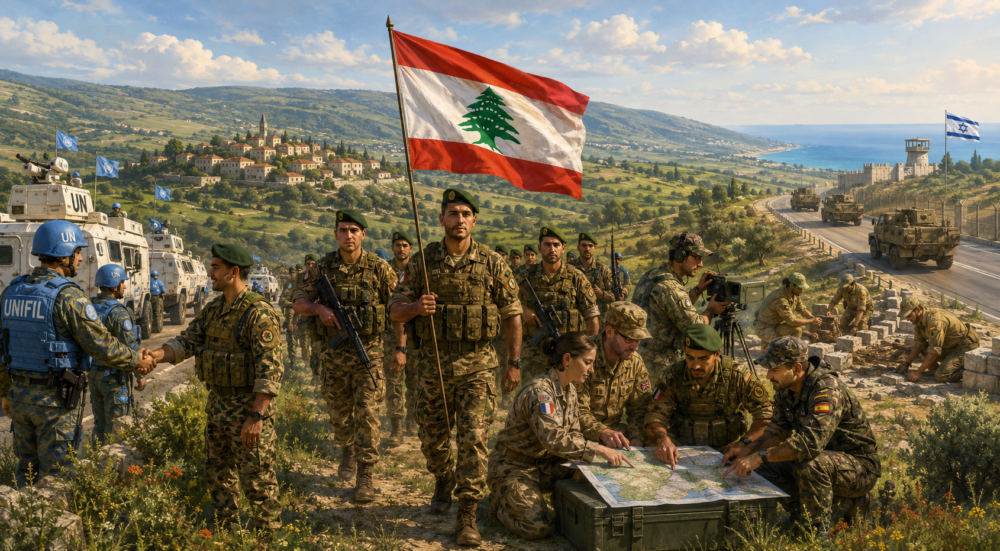
UNIFIL departs with Lebanon’s gratitude as a new international mission helps the Lebanese Army restore sovereignty, implement peace and facilitate Israel’s withdrawal.
The next international presence in southern Lebanon should strengthen the Lebanese Army, facilitate Israel’s withdrawal and make the Lebanese state—not Hezbollah or any foreign force—the sole guarantor of security.
By : The Editorial Board , Opinion
The United Nations Security Council has decided that the mandate of the United Nations Interim Force in Lebanon will end on December 31, 2026.
UNIFIL will cease its regular operations on that date and begin an orderly withdrawal that could continue for up to one year. The decision followed sustained American and Israeli opposition to another open-ended renewal, although the final Security Council resolution was adopted unanimously.
UNIFIL’s departure should not be treated as the abandonment of southern Lebanon. It should be used as an opportunity to replace an old and increasingly ineffective buffer force with a new international mission designed around the peace agreement now being negotiated between Lebanon and Israel.
France and Italy have already announced plans to co-lead an international coalition supporting Lebanon after UNIFIL. Their proposal is intended to strengthen Lebanese sovereignty and the Lebanese Armed Forces while preventing Lebanese territory from again becoming a launching point for regional escalation.
Germany has separately proposed examining an EU-mandated force that could prevent a security vacuum, enable the Israeli Army to withdraw and prevent Hezbollah from returning as an armed power in the South.
The European Union’s diplomatic service has also proposed a three-year mission to train and advise the Lebanese Army and Internal Security Forces, particularly in border security, intelligence, surveillance and maritime operations. That proposal is not formally intended to replace UNIFIL, but it could become an essential part of a broader international support structure.
These initiatives should be welcomed by Lebanon, Israel and the United States.
But the new mission must not simply reproduce UNIFIL under a different flag.
UNIFIL’s mixed record
UNIFIL served useful purposes. It maintained communications between the Lebanese and Israeli militaries, monitored violations, assisted civilians and reduced the possibility that every border incident would immediately become a larger war.
But it did not accomplish its central strategic objective.
Under Resolution 1701, the area between the Litani River and the Blue Line was supposed to contain no armed personnel, weapons or military infrastructure other than those belonging to the Lebanese state and UNIFIL. Yet Hezbollah expanded its military presence, constructed tunnels, accumulated weapons and prepared positions throughout the South.
It would be unfair to claim that every UNIFIL soldier knowingly watched Hezbollah build those tunnels. Peacekeepers often faced restrictions on their movement, obstruction by Hezbollah and its supporters, and political limitations imposed by a mandate that depended heavily on cooperation from the Lebanese authorities.
Nevertheless, the result cannot be ignored: a major Iranian-backed military infrastructure developed inside UNIFIL’s area of operations despite the presence of thousands of international peacekeepers.
Many Lebanese therefore became uncomfortable with a mission that could report violations but was unable to prevent them.
Lebanon does not need another international force that merely observes the next crisis being prepared.
A mission for implementation—not indefinite separation
The proposed successor should have a limited, clearly defined purpose: help the Lebanese Army implement the framework agreement between Lebanon and Israel.
As the Lebanese Army establishes the agreed pilot zones, international personnel should provide it with the equipment, training, intelligence, transportation, communications, surveillance and engineering capabilities it currently lacks.
The mission should help the Army:
- Assume exclusive security control over every evacuated area.
- Search for and dismantle unauthorized tunnels, weapons depots and military installations.
- Verify that Hezbollah and all other armed organizations have withdrawn from the designated zones.
- Monitor compliance by both Lebanon and Israel.
- Clear mines and unexploded ordnance.
- Establish secure communications between the Lebanese and Israeli militaries.
- Facilitate the phased withdrawal of Israeli forces from Lebanese territory.
This force should assist the Lebanese Army—not replace it. It must operate alongside Lebanese soldiers, under clearly negotiated rules, with the ultimate objective of making its own presence unnecessary.
Israel and America should support it
Israel and the United States opposed another indefinite extension of UNIFIL. They should therefore welcome a replacement mission that corrects UNIFIL’s shortcomings and advances the outcome both governments say they want.
Israel insists that it cannot withdraw from the areas it occupies if Hezbollah will simply return behind it. Lebanon insists that Israeli withdrawal is essential for restoring sovereignty and implementing the framework agreement.
A capable international support mission can help resolve both concerns simultaneously.
As Israeli forces withdraw from each agreed zone, the Lebanese Army—supported by the international coalition—should immediately take their place. Verification mechanisms should ensure that no Hezbollah forces, tunnels or weapons return.
This is not a concession to Israel. It is the restoration of Lebanese sovereignty.
Every position vacated by Israel should be occupied by the Lebanese Army, not Hezbollah. Every weapon removed from the South should strengthen the authority of the Lebanese state, not create another ungoverned space.
The Lebanese Army needs more than training
Training alone will not be sufficient.
The Lebanese Army remains seriously under-equipped for a mission of this scale. Its troops need reliable salaries, armored vehicles, helicopters, drones, surveillance systems, engineering equipment, secure communications and logistical support.
Europe, the United States and Arab states should establish a long-term financing mechanism tied to measurable stages in the implementation of the framework agreement.
The Army cannot be asked to assume responsibility for the entire South while being denied the resources required to perform that responsibility.
International assistance should therefore be linked to clear benchmarks: Lebanese deployment, Israeli withdrawal, the dismantling of unauthorized military infrastructure and the restoration of state control.
Peace must make the foreign forces unnecessary
The objective should not be to preserve an international military presence in southern Lebanon forever.
UNIFIL was created as an “interim” force in 1978. Nearly half a century later, its continued existence demonstrates how temporary arrangements can become substitutes for political solutions.
Lebanon and Israel are now moving toward direct negotiations and a framework for peace. If that process succeeds, neither country should need a permanent foreign buffer between them.
What they need during the transition is a capable, trusted and temporary mechanism that helps the Lebanese Army replace Israeli forces, prevents Hezbollah from reoccupying evacuated territory and verifies that both sides honor their commitments.
Lebanon can reclaim the territories occupied by Israel following Hezbollah’s decision to enter the war in support of Iran—but only by implementing the framework agreement and restoring the authority of the state.
The end of UNIFIL must not leave a vacuum. Nor should it lead to UNIFIL under another name.
It should lead to something better: an international mission with a defined task, measurable objectives and a clear exit strategy—helping the Lebanese Army establish peace, restore sovereignty and finally become the sole defender of southern Lebanon.
