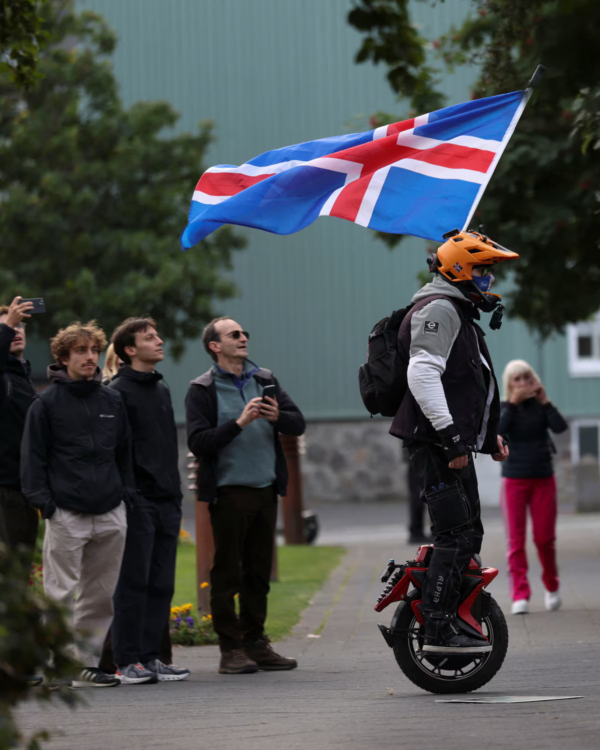
A man with an Icelandic flag rolls around in a park ahead of a referendum on whether Iceland should resume accession negotiations with the European Union, in Reykjavik, Iceland, August 29, 2026. REUTERS/Leonhard Foeger
The influential fishing industry led opposition to the referendum over fears the bloc’s common fisheries policy would open its waters to Spanish, Dutch and other trawlers.
By Johan Ahlander and Tom Little
REYKJAVIK – Icelanders voted to stay out of the European Union, referendum results showed on Sunday, as they rejected a government push to reopen membership talks and sided with those who said Iceland’s fishing waters were too important to risk.
The Arctic island of 400,000 people has debated whether to join the EU for well over a decade and had initially been expected to narrowly back holding membership talks, but opinion polls this month showed views had changed.
Prime Minister Kristrun Frostadottir told a press conference that Iceland would focus on strengthening its existing ties with the European Union through the European Economic Area agreement, which it shares with Norway and Liechtenstein.
“A big lesson for me and also for the government is that people are happy with the EEA agreement,” she said.
A European Commission spokesperson said it respected the choice of the Icelandic people and noted that Iceland remained a close partner of the European Union.
Frostadottir now plans to call Norway’s prime minister, public broadcaster RUV reported.
In Saturday’s referendum, 52.8% of ballots cast were against the government’s proposal to hold negotiations with Brussels, 47.2% were in favour, and 82.5% of eligible voters took part.
Out of six constituencies, only the two in central Reykjavik had a majority that voted in favor, while the rural areas and the Reykjavik suburbs voted against.
The government had framed membership as a shield against trade wars and Arctic rivalry and presented the referendum as a “now or never” moment. Frostadottir said the “no” would end the debate for as long as her centre-left coalition was in power.
DECADES OF MEMBERSHIP DEBATE
In Brussels, some officials had voiced hopes a vote to join from Iceland could ease scepticism toward EU enlargement and strategically strengthen the bloc when Arctic security is in focus.
“This is a clear setback for Brussels,” an EU diplomat told Reuters, adding that the issues of fishing and independence had been decisive.
Iceland, a NATO member state but with no standing army of its own, also debated whether EU accession could boost the country’s security when U.S. President Donald Trumphas cast doubt on the U.S. commitment to the military alliance.
Trump has also repeatedly said he wants to acquire Greenland, another Arctic island.
But for some Icelanders, fishing was a sharper focus than security.
The industry is one of Iceland’s biggest, making up 15% of gross domestic product in direct and indirect contributions, and some 40% of export revenue, data shows.
INTEREST RATES AND THE COST OF LIVING
The island nation first applied to join the EU in 2009 when a financial crisis hit the country’s small, exposed economy. A Eurosceptic government ended talks in 2013.
Ahead of Saturday’s referendum, finances were again a central issue as Iceland has grappled with high inflation and interest rates.
However, high salaries have helped offset the economic hit for a large majority of Icelanders, Vilborg Asa Gudjonsdottir, a researcher in international affairs at the University of Iceland, told Reuters.
“I think the biggest reason for these results is that there is no economic urgency for Iceland to join the European Union and the public doesn’t seem to think that there is an urgency when it comes to security and defence either.”
Supporters of a “yes” vote had said EU membership, and possibly adopting the euro, could bring relief. Iceland’s central bank interest rate is 8%, compared with 2.25% at the European Central Bank.
“It would not solve Iceland’s structural faults, but it could become a catalyst to a more healthy economy,” said chief economist Vilhjalmur Hilmarsson at Viska, one of Iceland’s largest labour unions.
Opposition leader Gudrun Hafsteinsdottir, who led the “no” campaign, said the economic case is overstated. “These are not problems that Brussels will solve for us. These are problems that Icelandic politicians must solve,” she said.
Under EU rules, fishing quotas are based on historical fishing patterns, among other factors. Some Icelandic officials have said Iceland would therefore retain control of its waters, since no EU country has fished there for decades.
Hafsteinsdottir disputed that. “I know that the European Union will come up with some promises of some flexibility, especially in the beginning, but we know that it will not be for good,” she said.
(Reuters)
