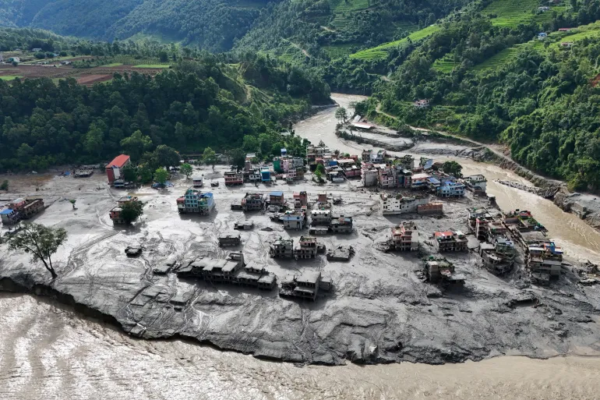
More than 390 dead, 1,500 missing in Nepal and Tibet after Himalayan floodsBy Gopal Sharma, Sahana Bajracharya, Saurabh Sharma and Liz Lee, Reuters
NUWAKOT, Nepal- Nepal and China resumed rescue operations in the flood-hit Himalayas on Friday, with a Chinese rescue team reaching the all-but-obliterated Gyirong border crossing complex for the first time and finding “nothing but ruins.”
A glacier collapse on Wednesday unleashed a huge torrent of rock, ice, mud and debris through Himalayan mountain river systems, killing at least 579 people in Nepal and seven in China’s Tibet.
The number of missing in Nepal has nearly doubled to 1,924, the country’s disaster authority said on Friday. At least 558 were missing in Tibet’s Gyirong County, Chinese state broadcaster CCTV said on Thursday. Of those missing in the disaster, at least 540 are foreigners, many of them Hindu pilgrims from India.
Surveillance camera footage from the worst-hit Gyirong border crossing complex showed huge torrents of water and debris engulfing buildings and people trying to flee.
Only on Friday were rescuers able to reach that area. State media reported that the Chinese team of 21 rescuers and a search-and-rescue dog crossed mountains and valleys and used ropes to navigate forests and cliffs after roads to the complex, hemmed in by steep Himalayan slopes, were destroyed.
“There was no road… it was all virgin forest and sheer cliffs,” rescue worker Zou Mingqi said. At the complex, “as far as the eye could see, there was nothing but ruins.”
More than 90,000 people are estimated to have been affected by the disaster, the Red Cross said.
The flooding led to the formation of a lake, which on Friday began overflowing into the Lhende Khola and Trishuli rivers.
The overflow sparked panic and warnings from authorities in Nepal, leading to rescue operations being suspended for about three hours. The risk prompted all Chinese rescue personnel and vehicles to withdraw as well, CCTV said.
Both resumed rescue operations after the threat eased, with Nepali officials saying that they were still hopeful of finding survivors.
MOTHER FINDS SON
That hope manifested for Matti Maya Tamang, 28, who was reunited with her 8-year-old son Zoyal Ghale on Friday after fearing that he and his brother had died when their school was destroyed.
Ghale escaped by running into a forest and climbing trees as the flood swept through. He was later found with a broken leg and cuts to his face and airlifted to a hospital, where Reuters journalists found him clutching two 10-rupee notes given to him by police to coax him to accompany them to seek medical treatment.
His mother found him after calling a number left by a Reuters journalist at the hospital.
“I felt my life was back,” said Tamang, who also found her younger son alive.
THREATS FROM GLACIAL LAKES REMAIN
Nepal is continuing to monitor two barrier lakes upstream of the flood zone, with an official warning that flood risks will persist until both lakes fully drain.
Satellite imagery showed the second lake growing larger with no visible outlet, raising concerns that water pressure could still be building.
China’s state-run Xinhua news agency said that the first barrier lake was reducing in size, citing analysis by the water resources ministry. A Chinese government geohazards expert warned, however, that the lake may be unstable and that over 100 glacial lakes scattered throughout the area could pose a threat.
In Beijing, a Politburo meeting chaired by President Xi Jinping called for stronger monitoring of glacier lakes and landslide risks, and for closer international disaster cooperation, Xinhua reported.
China’s Premier Li Qiang, the country’s No. 2 official, arrived in the area of Gyirong on Thursday afternoon, Xinhua said. The visit suggested Beijing was treating the disaster as a matter of the highest national priority
The Gyirong border port has a key role in China’s Belt and Road network linking the country to South Asia, with logistics zones and parking lots built there in the past decade.
‘ALL OF OUR PEOPLE ARE GONE’
Wednesday’s flood ripped through villages and valleys, destroying power stations, roads and bridges along a route that links Kathmandu with Lhasa in Tibet and is popular with trekkers and pilgrims.
Ten bodies were found in three places in the northern Indian state of Uttar Pradesh in rivers that flow down from Nepal, police told Reuters on Friday.
Earlier, Nepalese rescue teams used helicopters to search for survivors and drop emergency supplies to thousands cut off in towns and valleys.
Dibga Tamang was among the last people rescued from Rasuwa on Thursday, airlifted along with three others to an army camp in Nuwakot.
“All of our people have gone. They are dead,” Tamang said. “I have no one left waiting for me. Everything and everyone is gone. The end.”
A large number of people arrived at an army base in the area seeking information about missing and dead family members. Bodies were brought into the barracks and lists of rescued people were posted outside.
Around the world, relatives of those missing were desperate for information.
“Where are they?” said Sneha Sudhir, one of 10 women whose husbands had set out from Nepal on a trek to Tibet’s Mount Kailash. The men, all from northern Virginia, are among dozens of Americans missing.
“Everybody is taking turns in shedding their tears, wiping it off and getting back to work,” Sudhir said tearfully from her home in Chantilly, Virginia.
The United Nations and its partners were scaling up relief supplies, with 20,000 households estimated to need food assistance and more than 50,000 people emergency water and support, U.N. spokesperson Stephane Dujarric said.
While offers of search-and-rescue assistance are pouring in, Nepal said it does not need help from other nations.
A South Korean rapid response team in Kathmandu has not been deployed because Nepal does not have a plan to accept foreign rescue yet, the foreign ministry in Seoul said.
The Kathmandu Post reported that India, China, the United States, Britain, Japan, South Korea, Sri Lanka and Bangladesh had asked the government to allow their search-and-rescue teams to assist.
(Reuters)
