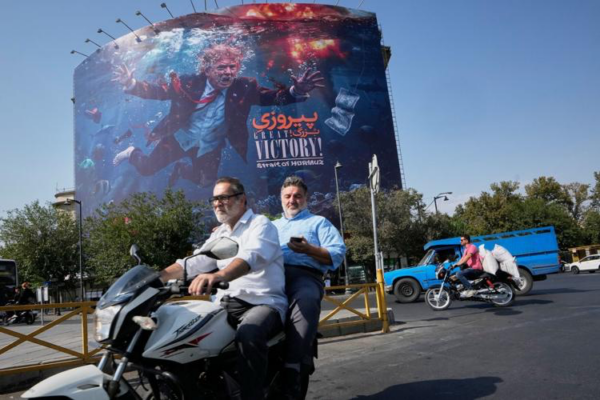
Motorcyclists pass a billboard depicting U.S. President Donald Trump underwater amid explosions, with the words “Great Victory! Strait of Hormuz,” in Tehran, Iran, Monday, Aug. 24, 2026. Credit: AP/Vahid Salemi
HERE IS THE LATEST:
- Iranian Economy Minister Ali Madanizadeh said Monday that Tehran has been preparing for the new sanctions announced by the U.S. “for a long time” and that it is ready to face them.
- U.S. Treasury Secretary Scott Bessent threatened on Monday to cut off economic ties to Iranian allies that continue to financially partner with Tehran, and introduced sanctions on digital assets, gold, aviation and shipping. The moves are part of a shift in U.S. strategy in the nearly six-month war to heap economic pressure on Iran’s rulers in the hope of breaking the stalemate between the two countries.
- Pakistan’s interior minister heralded “significant progress” after a meeting with Iran’s president on Tuesday that focused on the U.S.-Iran war. Pakistan was a key mediator in the memorandum of understanding signed by Washington and Tehran in June.
Iran’s currency continues falling. The US dollar is now worth over 2 million rials
Iran’s currency continued its plunge in value Tuesday, after the U.S. Treasury announced the beginning of an “unprecedented campaign against the Islamic Republic of Iran and its enablers” using sanctions and other economic measures aimed at pressuring the country into capitulation.
Iranian officials have shrugged off the new sanctions, insisting they will have little impact, but Iran’s economy has been in tatters for years, even before the war began, with high inflation making it difficult for most families to afford basic goods.
On Tuesday, the value of one U.S. dollar was up by another 10,000 Iranian rials , selling for about 2,030,000 rials .
In 1978 and just before the Islamic revolution the US dollar was worth less than 70 rials
According to Iran’s state-linked Nour News agency, currency market activity was being influenced by concern over possible restrictions along the Iran-Iraq border, which could disrupt foreign currency inflows, as well as uncertainty over the new U.S. sanctions.
Iranian lawmaker claims Pakistani army chief came to Tehran with U.S. message calling for renewed talks
Abbas Golrou, chairman of the Iranian Parliament’s Foreign Relations Committee, said Monday that the United States had asked a visiting Pakistani delegation to encourage Iranian officials to return to peace talks.
Golrou said Pakistani Army Chief Field Marshal Asim Munir, during his visit to Tehran on Monday, delivered a message from Washington urging Iran to return to the memorandum of understanding.
“The Americans asked the Pakistanis to speak with the Iranian side so that Iran enters the political space and they can move forward together,” Golrou told Iran’s state-run ISNA News Agency. “On behalf of the United States, Asim Munir sent a message to Iran that Iran should return to the memorandum of understanding.”
Iranian officials have called over the past couple days for a return to the principles of the MoU signed by President Trump and his Iranian counterpart in mid-June. That agreement ushered in a ceasefire and a 60-day period intended for talks to negotiate a wider peace deal, but it collapsed and fighting resumed in early July.
Mr. Trump declared the ceasefire over, and the U.S. and Iran have remained locked in a stalemate over control of the Strait of Hormuz ever since.
According to Golrou, the message conveyed by the Pakistani delegation reflected what he called a contradictory U.S. approach, with Washington simultaneously threatening Iran and imposing new sanctions while also sending direct and indirect messages seeking negotiations.
“Americans, on the one hand, threaten and, on the other hand, directly and indirectly send messages for negotiations. This approach shows the ugly dual behavior of the American side,” he said, adding that the message delivered by Munir would need to be assessed by Iran’s leadership.
“The Islamic Republic of Iran unanimously supports the political process and wants the interests of the Iranian people to be resolved through political processes,” he was quoted as saying, adding: “The people of Iran are now prepared to stand against the Americans’ excessive demands and not give concessions to the American side.”
CBS
