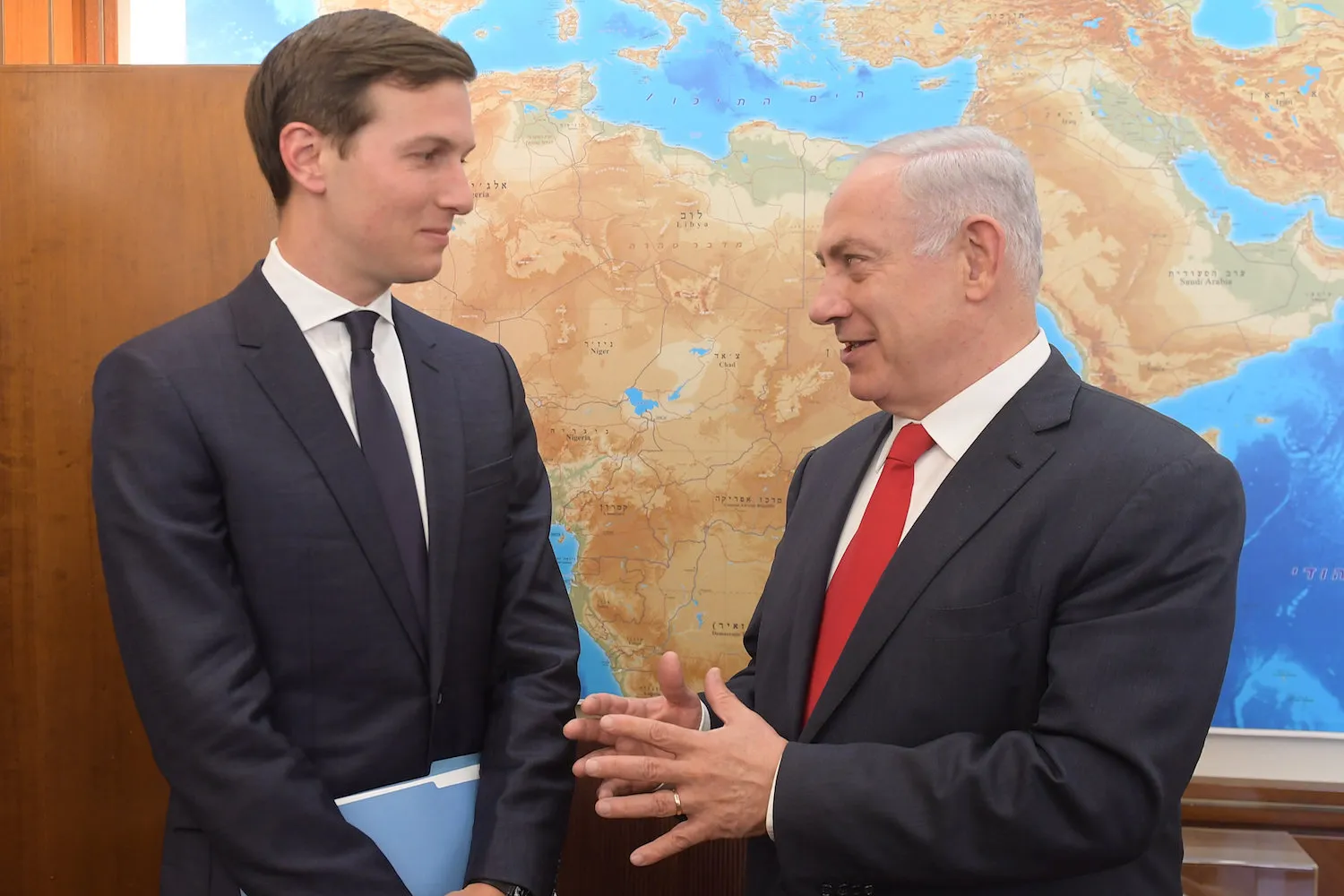
President Donald Trump’s son-in-law and envoy first held rare talks with Hamas’s new leader in Egypt over the weekend in his effort to advance the stalled 15-point plan.
TEL AVIV — Jared Kushner, President Donald Trump’s son-in-law and envoy, met with Israeli Prime Minister Benjamin Netanyahu in Jerusalem on Monday after holding rare talks with Hamas in Egypt in an effort to advance a stalled Gaza peace deal.
The 15-point plan, touted as a breakthrough by Trump in late July, calls for Hamas to disarm and Israel to withdraw from the Gaza Strip. Hamas and Israel disagree on which should come first, and last week, the plan hit another obstacle after Netanyahu voiced opposition to it in a rare break with Washington.
An official with the Trump-created Board of Peace said Kushner was joined by the group’s director, Nickolay Mladenov, and former British prime minister Tony Blair, a member of the body’s executive board. The aim of the meeting was to hear concerns from the Israeli side and to find a way to move forward.
“What is critical is that we both agree on the desired outcome and are finding ways to accelerate progress,” the official said, speaking on the condition of anonymity to discuss diplomatic talks.
The Board of Peace was set up in the aftermath of the 2025 deal to release the remaining hostages that Hamas seized during the Oct. 7, 2023, attack on Israel.
The meeting comes a day after Kushner held talks with a Hamas delegation in Egypt. The Associated Press reported that the meeting was with Khalil al-Hayya, the group’s new leader. A Hamas official told The Washington Post that al-Hayya was in Egypt for talks and the delegation met with all mediators.
The official, speaking on the condition of anonymity to discuss a private meeting, said the group’s talks with Kushner focused on the 15-point plan, which they have accepted, and their objections to Israel’s opposition.
The plan announced July 30 gave Hamas and Israel two weeks to agree on a timetable and implementing a gradual, reciprocal process in which Hamas would disarm and Israel would pull its forces out of the Strip.
Hamas says Israel must end its military campaign in Gaza as a first step, and Israel has called for complete disarmament of Hamas and removal of weapons from Gaza as a prerequisite for withdrawing.
Israel is also under pressure from the United Arab Emirates, which joined with other predominantly Muslim countries on Sunday in condemning Netanyahu’s refusal to move forward with Trump‘s plan.
Last week, a U.S. official told The Post that Israel is not being asked to “rely on trust or to make irreversible moves before verified steps are taken on the ground.” Speaking on the condition of anonymity to describe sensitive matters, the official added that the objective “remains the full decommissioning of weapons and ensuring Gaza can never again pose the kind of threat Israel faced on October 7.”
Netanyahu is fighting for political survival in an upcoming October election. Polls show him trailing major opponents, and analysts said that he is less likely to make any major commitments in an election year.
“Netanyahu does not want people saying he approved withdrawals” before the elections, said Gayil Talshir, a political analyst at the Hebrew University.
Kobi Michael, a former official in Israel’s Strategic Affairs Ministry, said American pressure may not yield results except for a limited Israeli redeployment along the Yellow Line, the boundary separating areas in Gaza under Israeli military control.
Speaking last week at a government meeting, Netanyahu presented himself as someone who can say no to Trump.
“We can and know how to stand our ground, even against our best friends when necessary,” he said.
THE WASHINGTON POST
