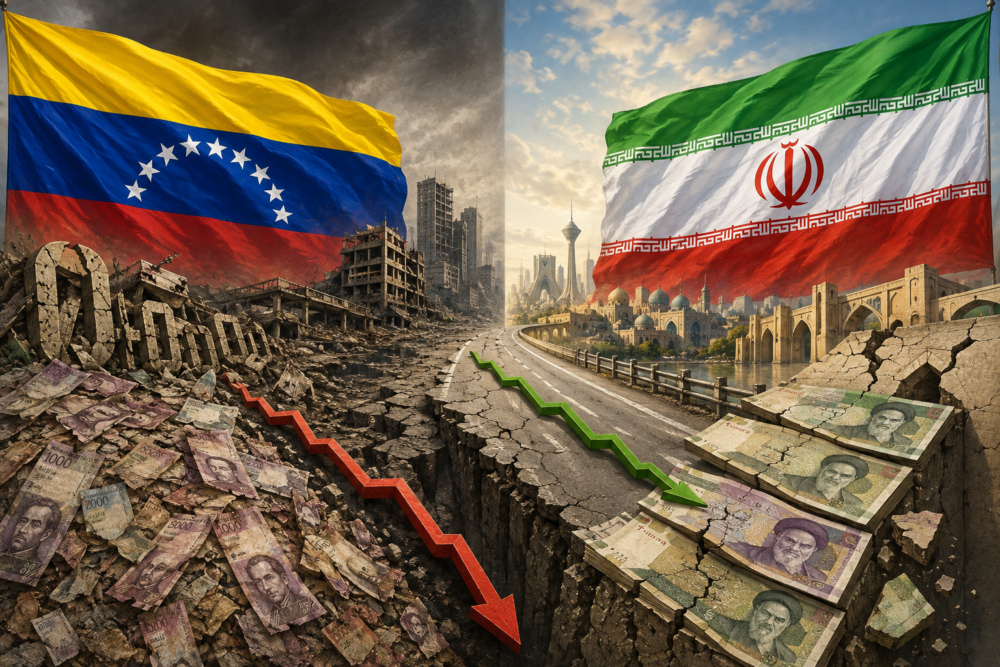
Photo illustration Venezuela shows where this road can end. Iran still has time to choose prosperity over ideology, regional warfare and economic ruin.
I witnessed both countries during more prosperous times. Iran has not yet suffered Venezuela’s complete economic collapse—but it is following a disturbingly similar path.
By : Ya Libnan, Op.Ed
I have spent considerable time in both Venezuela and Iran. I knew them not as impoverished or broken countries, but as prosperous oil-producing nations with strong currencies, capable people and enormous promise.
That is why watching their decline has been so painful—and why Iran’s present direction looks frighteningly familiar.
When I traveled regularly to Venezuela, the bolívar was one of Latin America’s strongest and most stable currencies. I remember exchanging one American dollar for approximately 4.20 bolívars. Venezuela’s oil wealth had made it one of the most prosperous countries in South America, attracting businesses, investors and immigrants searching for opportunity.
When I worked in Iran and maintained a company office in Tehran in 1978, one American dollar bought fewer than 70 Iranian rials. Iran possessed tremendous oil and gas reserves, a growing industrial sector, a well-educated population and the potential to become one of the world’s leading economies.
Today, Venezuela has removed so many zeros from its currency that its original bolívar has become almost impossible to recognize. Iran’s rial, meanwhile, is approaching two million to the dollar on the open market.
Iran is not Venezuela—not yet. But it is traveling along a disturbingly similar road.
Venezuela’s warning
Venezuela did not become poor because it lacked resources. It sits atop some of the largest proven oil reserves in the world.
Its tragedy was political.
Under Hugo Chávez and later Nicolás Maduro, ideology increasingly replaced sound economic management. The government nationalized industries, weakened private enterprise, imposed destructive currency and price controls, undermined independent institutions and used oil revenue to finance political influence abroad.
Venezuela attempted to export its political revolution throughout Latin America while its own productive economy deteriorated. Oil wealth temporarily concealed the damage. When oil income could no longer cover the failures of the system, the currency collapsed, production declined, shortages spread and millions of Venezuelans fled the country.
Successive governments tried to make the numbers manageable by repeatedly removing zeros from the bolívar. Three zeros were removed in 2008, five more in 2018 and another six in 2021.
Fourteen zeros disappeared—but Venezuela’s economic problems did not.
A government can change the appearance of its banknotes. It cannot manufacture confidence by decree.
Iran is approaching the same crossroads
Iran possesses many advantages Venezuela lost or never fully developed. It has a larger and more diversified industrial base, a highly educated population, an ancient commercial tradition and substantial manufacturing, scientific and technological capabilities.
Iran therefore has not yet experienced Venezuela’s complete economic collapse.
But the warning signs are becoming impossible to ignore.
The rial has fallen from fewer than 70 to the dollar in 1978 to approximately 1.9 million on the open market today. At that rate, Iran’s official monthly minimum wage is worth less than $100.
Iran is now moving to remove four zeros from its currency, converting 10,000 current rials into one new rial. Officials say this will simplify transactions and accounting.
That may be true, but it will not restore the currency’s purchasing power.
Removing zeros does not lower inflation. It does not attract investment, create productive employment, restore international confidence or recover the enormous national wealth spent on military adventures abroad.
Iran’s collapsing currency is not merely an accounting inconvenience. It is the verdict of markets and citizens who have steadily lost confidence in the regime’s management of the country.
Oil wealth diverted toward ideology
The comparison between Iran and Venezuela goes beyond currencies.
Both countries possess natural wealth that should have produced lasting prosperity. Both allowed ideology and regime survival to take precedence over sound economic development. Both concentrated power, weakened institutions, discouraged investment and blamed foreign enemies for crises greatly aggravated by their own policies.
There is, however, an important difference.
Venezuela principally attempted to destabilize its region politically. Iran has spent nearly five decades destabilizing the Middle East militarily.
Through the Islamic Revolutionary Guard Corps, Tehran has financed, armed and trained organizations in Lebanon, Syria, Iraq, Yemen, Gaza and elsewhere. It invested in missiles, drones, militias and regional confrontation while Iranian families struggled with inflation, unemployment and declining purchasing power.
Billions that could have modernized Iranian industries, strengthened healthcare, improved water infrastructure, created jobs and secured the country’s economic future were diverted toward building a regional war machine.
Sanctions have unquestionably harmed Iran’s economy. But sanctions did not appear in a vacuum. The regime repeatedly chose nuclear brinkmanship, hostage diplomacy, proxy warfare and confrontation despite knowing that these policies would produce isolation and economic retaliation.
Iran’s leaders cannot deliberately pursue policies that invite sanctions and then blame sanctions alone for the consequences.
Iran still has time
This is not an argument that Iran has already become another Venezuela. It is a warning that Iran is heading in that direction.
The distinction matters because Iran can still change course.
Its people remain its greatest resource. Iranian entrepreneurs, engineers, physicians, scientists and workers are capable of rebuilding the country. Iran’s natural resources and strategic location provide a foundation for extraordinary prosperity.
But recovery requires different priorities.
Iran must replace regional confrontation with regional cooperation. It must stop financing armed groups abroad and begin investing in its own people. It must restore confidence in private enterprise, strengthen the rule of law, normalize its international relations and allow its economy to reconnect with the world.
Most importantly, Iran’s national wealth must belong to the Iranian people—not to the IRGC and its foreign military projects.
In Venezuela, the destruction unfolded over many years. Each new intervention was presented as a temporary solution. Each currency reform promised greater stability. Each failure was blamed on foreign conspiracies. By the time the full scale of the collapse became undeniable, an entire generation had lost its savings, opportunities and future.
Iran should not wait until it reaches that point.
I remember Venezuela when the bolívar was strong. I remember Iran when the rial was respected. I saw firsthand what both countries possessed and what they could have become.
Venezuela shows where this road can end. Iran should treat it as a warning—not as its destination.
Removing four zeros may make Iranian prices easier to print. Only removing the policies that destroyed confidence in the rial can restore Iran’s prosperity.
