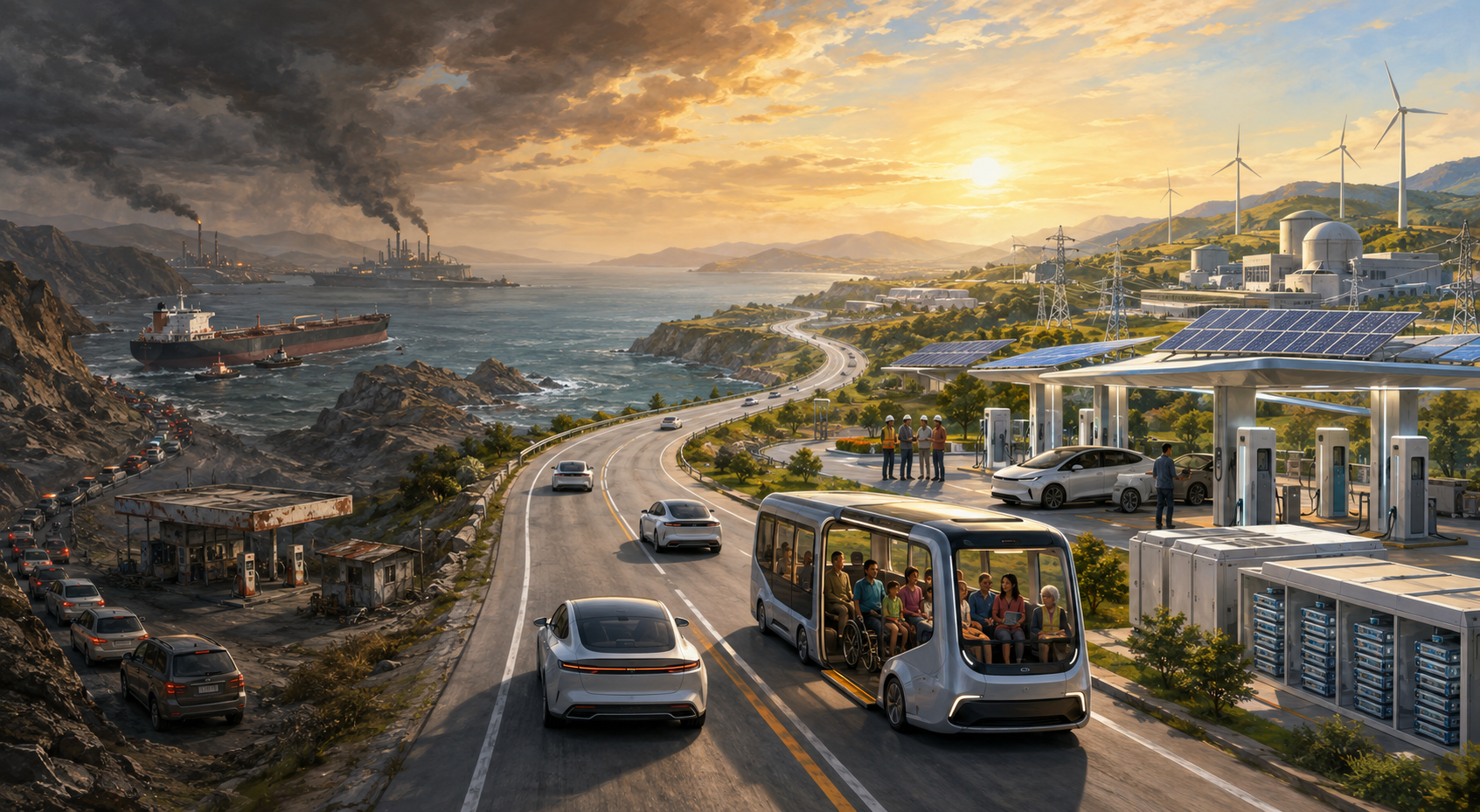
PHOTO ILLUSTRATION- The road to energy independence leads away from weaponized oil chokepoints and toward advanced batteries, trusted autonomous transportation and secure domestic electricity.
The winners of the next transportation revolution will build the longest-lasting batteries, the safest autonomous systems and the secure electricity networks that free nations from weaponized oil chokepoints.
By : Ya Libnan Editorial Board, Opinion
Automobile manufacturers continue investing billions of dollars in gasoline-powered vehicles even as repeated crises demonstrate the danger of tying transportation to a commodity that must cross vulnerable maritime chokepoints.
This is not simply an environmental mistake. It is a failure of strategic imagination.
When Iran threatens the Strait of Hormuz, the consequences are felt far beyond the Middle East. Oil prices rise, transportation costs increase, inflation spreads and governments are forced to release emergency reserves. Families who have never visited the Persian Gulf suddenly pay more to drive to work, heat their homes and purchase food transported by truck.
The International Energy Agency estimates that approximately 20 million barrels of crude oil and petroleum products normally pass through Hormuz each day—close to one-fifth of global consumption. During the 2026 disruption, traffic through the strait was reduced to a trickle, prompting the largest coordinated emergency release of oil reserves in history.
No hostile government should possess that much influence over the daily lives of billions of people.
The automobile industry should therefore stop thinking of electric vehicles primarily as a response to climate change. Electrification is also a declaration of energy independence.
The Wrong Competition
For more than a century, automobile companies competed over horsepower, styling, comfort and brand prestige. Those qualities will remain important, but they will not determine the winners of the next automotive era.
The decisive competition is shifting toward three capabilities:
- Who can produce the safest, longest-lasting and fastest-charging battery?
- Who can develop the most dependable autonomous-driving software and hardware?
- Who can provide the secure electricity required to operate the transportation system?
The vehicle itself is becoming a platform. Its battery will determine how far it travels and how long it lasts. Its intelligence will determine how safely and efficiently it moves. The national electricity system behind it will determine whether it delivers genuine independence.
A beautifully designed electric vehicle connected to an unreliable grid is not a transportation revolution. Neither is an autonomous vehicle whose software cannot be trusted in difficult weather, construction zones or emergencies.
The car of the future must combine dependable hardware, intelligent software and abundant domestic energy.
Why Gasoline Vehicles Have Not Disappeared
Automobile manufacturers are not continuing to produce gasoline-powered cars simply because they are blind to the future.
Consumers remain concerned about purchase prices, charging times, driving range and battery replacement costs. Apartment residents may not have convenient access to chargers. Rural communities and long-distance travelers need reliable charging stations. Electrical grids in many countries are not yet prepared for rapid mass electrification.
Gasoline vehicles also benefit from more than a century of accumulated infrastructure. Filling stations are everywhere, refueling takes minutes and consumers understand the technology.
These are legitimate obstacles—but they are arguments for accelerating innovation, not for accepting permanent dependence on oil.
The transition will not occur by ordering consumers to purchase vehicles that do not yet meet their needs. It will occur when electric vehicles become unmistakably more convenient, economical and dependable than gasoline-powered alternatives.
That requires better batteries.
The Battery Is the New Engine
For the twentieth-century automobile, the engine was the heart of the vehicle. In the twenty-first century, that role belongs to the battery.
The ideal battery must travel farther, charge faster, survive more cycles, operate safely in extreme temperatures and rely on materials obtained from diversified and responsible sources. It should also be recyclable, with used vehicle batteries finding a second life in homes, businesses or electrical grids.
Solid-state batteries may eventually offer greater energy density and improved safety because they replace flammable liquid electrolytes with solid materials. Other chemistries may reduce reliance on scarce or geographically concentrated minerals. No single technology has yet won the race.
Governments should treat battery research with the same strategic seriousness once given to oil exploration, aerospace and semiconductor development.
Countries that manufacture advanced batteries will gain industrial power. Countries that depend entirely on foreign batteries may merely exchange dependence on imported oil for dependence on imported minerals and technology.
Energy independence does not mean moving from one vulnerable supply chain to another. It means diversifying raw materials, developing recycling systems, maintaining domestic manufacturing capacity and cooperating with reliable partners.
Intelligence Will Matter as Much as Range
The second great competition involves autonomous driving.
A truly self-driving vehicle could transform transportation more profoundly than electrification alone. Instead of sitting unused for most of the day, a shared autonomous vehicle could transport one passenger after another. Families might no longer need two or three cars. Elderly and disabled people could gain new independence. Traffic accidents caused by fatigue, distraction and intoxication could decline dramatically.
Fewer privately owned cars could also reduce the need for enormous parking garages and surface parking lots. Valuable urban land could be converted into housing, parks, medical facilities, warehouses or community spaces.
But autonomy must not be introduced through promises and marketing slogans.
A system that works perfectly 99 percent of the time may still be dangerous if the remaining one percent includes children crossing streets, emergency vehicles, heavy rain or unexpected road construction.
Autonomous-driving systems require transparent safety standards, independent testing, cybersecurity protections and clear legal responsibility when something goes wrong. Manufacturers should not be permitted to investigate themselves and declare their own systems safe.
The competition should not be over who releases autonomous software first. It should be over who earns the public’s trust.
The UN Has a Role—but Cannot Do It Alone
Transportation is inherently international. Vehicles cross borders, manufacturers sell in multiple markets and software updates can affect millions of cars simultaneously. A fragmented system of conflicting national standards would slow innovation and weaken safety.
The United Nations Economic Commission for Europe has already taken an important step. In June 2026, its World Forum for Harmonization of Vehicle Regulations approved the first global framework legally enabling fully autonomous driving systems.
That work should be expanded.
The international community needs compatible standards for autonomous-driving safety, vehicle cybersecurity, battery testing, charging connectors, emergency response and battery recycling. An electric vehicle should be able to travel across borders without encountering incompatible charging systems. An autonomous system approved for public roads should meet rigorous and internationally understood safety requirements.
The UN can convene governments and help establish common rules. The International Energy Agency can coordinate energy-security planning. Universities can perform independent research. Private companies can supply innovation, investment and manufacturing.
But international organizations should establish the playing field, not choose the commercial winners. Competition must remain vigorous because competition—not bureaucracy—will produce better batteries, safer software and more affordable vehicles.
Governments Must Lead the Transition
The transition cannot be left entirely to the automobile industry or the marketplace. Companies naturally concentrate on their next quarter, their existing factories and the products consumers are purchasing today. Governments must look decades ahead and prepare the country for needs that the market alone may recognize too late.
This does not mean governments should design cars or select favored manufacturers. It means they must establish a clear national strategy, set realistic timetables and create the conditions that allow industry and consumers to make the transition successfully.
Governments should direct public investment toward battery research, domestic manufacturing, mineral recycling, charging networks and electrical-grid modernization. They should encourage automobile companies to convert existing factories and help workers acquire the skills required to manufacture batteries, electric drivetrains, sensors and autonomous systems.
They must also ensure that charging is available not only in wealthy neighborhoods, but in apartment buildings, rural communities, public parking facilities and along major highways. Building codes should require new homes, offices and garages to accommodate vehicle charging. Existing gasoline stations should be encouraged to evolve into energy and mobility centers rather than being abandoned as obsolete properties.
Public transportation must also become part of the strategy. Electric buses, autonomous shuttles and shared vehicles can reduce congestion and provide mobility to people who cannot afford or operate a private automobile.
Most importantly, governments must coordinate the transition between industries. There is little value in producing millions of electric vehicles if the grid cannot charge them, if power generation remains inadequate or if battery materials come from another politically vulnerable supply chain.
The state’s role is therefore not to replace private enterprise, but to provide direction, infrastructure and consistency. Industry should compete over who produces the best technology, while government ensures that the roads, electrical systems, safety standards and skilled workforce are ready to support it.
America’s interstate highway system was not created by automobile manufacturers. Airports were not built by aircraft companies alone. The internet itself grew from public research and national investment before private enterprise transformed it into a global commercial force.
The next transportation revolution will require the same combination: government vision, public infrastructure and private innovation.
Electrification Requires an Electricity Strategy
Electric vehicles do not eliminate the need for energy. They transfer demand from oil wells and refineries to power plants and electrical grids.
If millions of vehicles are electrified without expanding electricity production, transmission and charging capacity, drivers will exchange gasoline shortages for power shortages.
The transportation strategy of the future must therefore be inseparable from a national electricity strategy.
Countries need a dependable combination of nuclear power, renewable energy, storage and flexible generation. They need modern transmission networks, intelligent charging systems and protection from cyberattacks. Vehicles should be encouraged to charge when electricity demand is low rather than simultaneously during peak hours.
Properly managed, millions of electric-vehicle batteries may eventually help stabilize the grid by storing electricity when it is abundant and returning some of it when demand rises.
The automobile would then become more than transportation. It would become part of the national energy system.
Energy Independence Is National Security
Oil-producing countries will continue to play an important role in the global economy for decades. Petroleum remains essential to aviation, shipping, petrochemicals and many industrial processes. The transition cannot occur overnight, and attempting to force it faster than infrastructure permits could produce higher prices and public resistance.
But every electric vehicle placed on the road reduces the amount of oil that must be imported, transported through a chokepoint and defended by military forces.
That is why battery research, autonomous-driving technology and power-grid modernization should be regarded as national-security investments.
Nations spend enormous sums protecting oil routes after crises erupt. A portion of that money would be better spent reducing the vulnerability before the next crisis begins.
The cheapest barrel of oil to protect is the barrel transportation no longer requires.
The Road Ahead
The automobile industry is approaching a historic choice.
It can continue improving a twentieth-century machine whose fuel leaves consumers exposed to distant wars, hostile regimes and unstable chokepoints. Or it can build a new transportation system based on domestic electricity, advanced batteries and safe autonomous intelligence.
Gasoline cars will not vanish tomorrow. Electric vehicles will not immediately satisfy every driver, and fully autonomous transportation still faces serious technological and regulatory obstacles.
But the direction should now be unmistakable.
The future belongs to the companies that deliver greater range, faster charging, longer battery life and autonomous systems worthy of public trust. It belongs to countries that generate dependable electricity and secure their critical supply chains. And it belongs to governments wise enough to coordinate the transformation and establish common standards without suppressing innovation.
The car of the future will not merely carry us from one destination to another.
It will determine whether our mobility remains hostage to the world’s most dangerous chokepoints—or becomes powered by intelligence, innovation and genuine energy independence.
