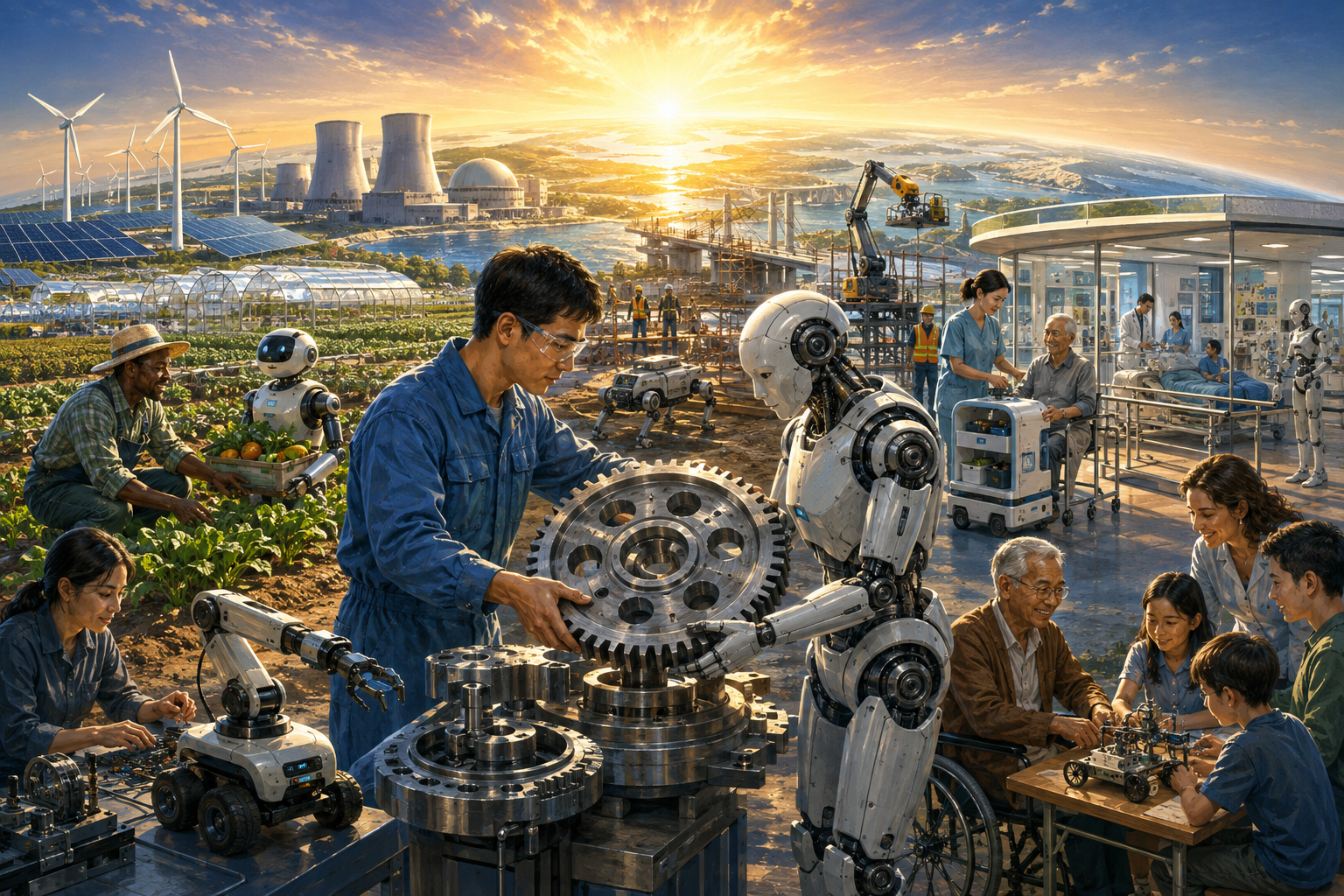
Photo illustration: Robotics will shape every pillar of future development. The nations that unite human ingenuity with intelligent machines will build a healthier, more productive and more prosperous world.
Half a century ago, American factories were pioneering complete automation while China was scarcely visible on the manufacturing map. China’s rise is not a reason for resentment—it is a warning that invention without industrial strategy cannot preserve leadership.
By The Editorial Board , Opinion
In the early 1970s, I managed a project to build a factory in Brazil that would manufacture air-conditioning units through complete automation.
Westinghouse’s Manufacturing Development Laboratories worked with me to develop the production system. The project was ultimately cancelled for financial reasons, but the technology, expertise and industrial vision already existed.
At the time, Westinghouse operated a highly automated air-conditioning plant in Norman, Oklahoma. That facility began shipping commercial HVAC systems in 1971.
China was then scarcely visible on the global manufacturing map.
Half a century later, China operates approximately two million industrial robots and installs roughly ten times as many new robots annually as the United States. China has made robotics and “embodied intelligence”—AI placed inside physical machines—central components of its national industrial strategy.
What happened?
China did not cause America to forget how to manufacture. America gradually convinced itself that invention mattered more than production, financial engineering mattered more than industrial engineering and quarterly returns mattered more than long-term national capability.
China did not steal a race America had never entered.
America began the race—and then wandered away from the track.
The Robot Revolution Is No Longer Science Fiction
Approximately 4.66 million industrial robots were operating in factories worldwide by the end of 2024. More than 542,000 new units were installed during that year alone—more than double the annual number installed a decade earlier.
Traditional industrial robots have been welding automobile bodies, painting vehicles, assembling electronics and handling materials for years. They are dependable but generally programmed to perform repetitive tasks within controlled environments.
The emerging revolution is different.
Artificial intelligence is giving robots the ability to recognize objects, understand instructions, learn from human demonstrations and adapt to changing conditions. AI is leaving the computer screen and acquiring eyes, hands, wheels and legs.
That is the meaning of physical AI.
Humanoid robots are now moving beyond staged demonstrations and entering limited commercial service.
Figure AI’s humanoid robot worked on an active BMW assembly line in South Carolina. According to the company, Figure 02 operated 10-hour shifts, loaded more than 90,000 components and contributed to the production of 30,000 vehicles.
Agility Robotics’ Digit has been commercially deployed in a GXO logistics facility, where it moves containers between mobile robots and conveyor systems. The company reports that Digit has handled more than 100,000 containers in actual operations.
Apptronik is testing its Apollo humanoid robot with Mercedes-Benz. Boston Dynamics and Hyundai plan to introduce the electric Atlas robot into Hyundai factories. Tesla is developing Optimus and hopes eventually to manufacture humanoid robots on an enormous scale.
These machines cannot yet perform every job a person can perform. Many require carefully controlled environments, limited assignments and occasional human assistance. Household robots face particularly difficult challenges because every home, staircase, kitchen, child and pet creates unpredictable conditions.
But the direction is now unmistakable.
Robots are evolving from machines that repeat movements into machines that interpret situations.
China Did Not Merely Discover Cheap Labor
Many Americans still view China’s industrial rise as the result of inexpensive labor. That explanation is dangerously outdated.
China is now one of the world’s most automated manufacturing economies. In 2024, it operated approximately 567 industrial robots for every 10,000 manufacturing employees. The corresponding American figure was around 300.
China installed approximately 295,000 industrial robots in 2024, accounting for 54 percent of global installations. The United States installed approximately 34,200.
This extraordinary difference did not appear accidentally.
China built ports, highways, power plants, industrial parks and manufacturing clusters. It trained engineers and technicians, supported domestic suppliers and used its enormous market to develop scale. It welcomed foreign factories, studied their methods and gradually created its own competitors.
China initially used its labor force to attract production. It then used production to acquire knowledge. It used that knowledge to develop supply chains. It is now using those supply chains to automate.
China has placed robotics at the heart of its Fifteenth Five-Year Plan. A state-backed investment initiative focused on robotics, AI and other advanced technologies is expected to attract nearly $138 billion over two decades.
Its objective is not simply to purchase robots. It is to manufacture the motors, sensors, gears, batteries, chips and software that make robots possible.
This is not a reason to condemn China. It is a reason to study it.
America Confused Invention With Leadership
The United States has repeatedly demonstrated an extraordinary ability to invent the future.
American laboratories helped pioneer semiconductors, computers, the internet, artificial intelligence and robotics. Westinghouse was building experimental robots as early as the first half of the twentieth century. American factories were exploring advanced automation while much of the world was still struggling to industrialize.
But invention does not guarantee permanent leadership.
A nation cannot develop technology, transfer its manufacturing overseas and confidently assume that the knowledge will remain at home.
Manufacturing is not merely the final execution of an idea. It is part of the innovation process.
Factory employees discover how to improve quality. Production engineers redesign products so they can be manufactured more efficiently. Suppliers develop stronger materials and more precise components. Technicians solve problems that never appeared in the laboratory. Each production cycle teaches the manufacturer how to improve the next one.
When production leaves, this accumulated knowledge eventually follows it.
America attempted to retain design, finance, software, patents and branding while allowing other countries to perform much of the manufacturing.
That separation worked temporarily. It did not work permanently.
America transferred production. China acquired an education.
Quarterly Capitalism Defeated Industrial Patience
The automated Brazilian factory I managed was cancelled for financial reasons, not because the concept or technology was impossible.
One cancelled plant cannot determine a nation’s future. But thousands of similar decisions can establish a national pattern.
American executives increasingly faced pressure to reduce immediate costs, improve quarterly earnings and maximize shareholder returns. Moving production to a lower-cost country could generate measurable savings quickly. Constructing an advanced domestic factory required large capital expenditures, patient management and years of development.
Wall Street rewarded the visible saving. It rarely measured the industrial capability that was being surrendered.
China operated on a different timetable. Its governments, banks, universities and companies were often prepared to invest for years in infrastructure, workforce development and manufacturing capacity.
America optimized the quarterly report.
China optimized the industrial ecosystem.
Manufacturing Was Mistaken for Yesterday’s Economy
For decades, Americans were told that advanced countries naturally become service economies. Manufacturing was portrayed as repetitive work that could be transferred to developing nations while Americans moved into management, finance, technology and professional services.
This was a profound strategic error.
When factories departed, toolmakers, component suppliers and production engineers often went with them. Technical education programs weakened because fewer local employers needed their graduates. Communities lost not only assembly lines but also the ecosystems required to support future factories.
America retained highly advanced manufacturing in aerospace, defense, pharmaceuticals, semiconductors and other critical industries. It remains a major manufacturing power and operates the world’s third-largest stock of industrial robots.
But important gaps developed.
The United States now imports most of its industrial robots from Japan and Europe. It relies upon foreign supply chains for many motors, sensors, batteries, electronic components and machine tools.
America may design some of the world’s most intelligent robotic brains. Unless it restores the manufacturing ecosystem, those brains may inhabit bodies built elsewhere.
Trade Without an Industrial Strategy
China’s entry into the World Trade Organization in 2001 greatly accelerated its integration into global manufacturing.
American policymakers expected lower consumer prices, increased exports and gradual political and economic convergence. Trade did deliver real benefits, but its domestic costs were underestimated.
Imports surged in industries that experienced some of the greatest American employment losses. Factories closed faster than many affected communities could adjust. Workers who had spent decades acquiring manufacturing skills frequently discovered that the promised replacement jobs either did not exist or paid considerably less.
The mistake was not engagement with China itself.
The mistake was pursuing global trade without an equally serious national strategy for automation, investment, technical education, worker retraining and industrial renewal.
Trade policy was treated as an economic theory. China treated manufacturing as a national mission.
America Still Possesses Formidable Advantages
This story is not over.
The United States remains exceptionally strong in artificial intelligence, software, advanced semiconductor design, research universities, national laboratories, aerospace, defense technology and venture capital.
It has promising robotics companies including Figure AI, Agility Robotics, Apptronik and Tesla. Boston Dynamics, although owned by South Korea’s Hyundai, remains deeply rooted in American research and engineering.
America’s entrepreneurial culture can move rapidly when capital, technology and national purpose converge.
But it needs a coherent robotics strategy—not scattered programs distributed across defense, AI, scientific research and industrial policy.
The objective should not be to duplicate China’s political or economic system. Nor should government attempt to select a single national robot manufacturer.
Government should establish the conditions in which many companies can compete successfully.
A National Robotics Strategy
America and other countries seeking to preserve industrial independence should act on several fronts.
First, they should support research not only into AI software, but also into the physical components robots require: motors, actuators, sensors, machine vision, batteries, precision gears and advanced materials.
Second, they should help small and medium-sized manufacturers adopt automation. Large corporations can afford teams of engineers and system integrators. Smaller factories often cannot carry the initial cost and disruption alone.
Third, technical education must be restored to a place of honor. Automated factories need robotics technicians, electricians, machinists, programmers, maintenance specialists and production engineers. These are sophisticated careers, not consolation prizes for people who did not attend universities.
Fourth, governments should establish rigorous standards for worker safety, cybersecurity and accountability. A compromised industrial robot could disrupt production, damage equipment or injure workers.
Fifth, workers must share in the productivity gains. A robotics strategy that enriches only shareholders while displacing employees will provoke understandable resistance. Governments and companies should provide retraining, portable benefits, transition assistance and opportunities for employees to acquire ownership in the more productive economy.
Finally, international cooperation must continue. America should work with Europe, Japan, South Korea and other partners to develop resilient supply chains and compatible safety standards.
Strategic independence does not require isolation.
The Test Is Not Whether a Robot Can Dance
Humanoid robots generate publicity by dancing, running and performing carefully rehearsed household tasks. Those demonstrations are impressive, but they are not the correct measure of industrial progress.
The real questions are more demanding:
Can the robot perform useful work safely for thousands of hours?
Can it adapt when an object is moved or something unexpected occurs?
Can it operate without constant human supervision?
Can it be repaired quickly?
Can it perform the task at a cost lower than the alternative?
A robot that succeeds in a five-minute demonstration may still fail economically. A less glamorous machine that works reliably throughout a factory shift may transform an industry.
Robotics leadership will belong not to the country producing the most spectacular video, but to the country capable of manufacturing, deploying and continually improving millions of useful machines.
The Lesson Is Not That China Should Slow Down
China recognized that manufacturing, automation and robotics would shape the next industrial age. It developed a long-term strategy and acted upon it.
Its achievement should not be dismissed as the product of cheap labor, nor should it be answered solely with tariffs and accusations.
The proper response is competition.
America and other nations must rediscover the connection between invention and production, between laboratories and factories, and between national prosperity and the ability to build physical things.
More than fifty years ago, I witnessed an American company developing the technology for factories that could operate through comprehensive automation. The future was already visible.
But seeing the future is not enough.
A country must finance it, manufacture it, train people for it and remain committed long enough to make it real.
China did not cause America to abandon that commitment. China demonstrated what sustained industrial strategy can accomplish.
The lesson is not that China should slow down.
It is that America—and every other country hoping to participate in the robotic future—must wake up.
Note to readers :
The author is a former Westinghouse executive who managed in the early 1970s a project to build a factory in Brazil that would manufacture air-conditioning units through complete automation. The project was canceled after Westinghouse missed the profit estimate for the quarter . That was the beginning of the end of Westinghouse . George Westinghouse started the Westinghouse Electric Company in 1886 in Pittsburgh. Today, the iconic name lives on mostly through trademark licensing on consumer goods and separate corporate entities that bought pieces of the industrial giant.
