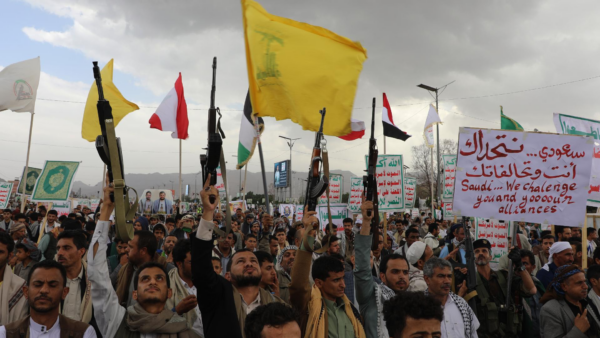
Houthi supporters attend a rally against the Saudi-led coalition in Sanaa, Yemen, Friday, July 31, 2026. AP
Here is the latest
The conflict in Iran continues to spread throughout the Middle East, as Iranian-backed Houthi rebels fight in Yemen and Israel continues its campaign against Hezbollah in Lebanon.
Meanwhile, the Strait of Hormuz remains closed to most traffic, continuing an impasse that has complicated international trade and led to higher gas prices across the U.S.
President Donald Trump on Monday said that since Iran is seeking compensation as part of any peace talks, he’ll demand the same. It’s part of a larger pivot by Trump, who’s arguing that Iran is on the cusp of financially collapsing, even though the decades of financial sanctions it faces aren’t an immediate conflict-ending tool.
Houthis hit targets in central Yemen and Red Sea port city
Iranian-backed Houthi rebels in Yemen attacked the government-held port city of Mokha on the Red Sea coast and other areas of the country, deepening fears over threats to strategic shipping routes and a potential return to civil war.
Yemen’s military said the rebels targeted both Mokha and the central province of Marib with missiles and drones but did not provide further details.
The Houthis struck Marib and the eastern province of Hadramout last week, killing dozens of government troops and civilians. They hit Mokha with missiles and drones over the weekend and killed at least seven people, including three troops, according to the Yemeni military.
Mokha is a main port under Yemen’s internationally recognized government and has been renovated to handle shipping to avoid the Houthi-held port of Hodeida.
The strikes came as part of a recent escalation by the Houthis against government forces in Yemen and oil facilities in neighboring Saudi Arabia, which supports the internationally recognized Yemeni government, and the kingdom’s shipping in the Red Sea.
With the Strait of Hormuz effectively shut down by Iran, there has been a renewed focus on the Red Sea and Bab el-Mandeb Strait at Yemen’s southern tip, which is an alternate route for Saudi Arabia to ship its oil to open oceans.
Trump also claimed Monday in an Oval Office exchange with reporters that the U.S. has “100% control” of the Strait of Hormuz, but that the situation remains complex.
He said the U.S. Navy’s blockade is preventing Iran from selling its oil on the international market, effectively choking the Iranian economy.
“Now, can they make trouble? Yeah, they can make trouble, but they’re broke,” Trump said.
Why are the U.S. and Iran at war?
The U.S. and Iran have been at war since the end of February, when a coalition of strikes from the U.S. and Israel kicked off the conflict. Since then, U.S. and Iranian missiles have flown over the Middle East.
President Donald Trump said the strikes were a preemptive measure designed to ensure Iran will never be able to enrich uranium into a nuclear weapon. But his administration has offered no evidence Iran was close to developing a bomb.
The U.S. has not committed any ground troops to the conflict, but it maintains a presence at a series of bases in the Middle East to help stabilize the region. These bases are the main targets for Iranian strikes, and at least 18 U.S. service members have died so far during the war.
As the war has raged on, Iran has begun using a critical asset in peace negotiations.
The Strait of Hormuz, a narrow waterway through which about a fifth of the world’s oil supply flows, is directly south of Iran.
Since the beginning of the conflict, Iran has refused to allow most ships to pass through, crippling oil markets across the globe and leading to domestic gas prices rising in the U.S.
There doesn’t seem to be an end to the war in sight, despite repeated insistences by Trump that a deal with Iran is imminent.
A one-time ceasefire over the summer failed to lead to any major diplomatic breakthroughs, and attacks on ships in the Strait of Hormuz led to a breakdown of talks and renewed fighting in the region.
CBS
