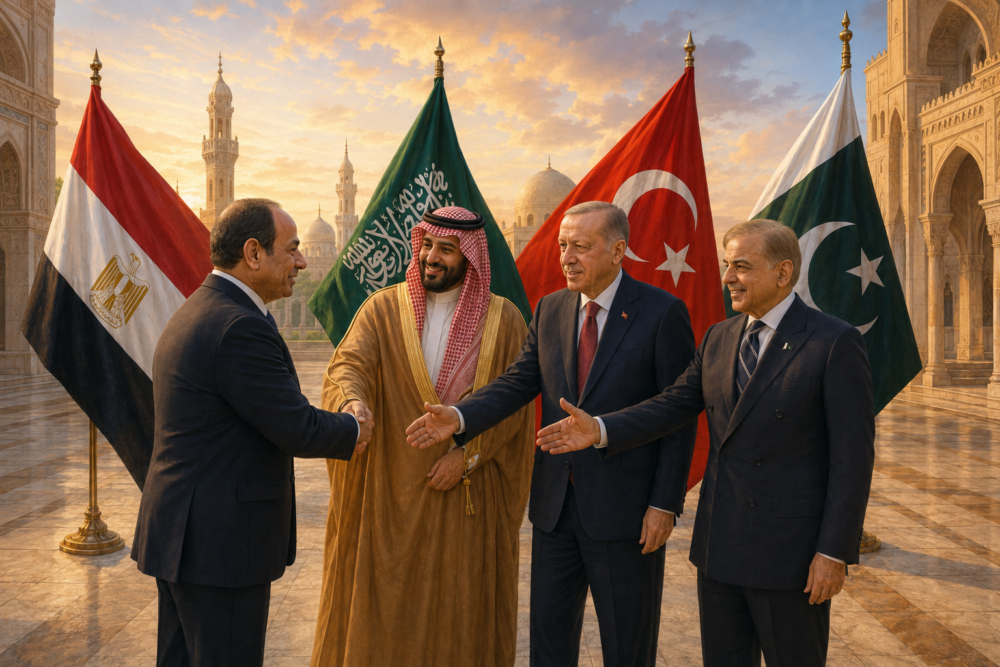
Illustration photo-From left to right: Egyptian President Abdel Fattah el-Sisi, Saudi Crown Prince Mohammed bin Salman, Turkish President Recep Tayyip Erdoğan and Pakistani Prime Minister Shehbaz Sharif
Egypt’s participation could transform the Mecca agreement from a pact among three countries into the foundation of a credible regional defence system.
By: The Editorial Board, Opinion
The Mecca Joint Defence Agreement signed by Saudi Arabia, Turkey and Pakistan could become the foundation of a new regional security architecture. Its central principle—that an armed attack against one member will be treated as an attack against all—is both timely and necessary.
Iran and its proxies have demonstrated how missiles, drones and attacks on shipping can threaten not merely one country, but the security and economic stability of the entire region. No state can confront these dangers alone.
Yet one country is conspicuously absent: Egypt.
Egypt participated with Saudi Arabia, Turkey and Pakistan in the four-country consultations that preceded the agreement. Turkish Foreign Minister Hakan Fidan has described Egypt as a “natural partner” and expressed confidence that Cairo could eventually join once certain “technical issues” are resolved.
Those issues, however, are not merely technical. They touch directly upon Egyptian sovereignty, constitutional authority and national security.
Egypt belongs in the Mecca agreement. It possesses the Arab world’s largest army, controls the Suez Canal, overlooks both the Mediterranean and Red seas and occupies an indispensable position between Africa, Asia and the Arab world. No regional defence structure can reach its full political or military potential without Cairo.
But Egypt should not sign a blank check.
The obligations must be clearly defined
The agreement declares that an attack against one member will be considered an attack against all. But what would that require in practice?
Would an Iranian missile against Saudi Arabia automatically oblige Egypt to send combat forces? Would an attack against Turkish troops stationed outside Turkey be treated as an attack against Turkish territory? Could Egypt be drawn into Turkey’s military operations in Syria or Iraq—or into another conflict in western Libya?
Could a clash between Pakistan and India activate the same collective-defence provision?
These are not hypothetical technicalities. They are questions of war and peace.
Before Egypt joins, the agreement must clearly distinguish between an attack on a member’s internationally recognized territory and an attack on that member’s forces operating abroad. No country should be able to deploy troops into another state and then expect every alliance member automatically to defend that intervention.
Turkey must respect Arab sovereignty
The dispute between Egypt and Turkey over the Muslim Brotherhood has largely been contained. Diplomatic relations have been restored, inflammatory media activity has been restricted and military cooperation between Cairo and Ankara is expanding.
This progress should be welcomed. But restoring relations does not erase the causes of the original rupture.
For years, Turkey supported political Islamist organizations and expanded its military involvement across the region. Its continued presence and influence in western Libya remain particularly sensitive for Egypt, whose national security is directly affected by instability along its western border.
Egypt therefore has every right to demand a binding commitment to noninterference in the internal affairs of member states and respect for the sovereignty of Arab countries.
The Mecca agreement must never become a mechanism through which one member legitimizes its foreign deployments and obliges the others to defend them.
Egypt must retain the right to decide when it fights
The Egyptian Constitution imposes clear requirements on sending combat forces abroad. Such action requires consultation with the National Defence Council and the approval of a two-thirds parliamentary majority.
Therefore, Egyptian membership cannot mean automatic participation in every war involving another signatory.
The agreement should require immediate consultation after an attack, followed by assistance determined by each member in accordance with its constitution. That assistance could include intelligence sharing, missile interception, logistical support, maritime protection or humanitarian relief without necessarily requiring the deployment of combat troops.
Collective defence should create solidarity, not eliminate national sovereignty.
Existing treaties must be protected
Egypt must also ensure that joining the agreement does not undermine its international obligations, including its peace treaty with Israel, its military relationship with the United States and its partnerships with Greece and Cyprus.
Cairo should never be placed in a position where it must choose between its existing commitments and the ambitions of another alliance member.
Nor should Turkey’s disagreements in the eastern Mediterranean become Egypt’s disagreements. The agreement should explicitly state that it does not supersede existing treaties or require members to participate in territorial disputes predating their accession.
Saudi-UAE competition must remain outside the alliance
The growing rivalry between Saudi Arabia and the United Arab Emirates is another factor Cairo cannot ignore.
Egypt enjoys essential strategic and economic relationships with both Riyadh and Abu Dhabi. It should not be forced to choose between them.
Saudi-Emirati differences over Yemen, Sudan, regional investment and political influence must not be imported into the Mecca agreement. The alliance should remain open to the UAE and other Gulf Cooperation Council states, provided they accept its defensive principles.
A regional security system divided into competing Saudi and Emirati camps would weaken every Arab country and create opportunities for Iran and other outside powers to exploit.
The objective should be to unite the region against aggression—not reorganize it around new rivalries.
Egypt should negotiate, not remain outside
Egypt should not reject the Mecca agreement because of these concerns. It should use its strategic importance to improve it.
Cairo should propose several conditions for joining:
- A precise definition of what constitutes an attack activating collective defence.
- No automatic commitment to deploy combat forces.
- No collective protection for unauthorized military interventions or proxy forces operating abroad.
- Respect for every member’s constitution, sovereignty and existing international treaties.
- A binding principle of noninterference in the internal affairs of other states.
- Collective decision-making in which no single country dominates the alliance.
- An initial operational focus on missile and drone defence, maritime security, intelligence sharing and counterterrorism.
- A commitment that the alliance will not become a Sunni-versus-Shiite coalition or target any people, religion or sect.
These conditions would not weaken the agreement. They would give it credibility.
Saudi Arabia brings economic and political weight. Turkey brings a powerful military and an advanced defence industry. Pakistan brings military experience and strategic deterrence. Egypt would bring geographical centrality, control of one of the world’s most important waterways and the military and political weight needed to turn a trilateral pact into a genuine regional institution.
Qatar, Kuwait, Jordan and other countries may eventually join. But Egypt’s accession would be the development that transforms the Mecca agreement from a coalition of three governments into the possible foundation of a wider Arab and Islamic collective-security system.
Egypt belongs in the Mecca Joint Defence Agreement. But belonging does not require unquestioning acceptance.
Cairo has every right—and an obligation to its people—to establish the conditions under which Egyptian soldiers may be sent into danger.
If the three founding members accept those legitimate safeguards, Egypt should join. Its participation could help turn an ambiguous declaration into the responsible, inclusive and effective defence system the region urgently needs.
