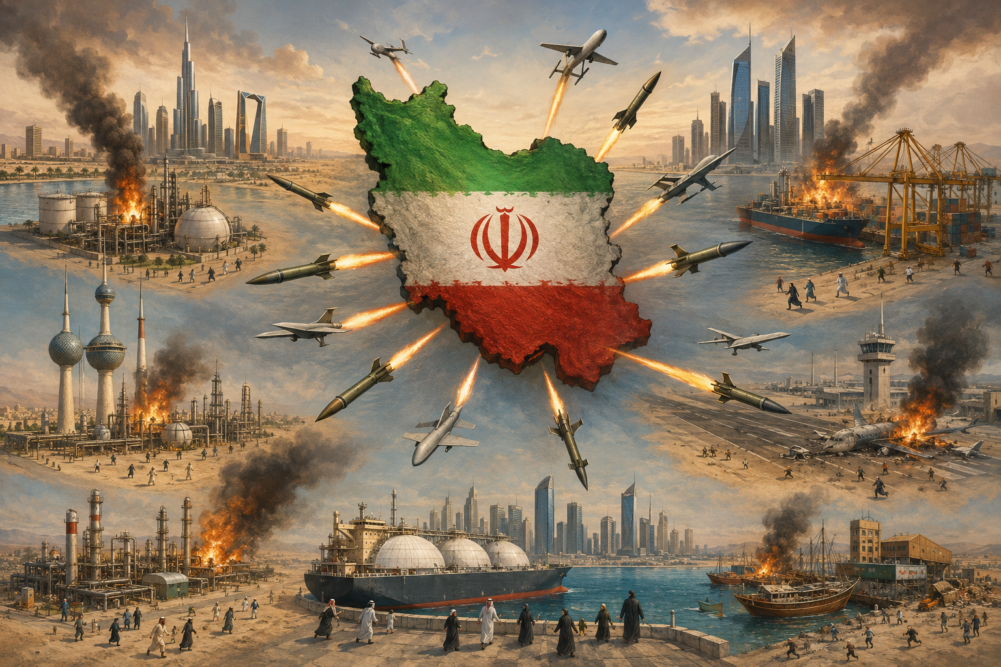
Illustration- Iran calls for solidarity with the Muslim world while its missiles, drones and proxies attack the Muslim countries it asks to stand beside it.
Araghchi cannot preach Muslim solidarity while Iran attacks its Muslim neighbors, targets their infrastructure and uses arms militias that undermine their sovereignty.
By: The Editorial Board, Opinion
Iranian Foreign Minister Abbas Araghchi declared that Iran’s “powerful armed forces” had demonstrated their “readiness, capability and might” in confronting “the world’s most powerful military.”
He then appealed for Islamic unity:
“When Muslims stand together, we can face every challenge by malicious outsiders head-on. It is time to rely only on ourselves and embrace true brotherhood.”
Araghchi should have covered his face in shame before uttering those words.
His statement followed the signing of the Mecca Joint Defense Agreement by Saudi Arabia, Pakistan and Turkey. The agreement declares that an armed attack against one of the three countries will be considered an attack against all—a collective attempt to strengthen regional deterrence amid growing instability.
The pact was announced after Iran-backed Houthi forces intensified their attacks against troops belonging to Yemen’s internationally recognized government and threatened Saudi interests. At least 30 Yemeni government soldiers were reportedly killed in Houthi missile and drone attacks in Marib and Hadramout.
Yet Araghchi would have the Muslim world believe that Iran stands ready to defend its neighbors against “malicious outsiders.”
Defend them from whom?
During the war involving Iran, Israel and the United States, Tehran occasionally attacked Israel and American military installations. But the main weight of Iran’s retaliation fell on its Muslim neighbors.
Iranian missiles and drones struck or threatened Bahrain, Jordan, Kuwait, Oman, Qatar, Saudi Arabia and the United Arab Emirates. In the UAE, Qatar and Saudi Arabia especially, Iran’s campaign focused heavily on national infrastructure—including airports, ports, energy installations, industrial facilities and shipping.
These were not merely American military targets located on Arab soil. Many were assets belonging to the countries themselves, essential to their economies and civilian populations.
Iran was therefore not simply using its neighbors’ territory as a battlefield. It was deliberately making their infrastructure part of the battlefield.
Tehran claims that its armed forces confronted Israel and “the world’s most powerful military.” But much of the destruction and danger was imposed upon Muslim countries that had not attacked Iran. While Iranian officials spoke of confronting Washington and Jerusalem, Iranian missiles and drones endangered Arab cities, Arab economies and Arab civilians.
That is not collateral damage incidental to resistance. It is aggression against Iran’s Muslim neighbors.
How, then, can Araghchi ask those same countries to embrace “true solidarity ”? Solidarity does not mean attacking your neighbors’ airports, ports and energy facilities—and then asking them to stand beside you against outsiders.
Iran’s actions in the Strait of Hormuz provide another glaring example of its hypocrisy.
Closing or threatening this vital waterway does not primarily punish the United States. It harms the Muslim countries of the Middle East, endangers Arab ports and energy exports, raises shipping and insurance costs and threatens the livelihoods of millions throughout the region.
The Gulf states depend on safe navigation through Hormuz. By attacking vessels and disrupting maritime traffic, Iran has repeatedly placed the economic security of its Muslim neighbors in jeopardy.
What kind of brother closes his neighbors’ principal commercial artery?
This pattern did not begin with the latest war. Since the establishment of the Islamic Republic in 1979, Tehran has attempted to export its revolution and project power throughout the region. It created, armed and financed proxy organizations in Lebanon, Iraq, Syria, Gaza , Yemen and elsewhere.
These militias did not unite the Islamic world. They fractured it.
Hezbollah weakened the Lebanese state and dragged Lebanon into wars serving Iran’s regional strategy. Iran-backed militias undermined Iraq’s sovereignty. The Houthis devastated Yemen, attacked Saudi Arabia and threatened international shipping. In Syria, Iranian intervention helped prolong a catastrophic conflict.
Iran speaks of resisting foreign interference while interfering relentlessly in the affairs of its neighbors. It invokes Islamic solidarity while arming Muslims to fight other Muslims. It demands trust while threatening governments that refuse to submit to its regional ambitions.
The defense agreement among Saudi Arabia, Pakistan and Turkey is therefore not evidence of Muslim disunity. It is evidence of the distrust Iran itself created.
If Tehran truly believes that regional countries should “rely only on ourselves,” it should begin by respecting their sovereignty. It should stop arming proxies, attacking neighboring countries, threatening international waterways and treating the Arab world as strategic depth for its confrontation with America and Israel.
True brotherhood cannot be proclaimed in a speech. It must be demonstrated through conduct.
Iran cannot set its neighbors’ homes on fire and then invite them to stand beside it against the flames. It cannot attack their cities, cripple their infrastructure and threaten their ports, oil facilities and shipping routes—and then demand that they embrace it as a trusted Muslim partner.
Araghchi is correct about one thing: the countries of the Islamic world should work together and develop the capability to defend themselves.
But Iran’s conduct has taught them that the danger does not come only from “malicious outsiders.”
Sometimes the greatest danger comes from the neighbor who attacks your cities, cripples your infrastructure and then lectures you about brotherhood.
With a neighbor like the Iranian regime, the Islamic world needs no enemies.
