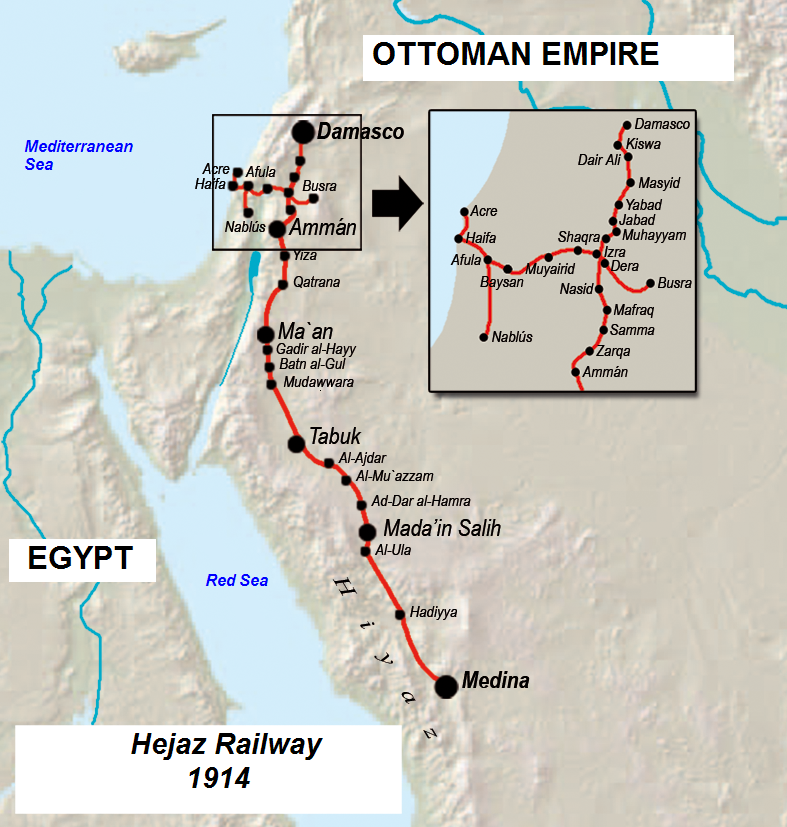
Turkey has expressed its readiness to include Lebanon in the project of reviving the Hejaz Railway—a move discussed during high-level official talks, including meetings with the Turkish leadership in Ankara—aimed at reconnecting regional trade corridors and strengthening economic partnerships and land transport among the region’s nations.
About the Hejaz railway:
The Hejaz railway was a narrow-gauge railway (1,050 mm , about ( 3 ft- 6″) in track gauge) that ran from Damascus to Medina, through the Hejaz region of modern-day Saudi Arabia, with a branch line to Haifa on the Mediterranean Sea. The project was ordered by Sultan Abdul Hamid II in March 1900 .
The current global standard railway track gauge is 4 feet 8.5 inches (1,435 mm), used by about 60% of the world’s tracks. Other common current gauges include broad gauges (like 1,520 mm in Russia and 1,676 mm in India)
It was a part of the Ottoman railway network and the original goal was to extend the line from the Haydarpaşa Terminal in Kadıköy, Istanbul beyond Damascus to the Islamic holy city of Mecca. However, construction was interrupted due to the outbreak of World War I, and it reached only to Medina, 400 kilometres (250 mi) from Mecca. The completed Damascus to Medina section was 1,300 kilometres (810 mi). It was the only railway completely built and operated by the Ottoman Empire.
Complete rebuilding estimates for the historical 1,300-kilometer Hejaz railway from Damascus to Medina range extensively depending on the scope, with broader regional revival initiatives cited at over $200 billion
The historic rail link connecting Beirut and Lebanon’s Bekaa Valley to Damascus opened on August 3, 1895. It later integrated into the broader Ottoman Hejaz railway network. The line ceased operations during the Lebanese Civil War (1975–1990) and fell into complete disrepair.
