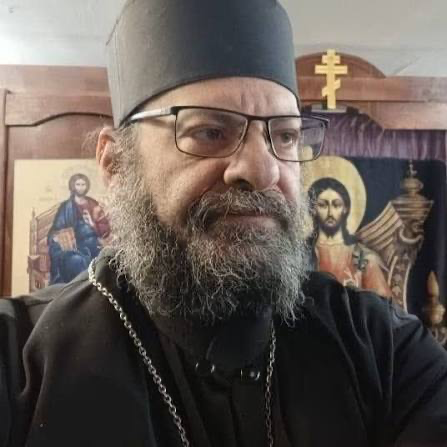
Father Spyridon Tannous, the representative of the Greek Orthodox Church in Syria, addressed a letter to Syrian President Ahmed al-Sharaa, Interior Minister Anas Khattab, and Justice Minister Mazhar al-Alwis. In the letter, he stated: “We wish to explain our concept, vision, and intended steps regarding the statement issued by the parish committees of the Greek Orthodox, Syriac Orthodox, and Greek Melkite Catholic communities in Saidnaya, as well as regarding the prevailing situation as a whole.”
He noted that “the statement is not an escalation, but rather an attempt to convey a message that justice is absent, dignity is being violated, and freedom does not exist.”
He remarked, “Escalation has not yet occurred, and we hope we do not reach that stage,” while warning against the current approach. He explained that “the notion that Christians will not pose an obstacle to the disastrous approach adopted by the current authority is a mistaken one; we hope the authority recognizes this error in thinking and works to correct its course for the sake of the country.”
Father Tannous added: “Within the inner circle of the head of the transitional phase, there are those convinced that Christians can be controlled through deranged individuals consuming tainted Captagon, and through Ahmed Zaidan—who enjoys visiting monasteries to deliver sermons that neither interest the Christian public nor concern them in the slightest.”
He further pointed out that “there are individuals within the inner circle advising the authority based on information riddled with grave errors; continuing to act upon this information could lead to disasters—in every sense of the word.” Father Tannous emphasized that “anyone who mistakenly believes that Christian tolerance and the desire to live in peace render us powerless is leading the country toward dire consequences; the truth is that our reach extends far beyond what some imagine—though I will not elaborate further, lest my meaning be misunderstood.”
He noted that “those who delude themselves into thinking they are emboldened by the support of US President Donald Trump—while violating people’s dignity and freedoms—actually have no idea what Trump truly wants. We, however, do know—and our knowledge does not come from media channels.”
Tannous pointed out that “the handful of Christian figures close to the authorities have no connection to the Christian street or its sentiments; therefore, the authorities must rein in these young men before the situation escalates further.”
He advised “changing the current approach without delay—for the good of the country and its people.”
He stated: “The Syrian revolution arose for the sake of justice, freedom, dignity, and political liberty—not to establish a religious state (whether Sunni, Alawite, or Christian), regardless of its orientation. Syria cannot be governed by religious logic; religion belongs within mosques and churches, where it is honored and respected.”
Meanwhile, the parish committees of the Greek Orthodox, Syriac Orthodox, and Greek Melkite Catholic communities in the town of Saidnaya (in the Damascus countryside) announced the cancellation of all festive activities associated with this year’s religious holidays. This move serves as a protest against the continued detention of several town residents and a demand for their release, as well as a call for information regarding the fate of abducted individuals and the assurance of their safe return. A statement issued by the committees indicated that the decision was made in light of the continued detention of several residents of Saidnaya. It noted that previous appeals and promises regarding their release had not translated into practical steps, and emphasized that the detainees’ families have so far been unable to meet them through security or judicial channels.
The statement highlighted the mistreatment faced by Saidnaya residents—particularly at the Jdeidet Yabous border crossing with Lebanon—where travelers from the town are subjected to hours-long search and screening procedures. These include photographing individuals and transmitting their data for review before passage is granted, with no special consideration given to the elderly or women.
It also addressed ongoing campaigns of incitement and threats on social media, alongside a rise in theft and kidnapping incidents. These circumstances prompted representatives of the town’s three Christian denominations, in coordination with the clergy, to decide to cancel all festive activities associated with the feasts of the Transfiguration, the Dormition (Assumption), the Holy Cross, and Hagia Sophia, limiting observances to prayers held inside the churches.
The committees affirmed that the suspension of celebrations would remain in effect until the detainees are released, the kidnapped and displaced residents return, and the targeting of the town’s youth at checkpoints ceases. They called for the application of justice to all parties without exception, the opening of all relevant files, and the holding of those responsible for violations accountable, ultimately aiming for a genuine national reconciliation based on the principles of justice and citizenship.
The committees concluded their statement by reaffirming the residents’ commitment to their right to express their demands peacefully and civilly, should legal and legislative solutions regarding the issue of detainees and kidnap victims continue to stall.
Source: El Nashra, translated from Arabic
