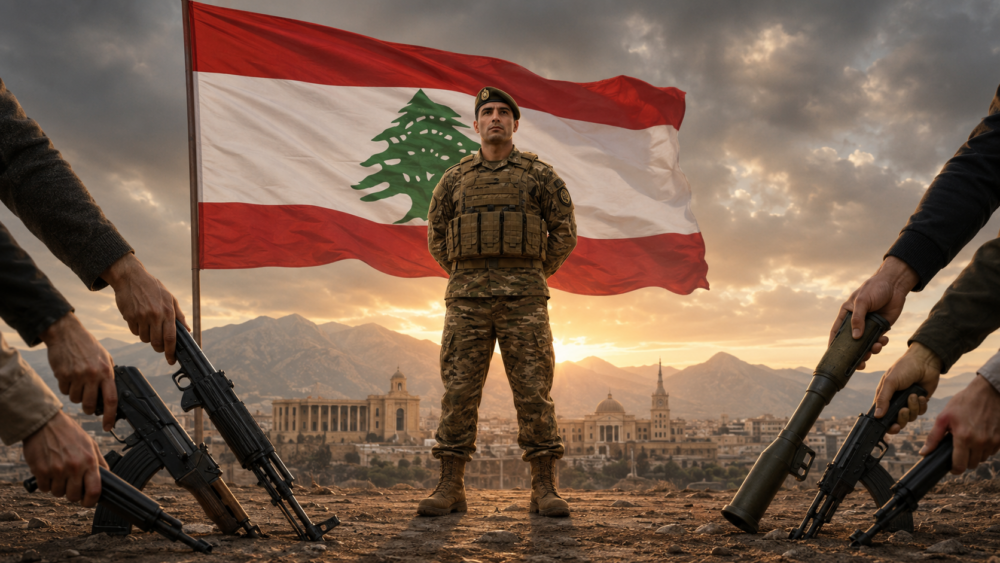
ILLUSTRATION- One nation, one army, one authority: In a sovereign Lebanon, no armed group can stand above the state.
Iraq has imposed a deadline and promised consequences. Lebanon has produced phases, extensions and excuses. Sovereignty cannot survive when armed factions are permitted to veto the authority of the state.
By : Ali Hussein, Lebanese Political Analyst. Opinion
The new Iraqi government of Prime Minister Ali al-Zaidi has given armed factions until September 30, 2026, to surrender their weapons and accept a fundamental principle of national sovereignty: No organization outside the state may maintain an independent military force.
After that date, al-Zaidi has declared, Iraq will not permit any entity other than the state to carry weapons. Some powerful Iran-backed factions have reportedly begun cooperating, while others—including Kataib Hezbollah and Harakat al-Nujaba—continue to resist. Baghdad’s determination therefore remains to be tested. Nevertheless, Iraq has done something Lebanon has repeatedly avoided: It has established a clear deadline and publicly placed armed organizations on notice. Associated Press, The National
The Iraqi government has also warned that groups refusing to surrender their weapons will face prosecution under the country’s weapons and penal laws. Potential measures include arrests, financial sanctions, asset freezes and the confiscation of militia headquarters. Baghdad has additionally begun confronting militia influence within official military and security institutions.
These measures do not guarantee success. Powerful militias do not disappear merely because a government issues an ultimatum. Questions remain about which organizations must disarm, how weapons will be transferred and whether Baghdad possesses the political and military strength to enforce its decision.
But Iraq has at least recognized an essential truth: A deadline without consequences is only a suggestion.
Lebanon’s open-ended roadmap
Lebanon took an important step on August 5, 2025, when the government instructed the Lebanese Army to prepare a plan establishing a state monopoly over weapons. The resulting “Homeland Shield” plan divided the country into five geographical phases:
- South of the Litani River
- From the Litani to the Awali River
- Beirut and its suburbs
- The Bekaa Valley
- Northern Lebanon and the remaining regions
The first phase has largely been completed, and operations have moved northward. That is genuine progress, and the Lebanese Army deserves recognition for carrying out an extraordinarily sensitive mission under dangerous conditions.
The weakness lies in what comes afterward.
The later stages have no firm national completion date. Their implementation remains subject to logistical capabilities, political negotiations, sectarian sensitivities, changing conditions on the ground—and, inevitably, Hezbollah’s objections.
In other words, Lebanon has a sequence but not a deadline, an objective but not an ultimatum, and laws but no clearly announced enforcement mechanism.
That is not enough.
Hezbollah cannot be allowed to veto sovereignty
Hezbollah responded to the government’s decision by calling it a “grave sin” and treating it “as if it does not exist.” Its leaders insist that the organization’s weapons are a red line and refuse to accept any process leading to their surrender. Reuters
Several Palestinian factions have been no more cooperative. Some ignored the initiative altogether, while others conducted largely symbolic handovers of obsolete or operationally insignificant weapons.
This exposes Lebanon’s central problem: Armed factions continue to behave as though compliance with the law were optional.
No political party has the right to maintain rockets, drones, military bases, communications systems or an independent chain of command. No Palestinian organization has the right to turn a refugee camp into an armed enclave. No militia may decide when Lebanon goes to war, negotiate with foreign governments or impose its regional agenda on the Lebanese people.
The principle must apply universally: Hezbollah, Palestinian factions and every other armed organization operating outside the legitimate security forces.
A plan without enforcement is not a plan
Lebanon does not necessarily need harsher laws. It needs the political will to enforce the laws it already possesses.
The government should now establish:
- A binding national deadline for the surrender of medium and heavy weapons
- Mandatory registration and licensing of all legally permitted firearms
- Criminal prosecution of those concealing military arsenals
- Freezing of assets belonging to organizations that refuse to comply
- Confiscation of illegal military facilities and weapons depots
- Removal from public institutions of personnel maintaining organizational allegiance to armed factions
- Parliamentary oversight and regular public reports on implementation
Disarmament should be conducted by the Lebanese Army, supported financially and technically by Lebanon’s international partners. It must be implemented carefully to avoid civil conflict—but caution cannot become a permanent excuse for paralysis.
Iraq has taken the stronger political position, although it still must prove that it can enforce it. Lebanon, by contrast, risks allowing its roadmap to become another exercise in postponement.
The Lebanese government must stop treating sovereignty as a subject for endless negotiation. A state either possesses the exclusive authority to bear arms—or it is not fully a state.
Lebanon has issued enough declarations. It is time to set a deadline, announce the consequences and enforce the law against Hezbollah and every other illegal armed group.
