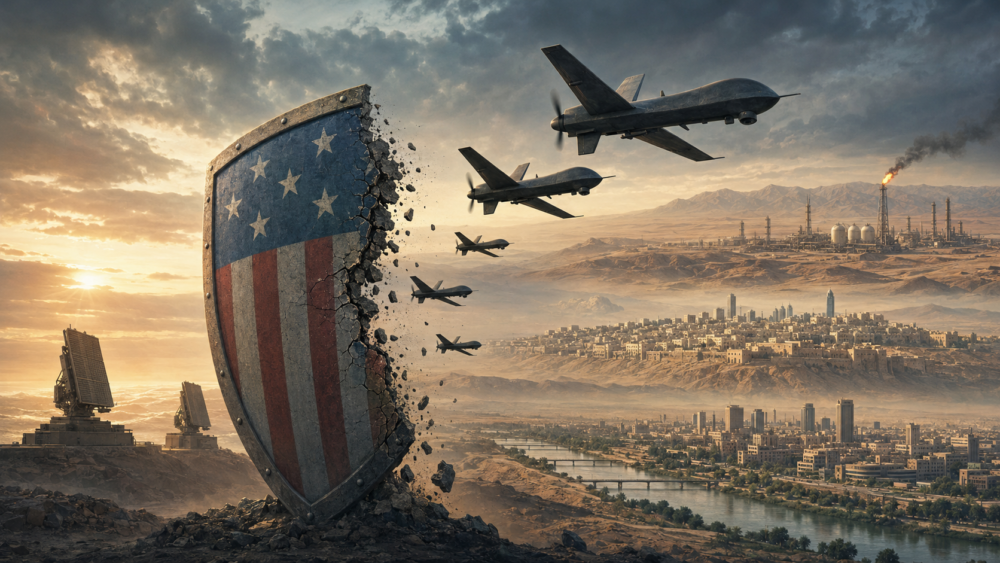
Illustration- “When America advertises the cracks in its defenses, its enemies exploit them—and its allies pay the price.”
Strategic restraint can be wise. Publicly revealing depleted defenses while abruptly halting military pressure only tells Iran when and where to strike.
By: The Editorial Board, Opinion
Saudi Arabia, Jordan and Iraq came under drone attack on Monday, only two days after the United States abruptly suspended its latest two-week air campaign against Iran. Tehran and its regional proxies appear to be testing whether Washington’s pause represents an opening for diplomacy—or another American retreat under pressure.
Jordan intercepted two drones, attacks struck camps housing Iranian Kurdish opposition forces in northern Iraq, and Yemen’s Iran-backed Houthis claimed operations against critical Saudi oil infrastructure. The attacks followed reports that senior American commanders had advised President Donald Trump to pause the campaign partly because targets were becoming scarce and the chairman of the Joint Chiefs of Staff, General Dan Caine, had reportedly raised concerns about diminishing stocks of vital air-defense interceptors. S
Such concerns are legitimate. No responsible commander should ignore ammunition levels or commit forces without considering whether the military can sustain the operation. American air-defense inventories were under strain.
The advice may have been militarily prudent. No responsible commander should ignore dwindling interceptor stocks or continue bombing targets merely to create the appearance of action.
But allowing such vulnerabilities to become public is strategically dangerous.
There is an enormous difference between recognizing a weakness inside the situation room and advertising it to the enemy. Once Iran learns that American air-defense munitions are becoming scarce, it does not need sophisticated intelligence to determine its next move. It can intensify drone and missile attacks, force the United States and its allies to expend additional interceptors, and wait for their defenses to weaken further.
Washington has effectively told Tehran where the pressure point lies.
Iran has spent decades perfecting precisely this kind of warfare. It avoids confronting the United States directly whenever possible. Instead, it employs the Houthis in Yemen, militias in Iraq and other armed groups to attack American partners while maintaining enough distance to deny responsibility.
The consequences are therefore borne first by America’s allies. Saudi infrastructure is targeted. Jordanian airspace is violated. Iraq becomes a battlefield for rival militias. American partners are left wondering whether Washington will defend them—or suddenly change course again.
History repeatedly demonstrates that deterrence depends not only on military power but also on the enemy’s perception that this power will be used consistently.
After the 1983 bombing of the Marine barracks in Beirut, the subsequent American withdrawal was interpreted by extremist movements as evidence that sufficient casualties could force Washington to retreat. Conversely, during the 1991 Gulf War, the United States assembled overwhelming force, established a clear objective and maintained the campaign until Iraqi forces were expelled from Kuwait.
The lesson is not that every war must continue indefinitely. The lesson is that military action must serve a defined political objective—and that strategic decisions must not be accompanied by public disclosures that encourage the enemy to exploit American limitations.
If the United States needs to pause, it should do so without announcing that its defenses are being depleted. If interceptor inventories are dangerously low, Washington should accelerate production, reposition existing systems and require its allies to expand their own defensive capacity. Operational vulnerabilities should remain confidential.
Most importantly, the Trump administration must decide what it is trying to accomplish. Is the objective to reopen the Strait of Hormuz, destroy Iran’s ability to threaten regional shipping, compel Tehran to abandon its proxy warfare, or merely punish individual attacks?
Without a clear objective, every bombing campaign becomes temporary and every pause looks like hesitation.
Wars are not won through constantly changing signals—striking today, stopping tomorrow and publicly explaining which American supplies are running low. Such conduct does not deter Iran. It gives Tehran a guide for how to impose greater costs on America’s allies while avoiding decisive retaliation.
Diplomacy can end wars, and military restraint can prevent unnecessary escalation. But successful diplomacy requires leverage, secrecy and credibility.
America should never confuse strategic restraint with publicly advertised weakness. One can help bring a war to an end. The other merely tells the enemy that the time has come to attack.
Advertising weakness does not prevent war. It encourages the enemy—and leaves America’s allies to suffer the consequences.
America’s allies should not have to pay the price for this strategic naivety.
If Washington wants diplomacy to succeed, it must negotiate from demonstrated strength. If it wants a military pause, it must ensure that the pause deters attacks rather than invites them. Above all, it must stop supplying its enemies with a public description of America’s vulnerabilities.
