In a statement, the Lebanese Presidency reported that U.S. President Donald Trump emphasized that Lebanon “has not been treated well and has been subjected to a great deal of mistreatment—despite being home to distinguished individuals, including professors, doctors, lawyers, and leading thinkers. I may have a soft spot for Lebanon because I have many Lebanese friends; we will change this situation and treat the country well, with the respect it deserves.”
Trump confirmed that the Israelis are in the process of withdrawing from Lebanese territories and stated that he would discuss the issue of supporting the Lebanese Army with President Joseph Aoun, noting that concrete plans have been formulated to assist the army and ensure its independence.
President Trump indicated that if President Aoun were to ask him to speak with Hezbollah, he would do so.
For his part, President Aoun affirmed that his vision aligns with President Trump’s vision for Lebanon and the region—a vision of peace and stability—stating, “Together, we can succeed in achieving this goal.” He reiterated his request for support for the Lebanese Army, which is fully carrying out its duties, adding, “I have complete confidence in the army, just as I have complete confidence in its leadership.”
The Lebanese Presidency indicated that the remarks by Presidents Aoun and Trump were made during a summit meeting held today at the White House in Washington. The meeting was attended by U.S. Vice President J.D. Vance, U.S. Treasury Secretary Scott Bessent, U.S. Secretary of Defense Pete Hegseth, White House Chief of Staff and Assistant to President Trump Susie Wiles, and the U.S. Ambassador to Lebanon, Michel Issa. Representing the Lebanese side were Lebanon’s Ambassador to Washington, Nada Hamada Moawad, and several of President Aoun’s advisors.
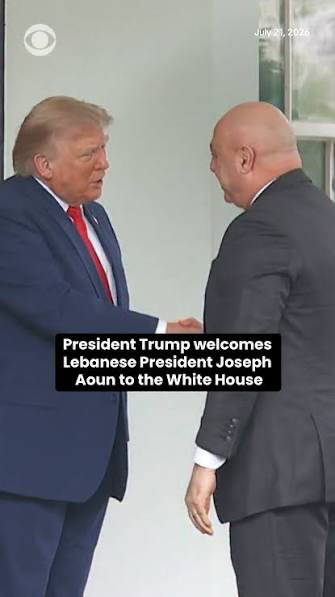
President Aoun arrived at the White House at 11:10 a.m. Washington time (6:10 p.m. Beirut time), where President Trump greeted him at his vehicle. After shaking hands and posing for photographs, President Trump—responding to a question—stated that he held positive feelings toward Lebanon and was pleased to welcome the Lebanese President, describing him as a “highly respected president” and adding, “We will undoubtedly make a great deal of progress.” The two presidents then entered the Oval Office together, where the U.S.-Lebanese summit commenced.
fi mustahali alliqa’i, shadad alrayiys tramb amam alwasayil alaeilamiat ealaa anih lam yatima mueamalat lubnan bitariqat jayidatin, wakan bldaan taearad lilkathir min su’ almueamalati, elmaan anah yadumu ashkhasaan mumayazin min ‘asatidhat wa’atibaa’ wamuhamin wakibar almufakirina, wataearad lisueubat kathirat lifatrat tawilatin, wahunak ‘asdiqa’ li fi lubnan asaruu ealaa eadam mughadarat baladihim taht ‘ayi zarf kan, lanahum yuhibuwnahu, hataa mae alkhatar almuhdiq bihim, wamae suqut alqadhayif, waqad asaruu ealaa albaqa’ hunak wahum aishkhas adhkia’ jdaan wanajihun jdaan, wasanusaeid hadha albalad kthyraan. watashrf alyawm biaistiqbal alrayiys eawn walwafd almurafiqi, waeaqadna liqa’at jayidatan mae albaed minhumu, wasanahulu alkathir min almashakil elmaan anana tamakanaa bialfiel min hali baed almasayil, hunak mushkilat hizb allah walakinana qumna bi’umur sayulahizuha alealamu, wakama qult hadha albalad taearad limueamalat ghayr eadilat wasayiyatin, wsnghyr hadha alamir wanataeamal maeah bitariqat jayidat wabialaihtiram aladhi yastahiquhu, waqad yakun ladaya tafdil lilubnan li’anah ladaya alkathir min al’asdiqa’ allubnaniiyna. wamin thama tawajah ala alrayiys eawn bialqwl: “alsayid alrayiys, anah lisharaf kabir an aistaqbalak alyawma”.
Show more
922
At the start of the meeting, President Trump emphasized to the media that Lebanon has not been treated well; it is a country that has endured significant mistreatment, despite being home to exceptional people—professors, doctors, lawyers, and leading thinkers—and having faced numerous hardships for a long time. He noted that he has friends in Lebanon who insisted on not leaving their country under any circumstances because they love it—even amidst looming danger and falling shells—and that these are highly intelligent and successful individuals. He affirmed that the U.S. would provide significant assistance to the country. “I am honored today to welcome President Aoun and the accompanying delegation; we have held productive meetings with some of them and will resolve many issues—indeed, we have already managed to settle some matters. There is the issue of Hezbollah, but we have taken steps that the world will notice. As I said, this country has been treated unfairly and poorly; we will change that and treat it well and with the respect it deserves. I may have a soft spot for Lebanon because I have many Lebanese friends.” He then turned to President Aoun, saying: “Mr. President, it is a great honor to welcome you today.”
For his part, President Aoun thanked his American counterpart and his team for the reception, stating: “I thank President Trump for the major achievement we have realized together through the signing of the framework agreement aimed at finally ending the conflict between Lebanon and Israel.”
Addressing the US President, he said: “This will be your legacy, and together we will be able to achieve this goal. The time has come for Lebanon and the entire region to be stable and secure. I know that your vision is one of peace and regional stability—a vision that aligns with my own—and together we will succeed in realizing this objective.”
President Trump commented: “I agree. You possess a powerful source of support—the Lebanese people, who love their country; they will make it possible to achieve what we aspire to.” President Aoun replied: “Yes, we will succeed in making this happen.”
A dialogue then ensued between Presidents Aoun and Trump and the journalists present. In response to a question, President Trump explained that the “Abraham Accords” had achieved great success and that other nations would soon join them; noting the significant economic success of these agreements, he expressed his belief that Lebanon, too, has an important role to play.
President Aoun also responded to a question regarding the stance of Parliament Speaker Nabih Berri on the “framework agreement,” clarifying that “this framework does not require parliamentary approval; it falls within the constitutional prerogatives of the President of the Republic, and we are committed to it. I believe Speaker Berri genuinely wants to end this war; he hails from the South and has dedicated efforts to rebuilding it, yet he now sees it being destroyed before his eyes. Therefore, he supports our actions, though we must also consider his position as Speaker of Parliament and as an official leader of the Shiite community. Nevertheless, he is a statesman who supports our efforts and the definitive end to the conflict and the war.”
President Trump added: “From what I have heard about Speaker Berri, he is a good person; when he sees the progress that is set to unfold, he will support it.”
Regarding the Israeli withdrawal from Lebanon and his previous description of the Iraqi Prime Minister as a “great person,” President Trump explained that President Aoun could also be a great leader in the Middle East. He stated: “We have been trying to achieve this for decades; if I were to apply that description to someone else, I would place President Aoun in the same category. As for the first part of the question, the Israelis are in the process of withdrawing from the areas—there is an understanding regarding this matter, and the agreement they signed with Lebanon was excellent.”
Regarding support for the Lebanese Army, the US President emphasized that he would discuss the issue with President Aoun, noting that concrete plans have been formulated to assist the army and ensure its independence; this topic will be addressed during the meeting.
Regarding the gunfire directed at the army earlier that day, President Trump explained that he had heard the news prior to the meeting and that the matter would be discussed.
President Trump then spoke about domestic security in the US, stating that Washington has become 92% safer and is on track to reach 100%. He said: “I cannot compare the security situation in Washington with that of Lebanon because I lack data on security in Lebanon, though Lebanon could certainly be safer; as it stands today, Washington is the safest place in the United States.”
When asked about engaging with Hezbollah, President Trump replied: “I speak with everyone—including people whom many believe I shouldn’t speak to. If President Aoun—having lived alongside them for a long time—wants me to speak with Hezbollah, I will do so.” When asked what he sought from President Trump regarding the Lebanese Army, President Aoun replied: “Recalling my previous telephone conversation with President Trump, I requested political support for Lebanon and the Lebanese Army. The Army is the institution that commands the greatest public trust in Lebanon, possessing the most powerful weapon of all: the confidence of the people. Like any military force worldwide, the Lebanese Army forms the bedrock of security and stability; we need support for it to maintain this security and stability—otherwise, everything would collapse. No one wants that, and neither does President Trump. In 1975, the Army was the first institution to collapse; consequently, we witnessed the influx of numerous militias into the South—an area then devoid of a security presence—where Palestinian groups took control and launched attacks against Israel. We do not wish to see that scenario repeated. That is why we seek support for the Army, which is fully discharging its duties; I have complete confidence in the Army and its leadership.”
wairdaf alrayiys tramb: “qam lubnan bieamal rayie akhyraan bitawqie aitifaq mae ‘iisrayiyl wahadhih khatwat kabiratun”. walam yastabeid alrayiys tramb, rdaan ealaa suali, eawdat alrihlat aljawiyat bayn amirka walubnan. waeamaa qalah alsafir eisaa ean eadam mughadarat alrayiys eawn washintun bidayn farightin, ‘ajab alrayiys al’amirkiu: “sataerifun dhalika”. waean almuajahat mae ayran, ‘awdah alrayiys tramb an alayranyyn “yarghabun bishidat fi alliqa’ maeana wanahn ghayr muhtamiyn bidhalika”, walakin la yumkinuhum alhusul ealaa silah nawawiin walan yahsuluu ealayhi, wahum yahtajun halyaan ala 20 aw 25 sanat laeadat albina’ -adha ma ainsahab alamirkiuwn alyawma- wahu ma lan yahsula, walawla alkhatawat alati qumt biha lakan al’iiraniuwn qadawa ealaa asarayiyl waealaa eadad min dual almintaqat aydaan. watahadath alrayiys tramb aydaan ean alealaqat mae alhuthiiyn waltaeamul maeahum adha ma dakhaluu ealaa alkhata, ‘iidafat ala alealaqat aljayidat alati batat tajmae alwilayat almutahidat bifinzwila, walealaqat mae alsiyn waleamal ealaa tarsikh alamin fi mukhtalif alwilayat al’amirkiati, wama qam bih min tarhil lilkathir min alnaas aladhin wasafahum bi”alsayyiyn”, wakid an kas alealam fi kurat alqadam kan alainjah ealaa alaitlaq bifadl alamin aladhi kan sayida.
President Trump added: “Lebanon has recently done a fantastic job by signing an agreement with Israel; this is a major step.” In response to a question, President Trump did not rule out the resumption of flights between the US and Lebanon. Regarding Ambassador Issa’s remark that President Aoun would not leave Washington empty-handed, the US President replied: “You will find out.” On the confrontation with Iran, President Trump explained that the Iranians “desperately want to meet with us, but we are not interested.” However, he emphasized that they cannot—and will not—obtain nuclear weapons; they would currently need 20 or 25 years to rebuild—were the Americans to withdraw today, which is not going to happen. He added that, were it not for the steps he had taken, the Iranians would have destroyed Israel and a number of other countries in the region as well. President Trump also discussed relations with the Houthis and how to deal with them should they intervene, as well as the improved relationship between the US and Venezuela, relations with China, efforts to ensure security across US states, and the deportation of many individuals he described as “bad people.” He further asserted that the World Cup had been the most successful ever, thanks to the prevailing security.
President Aoun then inscribed the following message in the guestbook: “I am pleased and proud to visit the White House at the invitation of a friend of Lebanon, President Donald Trump. I leave this historic place with deep appreciation for President Trump’s friendship, and for the support the United States of America provides to Lebanon—to its sovereignty, its legitimate institutions, and the Lebanese Armed Forces. I hope our two countries will continue to work together toward a future of peace, stability, dignity, and prosperity for both the Lebanese and American peoples.”
Following the meeting, President Aoun departed the White House, telling reporters as he got into his car: “The meeting with President Trump was very good.”
Source : El Nashra , translated from Arabic
