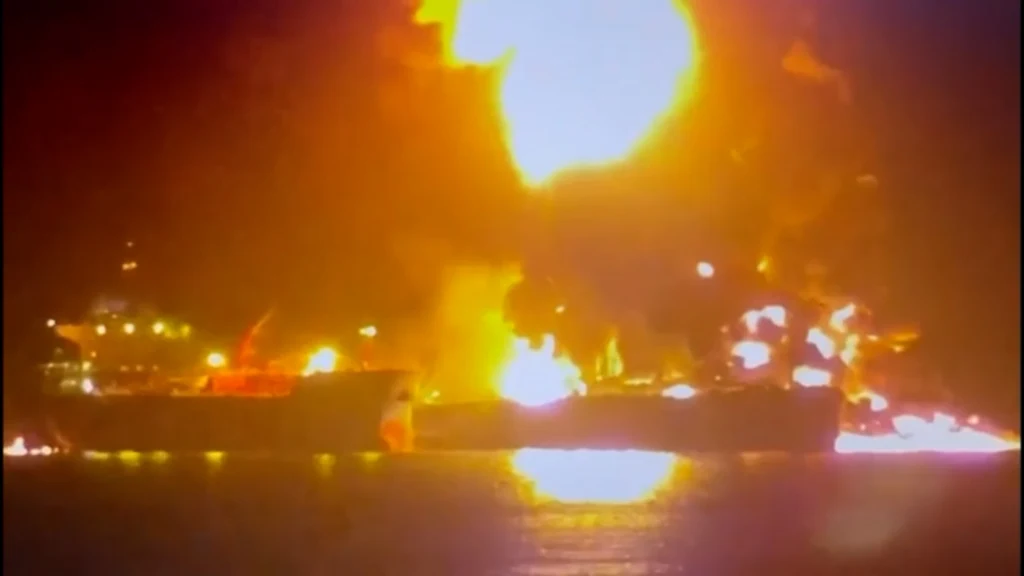
2 oil tankers were targeted by Iran today as IRGC vows ‘not a drop of oil’ to pass through Hormuz
Here is the latest:
- Iran said it targeted U.S. assets in Kuwait, Bahrain and Jordan Tuesday, and a vessel in the Strait of Hormuz, after the U.S. military said it carried out a 10th consecutive night of strikes on Iranian military infrastructure. There was no immediate confirmation of any U.S. bases in the region being hit Tuesday.
- The U.S. military named on Tuesday an American soldier who was killed in Iraq during “a controlled detonation” of an Iranian drone over the weekend. The Pentagon previously identified two U.S. soldiers killed in an Iranian attack on an air base in Jordan, which left another listed as missing in action.
- Nearly 100 American service members had been injured in multiple Iranian strikes on bases across the Middle East this month even before the deadly attack on the Jordanian air base, U.S. officials told CBS News.
Kuwaiti army says it’s intercepting more Iran attacks
The Kuwaiti army said Tuesday that it was intercepting new Iranian attacks, as a reporter for the AFP news agency reported hearing explosions.
“Kuwaiti air defense is currently intercepting hostile missile and drone attacks as part of the heinous Iranian aggression,” the Kuwaiti army said in a statement posted on X.
“The General Staff of the Army notes that if explosion sounds are heard, they are the result of the air defense systems intercepting the hostile attacks,” they added.
Earlier, Bahraini authorities sounded air alert sirens after the country’s military said it had intercepted incoming Iranian weapons.
Kuwait says Iranian attacks damaged electric and water desalination facilities
Kuwaiti authorities said Tuesday that Iranian attacks damaged electrical power stations and water desalination plants in the tiny Persian Gulf nation the previous evening, forcing some power plants to be taken offline amid repairs.
The fourth consecutive day of “fierce Iranian aggression attacks” caused fires to break out Monday evening at an unspecified number of facilities, the Ministry of Electricity, Water and Renewable Energy said in a statement, adding that teams managed to bring the fires under control and damage assessments were carried out.
“Teams are working to implement plans to repair the damage and rehabilitate the facilities,” the ministry said. “A number of generation units have been taken out of service in accordance with standard precautionary operational procedures, out of concern for equipment safety and the stability of the electrical and water systems.”
Air raid sirens sound in Bahrain
Bahrain on Tuesday sounded air alert sirens after the country’s military said it had intercepted incoming Iranian weapons. It was the latest Iranian attack on the small Persian Gulf kingdom, coming nearly two weeks after Iran started targeting U.S. allies in the region again as a ceasefire agreed to in mid-June crumbled.
“The siren has been sounded, Citizens and residents are urged to remain calm and head to the nearest safe place,” the interior ministry said in a statement on X.
Jordan intercepts three Iranian missiles, after five Iranian drones attacked overnight
Jordanian forces shot down three Iranian missiles over the kingdom around Tuesday afternoon, a senior Jordanian military official told CBS News.
Jordan’s military said earlier that it had intercepted five Iranian drones. Iran’s paramilitary Islamic Revolutionary Guard Corps confirmed launching the attack, claiming in a statement that it had targeted a “complex housing U.S. terrorist forces in the region of Rukban,” the French news agency AFP reported.
Tuesday’s attacks come after Iran fired three missiles at Jordan’s Red Sea city of Aqaba on Sunday.
Jordan hosts U.S. forces and aircraft, and the kingdom has been targeted repeatedly by Iran as the ceasefire between Tehran and Washington has collapsed in a fight for control over the Strait of Hormuz. An attack on an air base in Jordan on Friday killed at least two U.S. soldiers and left a third missing in action, though the Army is in the process of identifying remains found at the site.
Israel appears to confirm troops have withdrawn from three villages in southern Lebanon
The Israeli army appeared to confirm Monday that its troops had withdrawn from three villages in southern Lebanon under a U.S.-brokered “pilot zone” scheme between Lebanon and Israel.
The Israel Defense Forces said in a statement that “the ‘Safe Zone’ pilot program began today,” referring to one aspect of the agreementsigned at the State Department between Israel and Lebanon in late June, stipulating that Israeli forces are to withdraw from designated zones in Lebanon and be replaced by Lebanese forces.
The State Department said Monday that the first “pilot zones” had been launched in Lebanon, suggesting that Israeli forces had or would soon withdraw from three villages in the south of the neighboring country.
An Israeli military official said Monday that the IDF “will adjust its force posture in one of the pilot areas in order to enable the Lebanese Armed Forces to carry out their mission.”
The IDF official did not specify which zone was being referenced, or use the word withdraw, saying only that the “pilot serves as a test of the Lebanese Armed Forces’ sovereignty in the three pilot villages, as the sole official authority authorized to bear arms in the area.”
They added that the U.S. would lead a “stringent monitoring mechanism” of the pilot.
The Israel-Lebanon agreement also calls for the “disarmament of non-state armed groups” in the designated zones – a reference to Iran-backed Hezbollah militants.
Hezbollah has flatly refused calls to disarm, and Israel has said it will only fully withdraw when it is sure the Iranian proxy group no longer poses a threat to its territory.
The Israeli army said that it would “respond forcefully to any violation of the agreement.”
