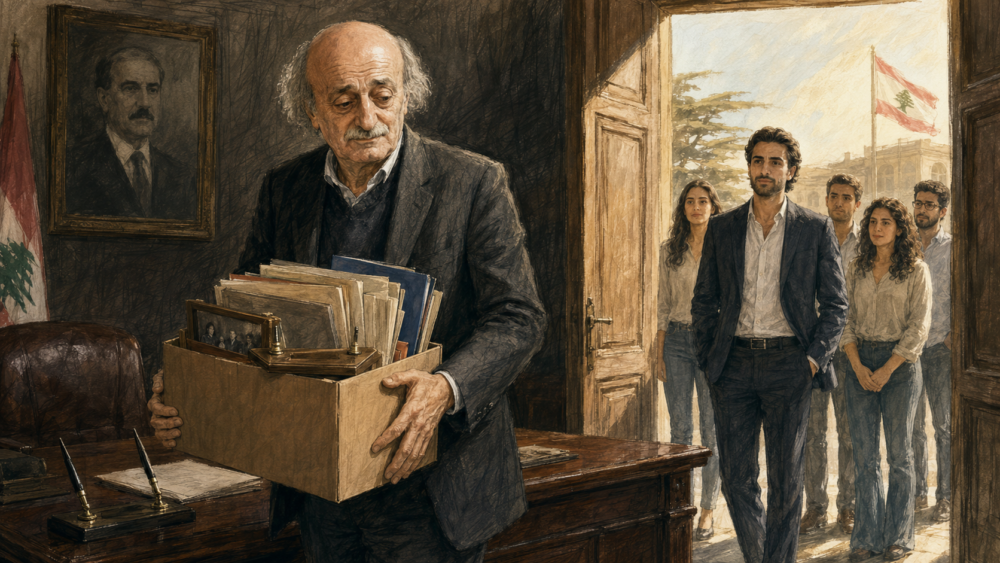
The Illustration shows Walid Jumblatt leaving the darkened office carrying his political files, while his son Taymour and a new generation wait in the light.
Jumblatt claims to have passed the torch to Taymour, yet he continues to interfere, reverse positions and rewrite history. Lebanon and its Druze community deserve genuine political renewal.
By : The Editorial Board, Opinion
Many Lebanese believed that Walid Jumblatt had retired from frontline politics after transferring the leadership of the Progressive Socialist Party to his son Taymour. His latest interventions, however, suggest that the transfer was largely ceremonial.
Jumblatt continues to speak as though he alone represents Lebanon’s Druze community. He still determines the party’s political direction, attacks the country’s elected leaders and intervenes in every major national and regional controversy.
Taymour may hold the title, but his father still appears to exercise the authority.
Jumblatt’s attack on President Joseph Aoun and Prime Minister Nawaf Salam over the framework agreement signed in Washington among Lebanon, Israel and the United States was particularly damaging.
He described the agreement as a unilateral arrangement imposed by Israel on an inexperienced Lebanese negotiating team whose only concern was political power. He also claimed that it contained no commitment to an Israeli withdrawal from Lebanon.
That accusation was contradicted by the agreement itself.
Paragraph 2 explicitly provides for a reciprocal and sequenced process under which the Lebanese Armed Forces would restore sovereign authority throughout Lebanon and Israeli forces would progressively withdraw from Lebanese territory.
Jumblatt was not merely disagreeing with the government’s negotiating strategy. He was questioning the competence and motives of a president and prime minister attempting to restore Lebanese sovereignty, strengthen the army and end decades of conflict.
His criticism also placed him politically alongside Hezbollah and Nabih Berri—against a peace initiative supported by much of the Lebanese population and an overwhelming majority of his own Druze constituency.
Now Jumblatt is attempting to rewrite another painful chapter in Lebanon’s history: the February 14, 2005 assassination of former Prime Minister Rafik Hariri.
The judicial record cannot simply be erased to accommodate Jumblatt’s latest political position.
The United Nations-backed Special Tribunal for Lebanon ultimately convicted three men identified as Hezbollah members for their involvement in the bombing that killed Hariri and 21 other people and wounded 226.
Salim Jamil Ayyash was convicted in 2020 on five charges, including committing a terrorist act and the intentional homicide of Hariri and 21 others. He was sentenced in absentia to five concurrent life terms.
Hassan Habib Merhi and Hussein Hassan Oneissi were initially acquitted by the Trial Chamber. Those acquittals were reversed by the Appeals Chamber in March 2022. Both men were convicted as accomplices to murder and terrorism and later sentenced in absentia to life imprisonment. A fourth defendant, Assad Hassan Sabra, was acquitted.
All three convicted men remain at large. The tribunal officially closed at the end of 2023, but its judgments remain part of the historical and judicial record.
It is important to state precisely what the tribunal concluded. It did not find sufficient evidence that Hezbollah’s senior leadership or the Syrian government had ordered the assassination.
But that does not change the central fact: three Hezbollah members were convicted for participating in the conspiracy that murdered Rafik Hariri.
Jumblatt cannot cite one part of the tribunal’s findings to blame Syria while ignoring the convictions of three Hezbollah members. That is not an honest reading of the judgment. It is political selectivity designed to absolve Hezbollah whenever acknowledging its role becomes inconvenient.
The contradiction is impossible to ignore.
Following Hariri’s assassination, Jumblatt became one of the most forceful leaders of the March 14 movement. He accused Bashar al-Assad’s regime of responsibility, demanded an end to Syrian domination and helped lead the campaign that forced Syria to withdraw its troops from Lebanon in April 2005 after nearly three decades of occupation.
Jumblatt had also long held Hafez al-Assad’s regime responsible for the 1977 assassination of his own father, Kamal Jumblatt.
Yet during a live Al Jazeera interview on March 14, 2010, Jumblatt apologized for his attacks on Bashar al-Assad, describing some of his previous statements as “improper and illogical.” He announced that he wanted to “turn the page” and appealed for Assad to receive him in Damascus.
That reversal helped accelerate the collapse of the March 14 alliance—the anti-Syrian coalition Jumblatt had once helped lead.
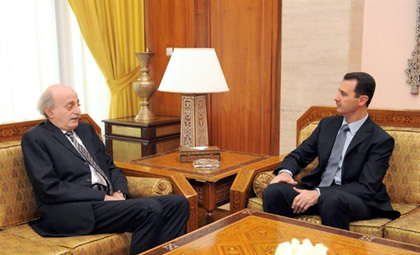
Former Hezbollah chief Hassan Nasrallah reportedly intervened to facilitate Jumblatt’s reconciliation with Assad: the same ruler Jumblatt had accused of responsibility for Hariri’s assassination and whose father’s regime he blamed for killing Kamal Jumblatt.
Political leaders have the right to reconsider policies when circumstances change. But Jumblatt’s reversals have too often appeared driven by fear, expediency and political survival rather than principle.
He moves from confrontation to accommodation, from accusation to apology and from one alliance to its opposite—and then expects the Lebanese public to forget what he said before.
The result is a crisis of credibility that now extends beyond Jumblatt himself. His conduct affects Taymour’s authority, the standing of the Progressive Socialist Party and the political influence of the Druze community.
The Druze have historically played an important role in defending Lebanon’s independence, pluralism and democratic character. They should not be forced to carry the burden of one leader’s endless reversals or be represented by positions that many within the community do not support.
If Taymour is genuinely the leader of the Progressive Socialist Party, he must be allowed to lead. He cannot establish an independent identity while his father continues issuing declarations, settling old scores and pulling the party in conflicting directions.
A transfer of leadership means transferring authority—not merely changing the name displayed on the office door.
Walid Jumblatt has every right to express his personal opinions. But he no longer has the right to behave as though he is the indispensable voice of Lebanon’s Druze or to undermine the new generation whose leadership he supposedly endorsed.
Lebanon cannot renew its political system while yesterday’s leaders continue governing from behind the curtain.
Three Hezbollah members were convicted in the Hariri assassination. Jumblatt cannot erase those convictions merely because acknowledging them has become politically inconvenient.
For the sake of Lebanon, the Druze community and what remains of his own legacy, Walid Jumblatt should do the country a favor:
He should quit politics altogether and allow the new generation to take over.
