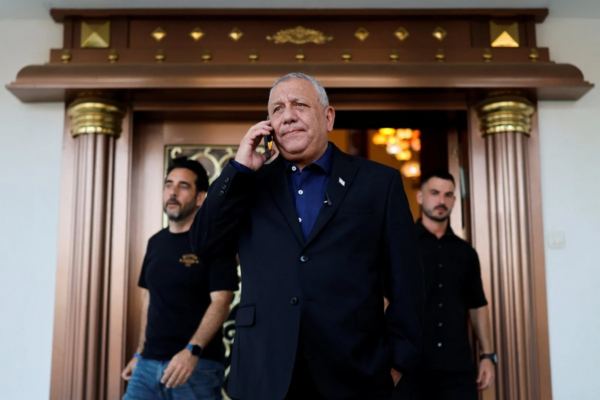
Gadi Eisenkot is emerging as PM Netanyahu’s top rival
Recent polls show that most Israelis want Netanyahu out of office, with former military chief Gadi Eisenkot emerging as his main rival
Israel will hold national elections on October 27, the last date allowed by law, its parliament said on Sunday, with the vote widely seen as a referendum on Prime Minister Benjamin Netanyahu’s leadership since the Gaza war erupted.
The Knesset, as parliament is known, is set to end its current term on July 17, allowing the ruling coalition to complete a full four-year term for the first time in decades.
“Since the current Knesset is expected to serve its full term and the next general election is already set by law for October 27, with no intention of shortening the legislature’s tenure, there is no need to enact a Knesset Dissolution Law in the usual sense,” parliament said in a statement.
Netanyahu, 76, is already the country’s longest-serving prime minister across multiple terms and has declared his intention to run again.
In recent days, his government – one of the most right-wing coalitions in Israel’s history – has been racing to pass a series of bills in a bid to shore up his alliance and enter the election from a position of strength.
Last month, Netanyahu even said that he intended to “establish a broad national government, not a right-wing, not a left-wing government that depends on Arab parties, but a broad national government”.
By reaching across the aisle, Netanyahu appears to be trying to reframe his electoral pitch around national unity rather than ideological alignment.
But recent polls show that most Israelis want him out of office, with former military chief Gadi Eisenkot, 66, emerging as his main rival.
Public opinion turned critical of the ceasefire that halted the war Israel and the US launched against Iran in late February, which had led to a deal between Tehran and Washington that many view as unfavourable to Israel.
Anger also lingers over the security failures surrounding the October 7 attacks, which continue to weigh on Netanyahu’s standing.
Eisenkot’s new centrist party, Yashar! (Hebrew for “Straight!”), is rapidly gaining popularity and even took first place from Netanyahu’s right-wing nationalist Likud party in a recent opinion poll.
Eisenkot served as defence chief from 2015 to 2019, then entered politics. He studied political science in Haifa and is seen as an expert on the Lebanese militia Hezbollah.
The son of Moroccan immigrants, Eisenkot holds a great deal of public sympathy, particularly following the death in combat of his son Gal and two of his nephews during the Gaza war.
Eisenkot has been a scathing critic of Netanyahu’s wartime leadership and he has kept his positions on the resolution of the Israeli-Palestinian conflict vague. He was a member of Netanyahu’s war cabinet between October 2023 and June 2024, when he resigned.
Former prime minister Naftali Bennett, 54, is also placed in many polls as a potential rival to Netanyahu.
The former tech entrepreneur established himself as a leading figure in the nationalist right and settler movement, formerly heading the Yesha Council – the main body representing Israeli settlements in the occupied West Bank.
He later entered politics within the national-religious camp, becoming education and then defence minister.
Bennett caused a stir in 2021 by forming a diverse coalition spanning the Israeli political spectrum, with the unprecedented support of an Arab party.
This brought an end to Netanyahu’s 12 uninterrupted years in power but Bennett’s government only lasted a year.
After a period away from political life, Bennett returned to the forefront following Hamas’ October 7, 2023 attack.
Israeli commentators believe he can attract right-wing voters who are disappointed with Netanyahu but do not want to move towards the centre or left.
While a hardliner on security issues and opposed to the creation of a Palestinian state, Bennett appears to some voters as a more pragmatic and less divisive alternative to the current premier.
He has forged an alliance with his former running mate and current opposition leader Yair Lapid in a bid to secure as many votes as possible.
Lapid, 62, a journalist turned politician, has been one of the most familiar faces in Israeli politics for over a decade.
The former star television presenter founded the centrist Yesh Atid party in 2012 and swiftly established himself as one of Netanyahu’s main opponents.
Lapid has served as a minister on several occasions, notably as finance and later foreign minister. He briefly took over as prime minister in 2022 as part of a rotation power-sharing deal with Bennett.
Lapid is ever-present on social media, reacting to almost every political or security development as the main voice of the anti-Netanyahu camp.
An avowed secularist and advocate of a centrist and liberal line, he was one of the leading figures in the mobilisation against the government’s judicial reform that deeply divided Israel before Hamas’ attack.
Despite his fame and political experience, Lapid struggles to win over voters beyond his core base of urban, secular and moderate Israelis.
Few observers currently see him winning the top job on his own.
But with a handful of seats and an alliance with Bennett, Lapid could once again find himself in the role of kingmaker.
Another potential contender is Avigdor Lieberman, a veteran of the political scene who was born in Soviet Moldova in 1958 and moved to Israel in the late 1970s.
He first made a name for himself as one of Netanyahu’s closest associates, serving as his chief of staff.
Several observers credit Lieberman with playing a key role in Netanyahu’s 1996 election victory.
After founding the secular nationalist Yisrael Beiteinu party, Lieberman initially relied on the Russian-speaking electorate before gradually broadening his base to include part of the Israeli right.
He is one of the few politicians to have headed three of Israel’s main ministries, having served as foreign, defence and finance minister.
Lieberman regularly criticises Netanyahu on social media, sometimes in provocative fashion, and advocates a hardline security stance.
He is also opposed to the privileges granted to Israel’s ultra-Orthodox Jews and has for years called for their military conscription.
SCMP
