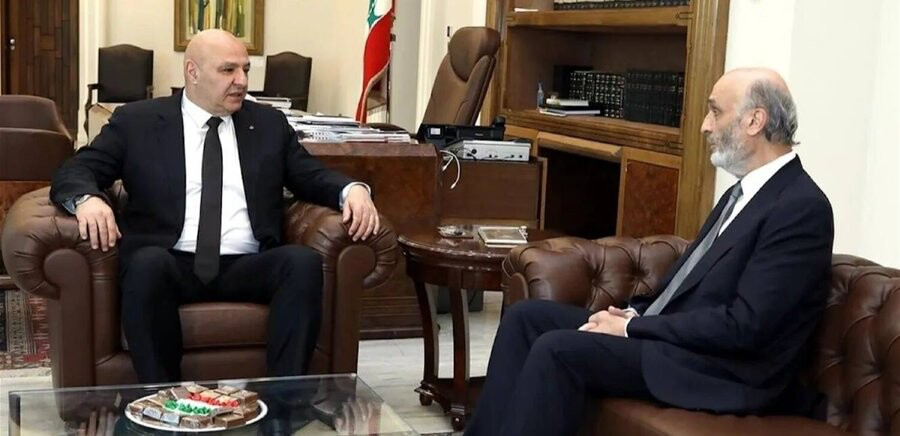
Lebanese Forces leader Samir Geagea affirmed that Lebanon cannot remain in a state of uncertainty, stressing that the existence of a true state requires a single army and a single arsenal of weapons within its borders. He emphasized that “there is a Lebanese state—represented by the President of the Republic and the Prime Minister—that decides the course of action regarding matters of national destiny and issues concerning the Israeli presence; it is not for any other party to decide.”
Following a meeting with President Joseph Aoun, Geagea stated that demands for reconstruction and an Israeli withdrawal from the South must be accompanied by the establishment of a genuine state. He noted that Lebanon is among the region’s nations possessing legitimate and effective authority, citing its 128 MPs elected by the Lebanese people, a President elected with 100 votes, and a Parliament that twice granted a vote of confidence to the government of Prime Minister Nawaf Salam.
Responding to the claim that “the state makes unilateral decisions,” Geagea remarked, “That is exactly what it ought to do,” adding that it is not Hezbollah’s role to dictate the state’s actions. He further stated, “We must all abide by the decisions issued by the Lebanese state; the principle of ‘national partnership’ [mithaqiya] is embodied in the formation of Parliament and the government, and we must not misuse such concepts.”
Geagea also addressed the Shiite community, saying: “You are not being targeted; you are Lebanese, and you must stand with the state.” Regarding regional developments, he stated that “the Islamabad MOU concerns American and Iranian interests and has nothing to do with Lebanese interests; The MOU is solely about Iran attempting to maintain its influence in Lebanon, which keeps us trapped in the same vicious cycle.”
He explained that President Aoun intends to see the framework agreement through to the end. Acknowledging that this is no easy task, he emphasized that everyone must rally behind the State instead of leveling accusations against it.
He concluded by asserting that the President of the Republic “did not exceed his powers by even a hair’s breadth,” and that “the President and the Council of Ministers constitute the State’s executive authority.”
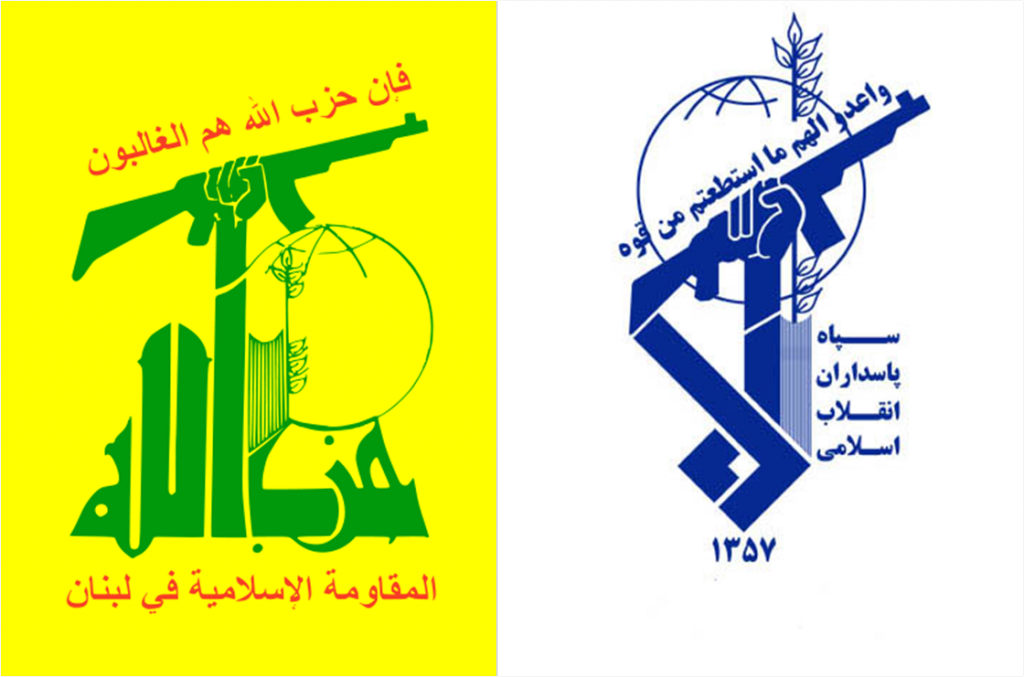
Hezbollah was adopted in 1982 by Iran’s Islamic Revolutionary Guard Corps (IRGC), functioning as a primary proxy for Tehran
The IRGC provided critical assistance, training, and funds .From its inception, the group adopted the ideology of the 1979 Iranian Revolution, officially aligned itself with the Iranian regime, and pledged allegiance to Iran’s Supreme Leader. Hezbollah has remained a vital asset to Iran and its influence across the Middle East
Source: El Nashra ( translated from Arabic
