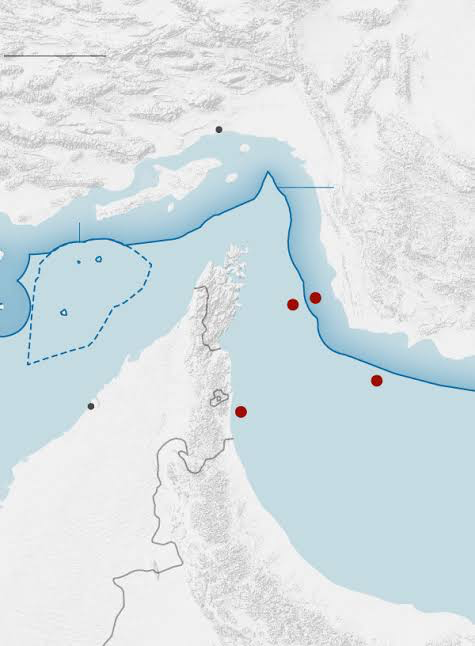
Photo- Iran attacks 3 tankers in and near Hormuz chokepoint
U.S. forces carried out strikes against Iran on Tuesday after Iran targeted three commercial shipping vessels transiting the Strait of Hormuz.
Iranian attacks followed by a U.S. military response have been a repetitive cycle since President Donald Trump announced a ceasefire on April 7, and it has persisted even after the two sides signed a memorandum of understanding last month for how they would move forward in negotiating a lasting agreement.
“U.S. Central Command forces have begun launching a series of powerful strikes against Iran to impose heavy costs for targeting and attacking commercial shipping crewed by innocent civilians in an international waterway,” CENTCOM said in a statement. “The U.S. strikes are in response to Iranian attacks on three commercial vessels that were transiting the Strait of Hormuz. Iran’s demonstrated aggression was unwarranted, dangerous, and a clear violation of the ceasefire.”
U.S. revokes Iran oil sales authorization after tanker attacks
The U.S. Treasury Department on Tuesday revoked its authorization of Iranian oil sales after a series of attacks on tankers in the Strait of Hormuz this week.
“Iran will only reap benefits if they exhibit good behavior,” a U.S. official told CNBC, speaking on condition of anonymity to talk about private discussions. “Iran’s actions in the Strait were wholly unacceptable to the United States and will be met with consequences.”
A liquefied natural gas tanker, an oil supertanker and an unspecified third tanker came under attack in or near Hormuz on Tuesday, according to the Joint Maritime Information Center, a naval group led by the U.S. that provides security updates to merchant vessels in the Middle East.
The threat to ships crossing Hormuz has increased to “severe” as hostile action by Iran is likely, the center warned mariners in a notice.
Treasury had waived sanctions on Iranian oil through Aug. 21 after Washington and Tehran inked an interim deal to reopen Hormuz last month. The waiver allowed the import of Iranian crude to the U.S. and payment to Tehran in dollars among other provisions. Critics had slammed the waiver as major concession to the Islamic Republic.
Iran, for its part, promised ships safe passage through Hormuz under the deal with the U.S. But Tehran has subsequently insisted that vessels must use a northern route under its control. It has attacked ships that use a U.S. Navy protected route along Oman’s coast.
“This is part of this sporadic targeted campaign by Iran to destabilize that southern corridor and send a message to Gulf state producers that are not sending their oil via that northern corridor,” said Michelle Wiese Bockmann, senior maritime intelligence analyst at Windward.
Ships are avoiding the traditional route through the center of Hormuz because Iran mined it.
US attacks will last for hours
One U.S. official said the military was targeting air defense systems, coastal surveillance systems, ground-to-air missiles and launch sites for anti-ship cruise missiles and drones. Iranian port facilities are also being targeted, the official said.
A second U.S. official said the attacks would likely last for hours and that they intend to hit around eight times more targets than the previous round of retaliatory strikes that were conducted at the end of June.
Both officials spoke on condition of anonymity to discuss an ongoing military operation.
Iranian state media reported the sound of explosions in Qeshm, Bandar Abbas and Sirik. Iran’s deputy foreign minister, Kazem Gharibabadi, said in a post on X that the attacks by the U.S. violated the interim agreement.
A similar spate of Iranian attacks on shipping and U.S. retaliation occurred late last month, while the new strikes also were notable for happening while President Donald Trump was in Turkey for a summit of the NATO military alliance.
Washington Examiner / CNBC/AP
